The New Wave of Autonomous Driving: A Larger AV Boom Has Arrived

TechCrunch Mobility says a larger AV boom is coming, driven by deep AI involvement reshaping the tech stack.
TechCrunch Mobility's latest issue says a new, larger autonomous driving boom is arriving. Unlike the previous cycle driven by road-test mileage and concept demos, the key variable this time is deep AI involvement. AI is shifting from an assistive tool in perception to an end-to-end decision-maker, blurring perception and planning. Competition is moving from sensors, test mileage, and permits to data scale, model iteration speed, and compute; assisted-driving and Robotaxi stacks are converging, with consolidation driven by capability complementarity rather than survival.
Title
A New Wave of Autonomous Driving: A Larger AV Boom Has Arrived
Meta Description
TechCrunch Mobility notes that a new, larger wave of autonomous driving is arriving, with AI playing a more prominent role than ever. This article analyzes how this AV boom differs from the last one, how AI is reshaping the transportation technology stack, and what it means for the industry landscape.
Article Content
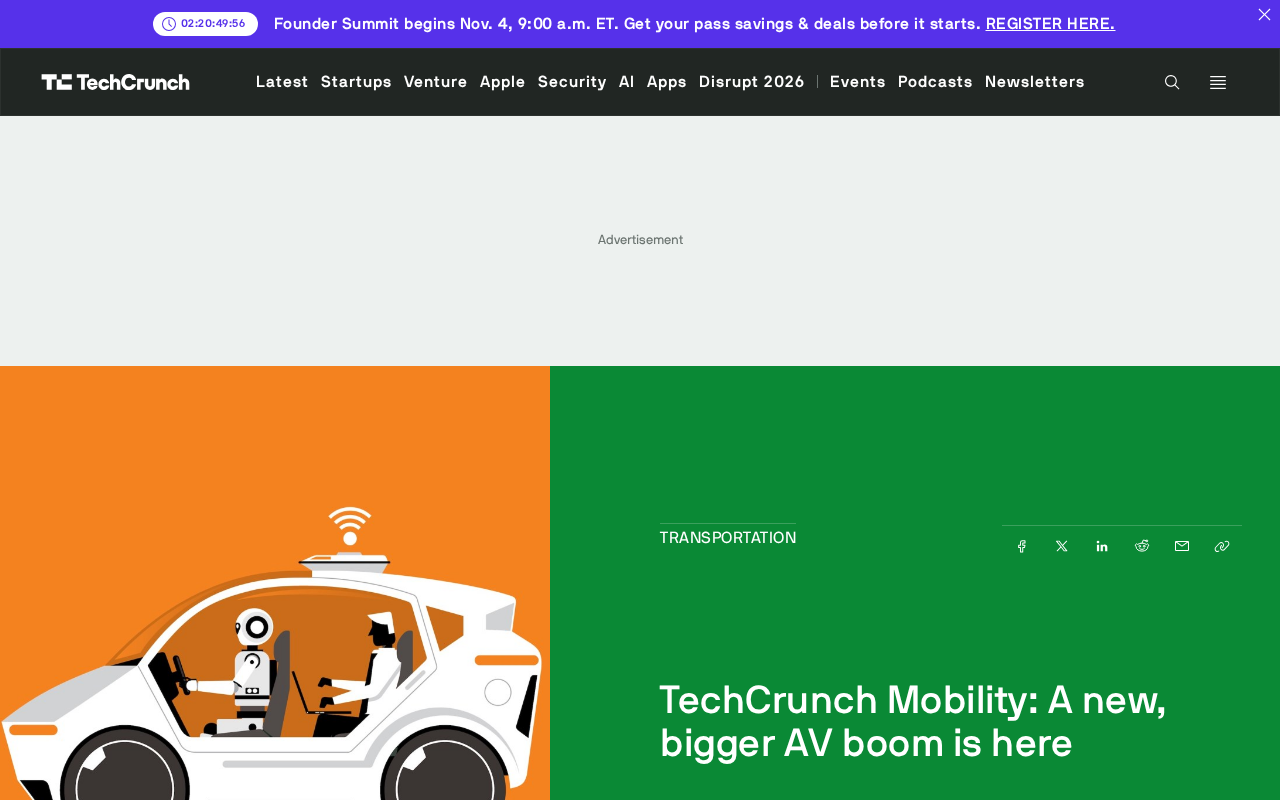
The latest issue of TechCrunch Mobility opens with a blunt statement: a new, larger-scale autonomous vehicle (AV) boom is arriving. Unlike the previous cycle a few years ago, which was driven by road-test mileage and concept demos, the keyword this time is deep AI involvement—AI is no longer just one component in the perception module, but is beginning to reshape the entire technology stack and business narrative of transportation.
Why this round is "larger"
TechCrunch Mobility positions itself as "the hub for the future of transportation," and in its introduction it emphasizes that "AI's role in it is more prominent than ever." That sentence itself reveals a judgment: the cycle reversal in the AV industry is happening in sync with the leap in AI capabilities.
The typical features of the previous AV boom were a flood of companies entering, expansion of test fleets, and commercialization that remained far out of reach—ultimately ending in consolidation, layoffs, and project cutbacks. What is different about the new round is that AI has turned "usable autonomous driving" from an engineering problem into a model problem—end-to-end learning, large-scale data closed loops, and stronger generalization are all compressing the distance from technical validation to commercial operation. "Larger" in scale refers not just to the number of participants, but to the magnitude of improvement in technical feasibility itself.
From tool to agent
What deserves attention is the change in AI's role. In the past, AI played an "assistive tool" role in the AV system: object detection, lane-line recognition, trajectory prediction—each handling its own segment. The current trend is for AI to take on more end-to-end decision-making responsibilities, blurring the boundary between perception and planning. This architectural change directly affects the competitive landscape for automakers, autonomous driving companies, and chip manufacturers.
End-to-End Learning is a key concept for understanding the technological shift in this round of AV development. The traditional autonomous driving architecture is modular: the perception module identifies objects, the prediction module infers trajectories, the planning module generates paths, and the control module executes steering and acceleration/deceleration—each link optimized independently and then connected in series. End-to-end learning attempts to use a single neural network to map directly from sensor inputs (camera images, lidar point clouds) to vehicle control commands, with no artificially segmented modules in between.
The advantage of this architecture is that it reduces information loss between modules and engineering glue code, allowing the model to learn implicit causal relationships from massive driving data on its own, thereby improving generalization to long-tail scenarios. Representative practices include Tesla's FSD end-to-end approach and unified-model attempts by several Robotaxi companies. The challenges are equally obvious: poor interpretability, difficult debugging, extremely high requirements for data scale and quality, and a safety validation system that is not yet mature. This also explains why computing power and data closed-loop capabilities have become new competitive barriers.
AI becomes the common foundation for transportation
TechCrunch Mobility explicitly places "AI's role in transportation" at the center of its core editorial agenda. Behind this shift is a consensus migration across the entire industry: whether it is Robotaxi, mass-produced assisted-driving vehicles, or logistics and delivery scenarios, AI model capabilities are becoming the common foundation.
For practitioners, this means a shift in the dimensions of competition. In the past, the contest was over sensor configurations, test mileage, and the number of permits; now it is over data scale, model iteration speed, and computing power reserves. Advantages are concentrating among players that possess both AI capabilities and transportation scenarios, and the space for players doing only hardware integration will be further squeezed.
Robotaxi and mass-produced assisted-driving vehicles are the two main paths to autonomous driving commercialization, and understanding their differences helps grasp the article's judgment about "technology stack convergence." Robotaxi refers to driverless vehicles that provide paid transportation services to the public without safety drivers, usually operating within specific urban areas, pursuing L4-level and above autonomous driving capabilities, with operators mostly being autonomous driving companies or mobility platforms. Mass-produced assisted-driving vehicles are passenger cars sold to individual consumers equipped with ADAS (Advanced Driver Assistance System) features, where the driver must still monitor at all times, and the technology sits between L2 and L3.
In the past, the two were seen as parallel routes: Robotaxi relied on high-definition maps and stacked lidar, pursuing extreme safety redundancy; mass-produced vehicles were constrained by cost and relied on camera-centric incremental solutions. But as end-to-end large models and vision-only approaches mature, the two technology stacks are beginning to share the same model foundation and data flywheel, with differences appearing more in commercialization pace, regulatory permits, and cost structure rather than in the underlying AI capabilities themselves.
Several judgments on the industry landscape
First, consolidation will continue, but the direction has changed. The previous round of consolidation was driven by survival pressure; this round is more likely to be about complementary capabilities—AI companies need scenarios, and mobility companies need models.
Second, the technology stacks for mass-produced assisted driving and Robotaxi are converging. The two are no longer viewed as parallel routes, but as the same set of AI capabilities expressed at different commercialization paces.
Third, the narrative focus is shifting from "can it drive" to "can it operate at scale." This precisely echoes the word "larger"—what the industry is focused on is no longer single-point breakthroughs, but systematic rollout capability.
It should be noted that the main text of this issue of TechCrunch Mobility does not elaborate on specific company developments or data details. The above judgments are analytical inferences based on the directional signals given in its introduction, and readers should verify them against subsequent reporting. For those interested in the intersection of AI and transportation, this column's follow-up content is worth continued tracking—it is likely to become the most direct information window for observing the new AV boom.
One-line Summary
TechCrunch Mobility judges that the new autonomous driving boom is larger in scale, with deep AI involvement reshaping the technology stack as the core driver.
Paragraph Summary
The latest issue of TechCrunch Mobility points out that a new, larger-scale autonomous driving boom is arriving. Unlike the previous cycle driven by road-test mileage and concept demos, the key variable this time is deep AI involvement. AI is no longer just an assistive tool in the perception module but is shifting toward being the end-to-end decision-making agent, blurring the boundary between perception and planning. The article argues that the dimensions of competition are shifting from sensor configuration, test mileage, and number of permits to data scale, model iteration speed, and computing power reserves; the technology stacks for mass-produced assisted driving and Robotaxi are also converging, and the logic of consolidation is changing from survival pressure to complementary capabilities. The original main text does not provide specific company developments or data, and the relevant judgments are analytical inferences based on signals from the introduction.
Related articles

AI Coding Tools Emerge as a New Attack Surface: Fake Claude Extension Steals Developer Information
A fake Claude code extension appeared in the Cursor marketplace, affecting up to 5,000 developers in 11 hours, stealing host information and implanting SSH backdoors. Learn the attack methods, self-check steps, and security defense strategies for AI coding tools.

ChatGPT Switches to Token Billing in December: Chat and Codex Share Quota — Who's Most Affected?
ChatGPT switches to Token billing in December, with chat and Codex sharing quota. Simple questions can use Instant for free; heavy Codex users are most affected.

ChatGPT and Codex Merge Usage Allowances: Who Runs Out First?
OpenAI merges ChatGPT and Codex paid allowances into one shared token pool in December. We break down the details, token metering ambiguity, OpenAI's financial motives, and how users should respond.