The Night Before NeurIPS Decisions: How Researchers Cope with Academic Anxiety

A viral Reddit post exposes the unspoken anxiety researchers face while waiting for NeurIPS acceptance decisions.
A researcher's candid Reddit post about NeurIPS decision anxiety — despite knowing reviews are noisy — struck a chord across the ML community. The piece examines why this stress runs so deep: top-conference outcomes carry the weight of PhD timelines, career advancement, and self-worth, not just a single paper. While experience may partially dull the anxiety, it often just shifts targets. The healthier path is decoupling results from identity — and academia needs to talk about researcher mental health far more openly.
A Reddit Post That Hit Close to Home
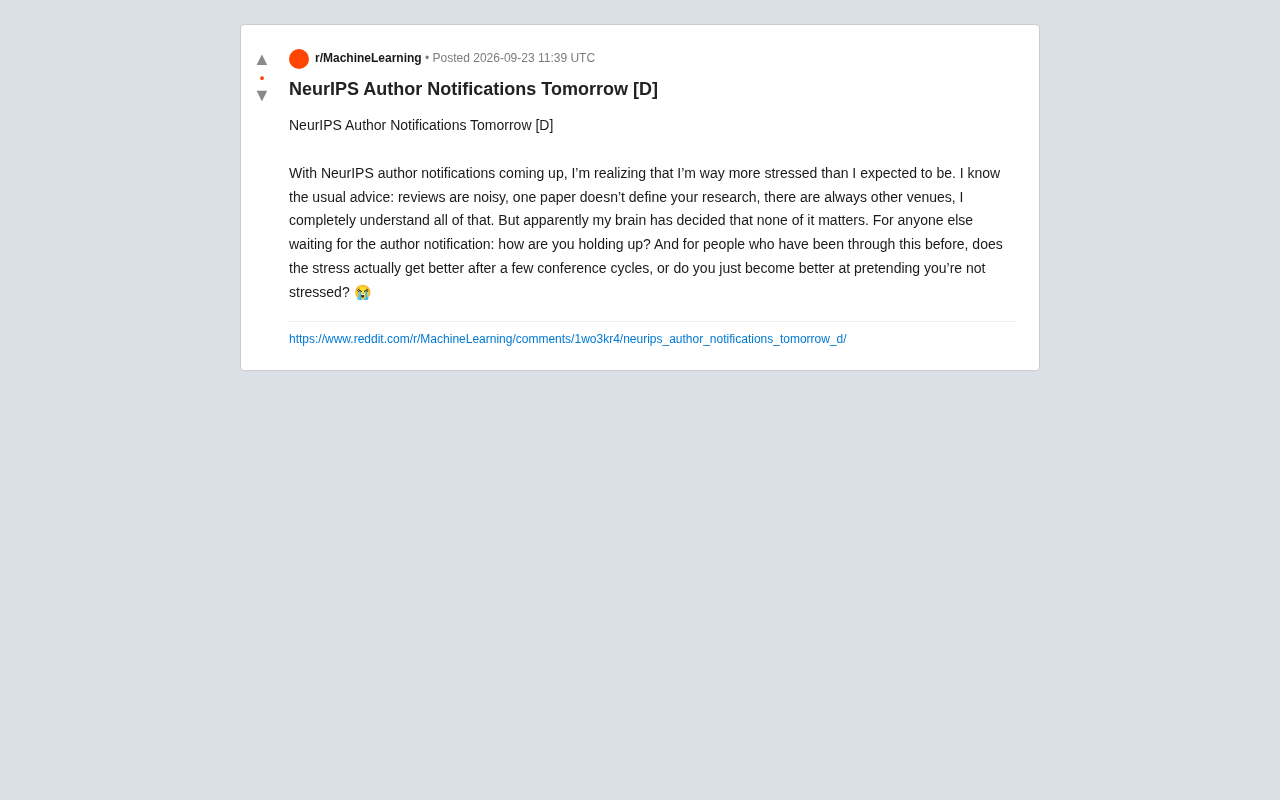
Every year as NeurIPS acceptance notifications approach, a wave of collective anxiety washes over the machine learning community. Recently, a researcher posted on Reddit admitting that despite knowing all the rational talking points — "reviews are noisy," "one paper doesn't define your research," "there are other venues" — none of it mattered when the actual waiting began. The anxiety hit harder than expected, and the brain simply refused to cooperate.
The post resonated widely because it named something pervasive yet rarely discussed openly in academia: the emotional weight that top conference outcomes carry for so many researchers. As one of the most influential venues in AI, NeurIPS acceptance or rejection can directly affect a PhD student's graduation timeline, a researcher's career advancement, and even a lab's resource allocation.
Why Top Conference Notifications Create So Much Pressure
Rationally, nearly every researcher understands that peer review has inherent randomness baked in. The same paper, evaluated by a different set of reviewers, can receive wildly different scores. As NeurIPS submission volumes have climbed steadily in recent years, the reviewer burden has grown and the variance in review quality has widened with it. This "noise" problem is widely acknowledged in the field.
Yet there is a vast gap between rational understanding and emotional response. The original poster captured this split precisely: "I completely understand all of this, but apparently my brain has decided none of it matters." The anxiety rarely stems from the paper alone — it's everything the paper represents: months or even a year of effort, an advisor's expectations, comparisons with peers, and an implicit judgment of one's own capabilities.
For early-stage researchers, an acceptance can mean confidence heading into a PhD proposal, or a critical line on a job application. For more senior researchers, it can affect grant applications and lab reputation. When a single paper carries so much weight beyond its academic content, the tension during the waiting period becomes entirely understandable.
NeurIPS (Conference on Neural Information Processing Systems) is widely recognized as one of the top academic venues in machine learning and AI, alongside ICML and ICLR. Its acceptance rate typically stays below 20%, and with submission counts growing from a few hundred to over ten thousand in recent years, competition has intensified dramatically. Many universities and research institutions treat NeurIPS acceptance as a key benchmark for evaluating researchers, and some PhD programs explicitly require a certain number of top-venue publications for graduation. This institutional pressure means that the symbolic weight of any single submission far exceeds its standalone academic contribution. Peer review, in this context, has come to serve a gatekeeping function far beyond its original design — what began as a mechanism for quality control has evolved into a pivotal node in researchers' career trajectories.
Does the Pressure Ease Over Time?
The original poster raised a genuinely thought-provoking question: after going through several conference cycles, does the stress actually get easier — or do you just get better at pretending you don't care?
There's no universal answer, but community experience suggests both outcomes occur. On one hand, researchers who have submitted more times do tend to build a kind of "psychological immunity" to the randomness of review outcomes — exposure breeds perspective, and a single result stops feeling so definitive. On the other hand, many senior researchers openly admit the pressure never truly disappears; it just shifts targets. The worry moves from "will this paper get in" to "is the lab productive enough," "what about my students' futures," or "will the next grant come through."
A healthier framing might be to gradually decouple submission outcomes from self-worth. Too many uncontrollable factors influence any individual paper's fate. What researchers can control is the quality of their thinking and the long-term arc of their scholarly contributions. Conferences are one distribution channel among many, and work that gets rejected, revised, and ultimately published elsewhere is the norm in academia — not the exception.
The psychological mechanism of desensitization partly explains why repeated rejection can genuinely make some researchers calmer over time. Repeated exposure to the same type of stressor gradually reduces the intensity of the stress response. However, academia's particular structure means that each career stage introduces new pressure dimensions, making the "composure that comes with experience" a partial improvement at best, not a comprehensive one. Moreover, researchers' sense of identity tends to be deeply tied to their academic output — a cultural phenomenon especially pronounced in AI, where the fast-moving technical landscape and intense external attention make it harder to separate personal worth from publication record than in many other fields.
Academia Needs More Emotional Honesty
The value of this post lies not in offering any solution, but in openly discussing something that has long been avoided. Academic culture is built around showcasing results and debating methods — rarely does it make space to acknowledge the psychological toll on researchers as human beings. PhD student mental health has received growing attention in recent years, and the cyclical anxiety around top conference submissions is one specific, concrete dimension of that broader problem.
The flood of responses beneath the post was itself a form of healing. When you discover that your anxiety isn't an isolated experience but something shared across an entire community, that tension becomes at least a little more bearable. For anyone currently waiting on a notification, perhaps the most useful advice is this: accept the anxiety rather than forcing yourself to seem indifferent, and remember that regardless of the outcome, the research journey stretches far longer than any single notification.
Related articles

Linux Kernel's AI Civil War: Anti-AI Activist Elected to TAB, Torvalds Scraps AI Disclosure
Anti-AI activist Laurent Pinchart elected to the Linux kernel TAB as Linus Torvalds scraps AI code disclosure. A rundown of the kernel community's AI civil war, both sides' positions, and the impact on open source.

When Did Paid Childcare Become the Norm? Working Mothers and the Evolution of Childcare
When did paid childcare become the norm? This article traces the evolution from the rise of childcare centers in the 1970s–80s and the 1990s linking of federal subsidies to work requirements, to declining stigma and rising costs, and explores advocates' 25-year effort to catch up with other countries on childcare and paid parental leave.

Red Flags for Product-Market Fit: A Practical Guide from Top VCs and the Superhuman Founder
Investors from Iconiq and Sapphire Ventures and Superhuman founder Rahul Vohra share PMF red flags and practical methods, including the 40% disappointment rule, retention curves, and acquisition costs.