The Nous Framework: A Statistical Solution for Memory Decisions Without Prior Source Calibration

Nous shows agent memory decisions can be learned and certified without calibrating information sources first.
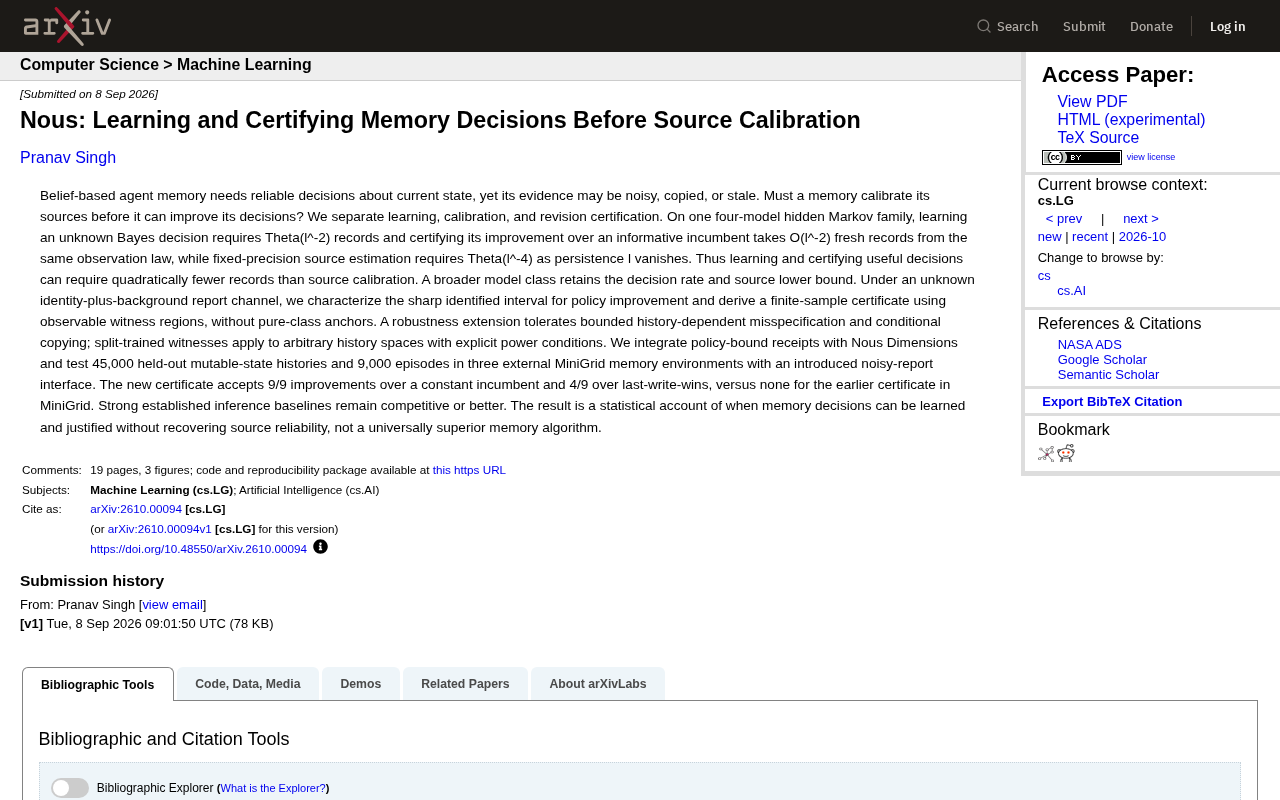
The arXiv paper *Nous* addresses memory decision-making for belief-based agents facing noisy, duplicated, or stale evidence, offering a surprising finding: learning and certifying memory decisions requires no prior source calibration. Within a hidden Markov model framework, the paper quantifies the gap — decision learning needs Θ(l⁻²) records versus Θ(l⁻⁴) for source estimation, a quadratic difference. It further characterizes sharp identified intervals for policy improvement without pure-class anchors and supports robustness to history-dependent misspecification. Experiments on 45,000 held-out histories and 9,000 MiniGrid episodes confirm the new certificates certify more genuine improvements, though established baselines remain competitive.
An Overlooked Challenge in Agent Memory
Belief-based agents need to make reliable judgments about the current state, yet the evidence they rely on is often noisy, duplicated, or stale. This raises a fundamental question: must a memory system first calibrate its information sources before it can improve its decisions?
A newly published arXiv paper, Nous: Learning and Certifying Memory Decisions Before Source Calibration, offers a surprisingly subversive answer — no. The research draws a clear distinction between learning, calibration, and revision certification, and argues from a statistical standpoint that memory decisions can be learned and justified without ever recovering source reliability.
The Core Finding: Sample Complexity
The paper's most significant contribution comes from a comparative analysis of sample complexity. Using a four-model hidden Markov family, the researchers present three quantitative results:
- Learning an unknown Bayesian decision requires Θ(l⁻²) records;
- Certifying that decision as an improvement over an informative incumbent policy requires O(l⁻²) new records drawn from the same observation law;
- Source estimation at fixed precision requires Θ(l⁻⁴) records as persistence l vanishes.
This means the number of records needed to learn and certify useful decisions can be quadratically fewer than what source calibration demands. In other words, as system signal persistence grows weaker, trying to first determine "whose information is trustworthy" becomes an increasingly costly detour. This quadratic gap is the theoretical backbone of the entire paper.
Sample Complexity is a core concept in statistical learning theory that measures how much data an algorithm needs to reach a target accuracy. Θ(f(l)) denotes an exact asymptotic bound, while O(f(l)) denotes an upper bound. The persistence parameter l in the paper characterizes the "survival strength" of hidden-state signals in an observation sequence — as l approaches zero, the signal is nearly swamped by noise, representing the most challenging extreme. Under such weak-signal conditions, source estimation requires Θ(l⁻⁴) samples while decision learning requires only Θ(l⁻²); as l→0, their ratio grows unboundedly. Intuitively: the weaker the signal, the more disproportionately expensive "figuring out the sources first" becomes relative to "learning the decision directly." Hidden Markov Models (HMMs) serve as the vehicle for this analysis — hidden states cannot be observed directly and must be inferred from noisy observation sequences, which maps naturally onto an agent's situation when facing an unreliable stream of evidence.
A Broader Model Class and Policy Improvement Intervals
The paper doesn't stop at a single model family. The authors show that a broader model class preserves the same decision rate and the same lower bound for source estimation, strengthening the generality of their conclusions.
Under an unknown identity-plus-background report channel, the authors characterize a sharp identified interval for policy improvement and derive a finite-sample certificate based on observable witness regions — crucially, without relying on pure-class anchors.
The paper also introduces robustness extensions that can tolerate bounded, history-dependent misspecification and conditional copying. So-called split-trained witnesses apply to arbitrary history spaces and come with explicit power conditions. These design choices make the approach more resilient when confronted with unclean evidence streams in the real world.
Identified Interval is a concept from partial identification theory: when model parameters cannot be uniquely pinned down from data, researchers instead infer the set of values they could plausibly take. The paper's "sharp identified interval" means that, under the identity-plus-background report channel assumption, both the upper and lower bounds on policy improvement can be rigorously derived from observable data — "sharp" meaning the interval cannot be narrowed further without introducing additional assumptions. Pure-class Anchors are a strong assumption commonly used in traditional source deconfounding methods, requiring that certain observed samples belong to a single class with high probability, serving as calibration reference points. Not requiring pure-class anchors means the method holds under looser, more realistic conditions, broadening its applicability.
Large-Scale Experimental Validation
Beyond theory, the authors combine policy-bound receipts with Nous Dimensions to run substantial empirical tests:
- 45,000 held-out mutable-state histories;
- 9,000 episodes across three external MiniGrid memory environments, augmented with a noisy-report interface.
The results are telling: in MiniGrid, the new certificates accepted 9/9 improvements over a constant incumbent policy and 4/9 improvements over a last-write-wins policy, while prior certificates accepted none. This represents a clear step forward in the method's willingness to certify genuine improvements.
That said, the paper remains measured: established inference baselines remain competitive — and in many cases superior.
MiniGrid is a lightweight grid-world environment library widely used in the reinforcement learning community, known for its partially observable (POMDP) scenarios. Agents can only perceive a local field of view and must rely on memory to complete navigation or state-tracking tasks, making it a natural testbed for memory decision methods. The authors add a noisy-report interface on top, further simulating the kind of unstable evidence quality found in the real world. Last-write-wins is a classic conflict-resolution strategy in distributed systems — the most recent write overwrites older values without further judgment. In the context of memory agents, it represents a simple but potentially history-blind baseline policy. The new certificates accepted only 4/9 improvements over this strategy (rather than all), reflecting that the baseline is genuinely hard to beat in certain cases — a finding the paper reports with appropriate objectivity.
How to Correctly Interpret This Work
It is worth emphasizing how the researchers themselves frame this contribution: it is a statistical account of when memory decisions can be learned and certified without recovering source reliability — not a memory algorithm that outperforms everything else in every setting.
For researchers working on AI agents and long-term memory systems, the paper's significance lies in reframing priorities: when facing noisy, duplicated, or stale evidence, rather than investing heavily in assessing the reliability of each source, it may be better to focus directly on learning and certifying the decisions themselves. This "bypass source calibration" approach could provide new theoretical grounding for building more efficient agent memory architectures — especially in low-persistence scenarios where signal attenuation is severe.
Of course, since the paper is still an early arXiv preprint, its performance in more complex, production-ready environments remains to be validated.
Related articles

Random Pruning of the DPO Computation Graph: 1.4x Training Speedup and Lower Peak Memory
DPO training too slow and memory-hungry? This paper proposes a random pruning framework for the DPO computation graph, sampling independently across position, sequence, and branch dimensions; branch pruning achieves a 1.426x step-time speedup and cuts training time by about 30%, with in-depth attribution of memory and time gains.

Why Does JEPA Underperform MLM in Longitudinal EHR Representation Learning?
New study compares JEPA and MLM for longitudinal EHR representation learning on MIMIC-IV: three JEPA variants train stably without collapse but underperform MLM; target size, not heterogeneity, drives prediction error.

Transfer Learning + Visible Light Communication: A New Approach to Energy-Efficient Indoor Positioning
A study proposes a transfer learning-based visible light communication indoor positioning method, achieving 47% accuracy improvement on the BOSCH factory dataset, 67.5% model efficiency under high noise, and introducing the ME composite metric for energy-efficient positioning in energy-constrained industrial IoT scenarios.