The Open Source Dilemma: A Non-Autoregressive Architecture Pioneer Overshadowed by Frontier Labs
An indie dev says frontier labs repackaged his open-source non-autoregressive RL architecture, exposing open source's attribution gap.
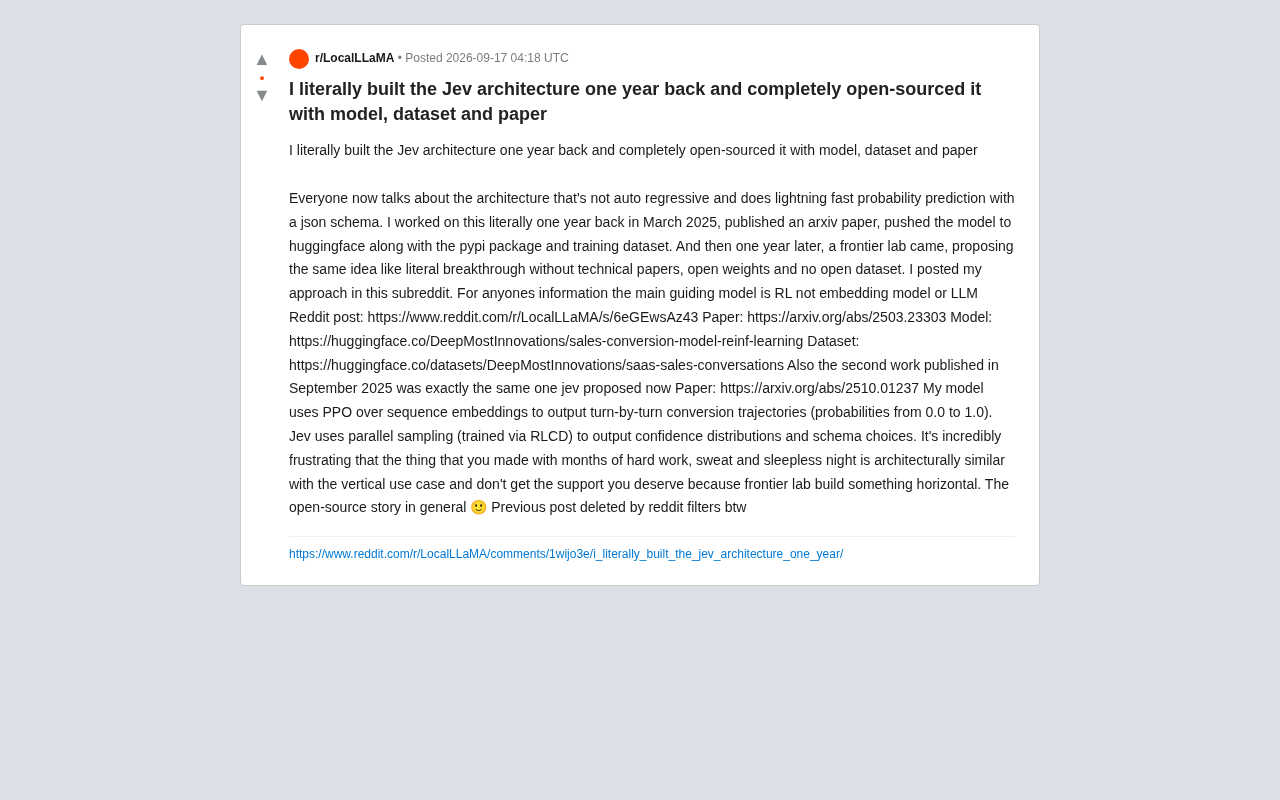
An independent developer posted on Reddit claiming that a non-autoregressive architecture now celebrated as a frontier lab "breakthrough" closely mirrors work he fully open-sourced a year earlier — including paper, model weights, and training data. His approach uses PPO over sequence embeddings to predict turn-by-turn conversion probabilities in sales conversations; the competing approach uses parallel sampling and RLCD to output confidence distributions for broader use cases. The post exposes a structural tension in open source: full transparency doesn't guarantee influence, and frontier labs can dominate discourse through brand and resources even when arriving later. Note that architectural similarity is the author's own assessment, with no independent third-party verification.
One Developer's Open Source Struggle
A post recently appeared in Reddit's r/LocalLLaMA community that struck a chord with many readers. An independent developer claimed that a certain non-autoregressive architecture now generating buzz — being presented by frontier labs as a "breakthrough innovation" — was something he had fully implemented and released as open source a full year earlier, complete with a model, dataset, and paper.
The author, from DeepMostInnovations, wrote: "Everyone's talking about this architecture that avoids autoregression and enables lightning-fast probabilistic predictions compatible with JSON schemas. I was doing exactly that a year ago." He then shared links to an arXiv paper, a model and training dataset on Hugging Face, and a PyPI package.
The emotion behind the post is straightforward: when something you spent months building — through countless sleepless nights — gets repackaged by a frontier lab as a "general-purpose" solution and celebrated widely, while your original "vertical-use-case" version goes unnoticed, the disparity is demoralizing. He also mentioned that a similar post had previously been removed by Reddit's filters.
Two Technical Approaches Compared
Setting aside the emotional dimension, the real value of this post lies in its clear comparison of two technical implementations — worth unpacking from an architectural perspective.
The Author's Approach: PPO over Sequence Embeddings
According to the author, his model uses PPO (Proximal Policy Optimization) over sequence embeddings to output turn-by-turn conversion trajectories — probability values ranging from 0.0 to 1.0. This is a classic reinforcement learning–driven modeling approach, applied to a highly vertical use case: conversion rate prediction in sales conversations.
The author highlights one key point for reference: "The primary guiding model is RL (reinforcement learning), not an embedding model or LLM." This means the system's decision-making core is controlled by an RL policy, with embeddings serving only as part of the input representation. He published this work on arXiv (paper number 2503.23303), completing it in March 2025.
Background: PPO PPO (Proximal Policy Optimization) is one of the most widely used policy gradient algorithms in deep reinforcement learning, introduced by OpenAI in 2017. Its core idea is to constrain the magnitude of policy updates during each parameter update by "clipping" the objective function, striking a balance between exploration efficiency and training stability. Compared to the earlier TRPO (Trust Region Policy Optimization), PPO is simpler to implement and less computationally expensive, making it the dominant method for fine-tuning large language models in RLHF (Reinforcement Learning from Human Feedback) pipelines. In the scenario described here, PPO is used to directly optimize a policy over sequence embeddings rather than generating discrete tokens — enabling the model to output continuous probability values (conversion trajectories from 0.0 to 1.0) instead of autoregressively generating text word by word. This design bypasses the decoding process of traditional language models, dramatically increasing inference speed at the cost of limiting the model's generality to specific structured output tasks.
The Competing Approach: Parallel Sampling + RLCD
The architecture the author compares himself to (which he refers to as "Jev") uses parallel sampling trained via RLCD, and outputs confidence distributions and schema selections.
The common ground between the two: both abandon the traditional autoregressive token-by-token generation in favor of directly producing probabilistic, structured results through reinforcement learning. The differences lie in modeling granularity and sampling mechanism — the author's approach focuses on turn-by-turn trajectory prediction, while the competing approach emphasizes parallel confidence distributions. The author considers the two "architecturally similar," with the main distinction being vertical use case versus horizontal generality.
Background: RLCD and Parallel Sampling RLCD (Reinforcement Learning from Contrast Distillation) is an alignment method that requires no human preference annotations. Its basic idea is to have the same model generate "positive" and "negative" sample pairs under different prompt conditions, then use these contrastive pairs — rather than human feedback — to train a reward model or directly optimize the policy. Compared to RLHF, RLCD reduces the dependence on large-scale human annotation, making it more suitable for resource-constrained research teams. Parallel sampling refers to generating multiple candidate outputs simultaneously during inference and selecting the one with the highest confidence or best conformance to schema constraints, rather than serially generating a single sequence token by token. Combined, these two techniques enable the architecture to efficiently produce structured outputs conforming to JSON schema constraints without relying on autoregressive decoding — which is precisely the technical foundation behind its "lightning-fast probabilistic prediction" capability.
A Structural Problem in the Open Source Ecosystem
What makes this post resonate beyond personal grievance is that it touches on a recurring structural tension in the open source community.
The author's core frustration: he practiced "more responsible" open source — publishing the paper, releasing weights, and making the dataset public — while frontier labs presenting similar ideas often release neither technical papers, nor open weights, nor open datasets, yet are celebrated as major breakthroughs.
There's a harsh reality at play here: the originality of a technical idea does not scale proportionally with its reach and influence. Frontier labs have brand recognition, compute resources, market distribution, and broadly applicable product positioning. Even if they arrive at similar ideas a year later, they can rapidly dominate the conversation. Independent developers, no matter how early or open they are, can be overlooked simply because their vertical-use-case audience is too narrow and they lack promotional resources.
It's worth noting that all the claims in this post come from a single source — the author himself. The assessment that the architectures are "similar" is also the author's own comparison, and no independent third-party technical verification currently exists. Judgments about "who came first" or "whether ideas were copied" should therefore be made with caution.
Background: Priority and Attribution in Research In academic and engineering communities, establishing "priority" typically relies on verifiable public timestamps — such as the submission date of an arXiv preprint, commit history in a code repository, or a conference paper's acceptance date. However, the existence of priority does not automatically translate into attribution of influence. In AI, there is often a vast propagation gap between "someone implementing an idea" and "that idea being widely cited." Work from well-known labs can garner thousands of citations and media mentions within days, while comparable work from independent researchers published months earlier may languish in single-digit citation counts for extended periods. This asymmetry isn't purely a "plagiarism" issue — it stems more from the Matthew effect in information dissemination: those who already have influence tend to accumulate more. This is why an arXiv timestamp, while objectively verifiable, cannot automatically translate into community recognition. The "discovery" of a technical discovery still requires social capital and distribution resources.
Takeaways for Open Source Developers
Regardless of how this specific dispute plays out, the post reflects a few points worth considering for open source developers.
Fully open sourcing your work (model + data + paper + installable package) is beyond reproach in terms of academic integrity and reproducibility — but it doesn't automatically generate influence. Making your work visible requires not just a release, but sustained communication, community engagement, and demonstrated real-world application.
The first-mover advantage in vertical use cases is also easily eclipsed by horizontally general solutions. When a general-purpose platform rolls a capability into a feature that "anyone can use," early explorations in niche domains are readily overshadowed. This reminds developers that when choosing a technical direction, you either need to go deep enough in a vertical space to build a genuine moat — or move early to claim a more universal narrative.
For the community as a whole, how to establish fairer mechanisms for tracing origins and assigning credit — so that true pioneers receive the recognition they deserve — remains an unresolved, long-standing challenge in open source culture. This developer summed up his situation with a resigned line: "That's the open source story. 🙂"
Related articles

AI Plans an Entire Vineyard: A Real-World Experiment with 100 Grapevines
A Spokane hobbyist let Muse AI plan his entire vineyard — variety, spacing, irrigation, even the logo. He planted 100 Cabernet Franc vines and is documenting everything publicly.

Iceland's Treble Raises $18M to Bet on Voice Simulation Platform
Iceland-based voice simulation company Treble raises $18M. Its platform serves voice AI developers, AI wearables, and robotics firms. A deep dive into the technology and what the funding signals.
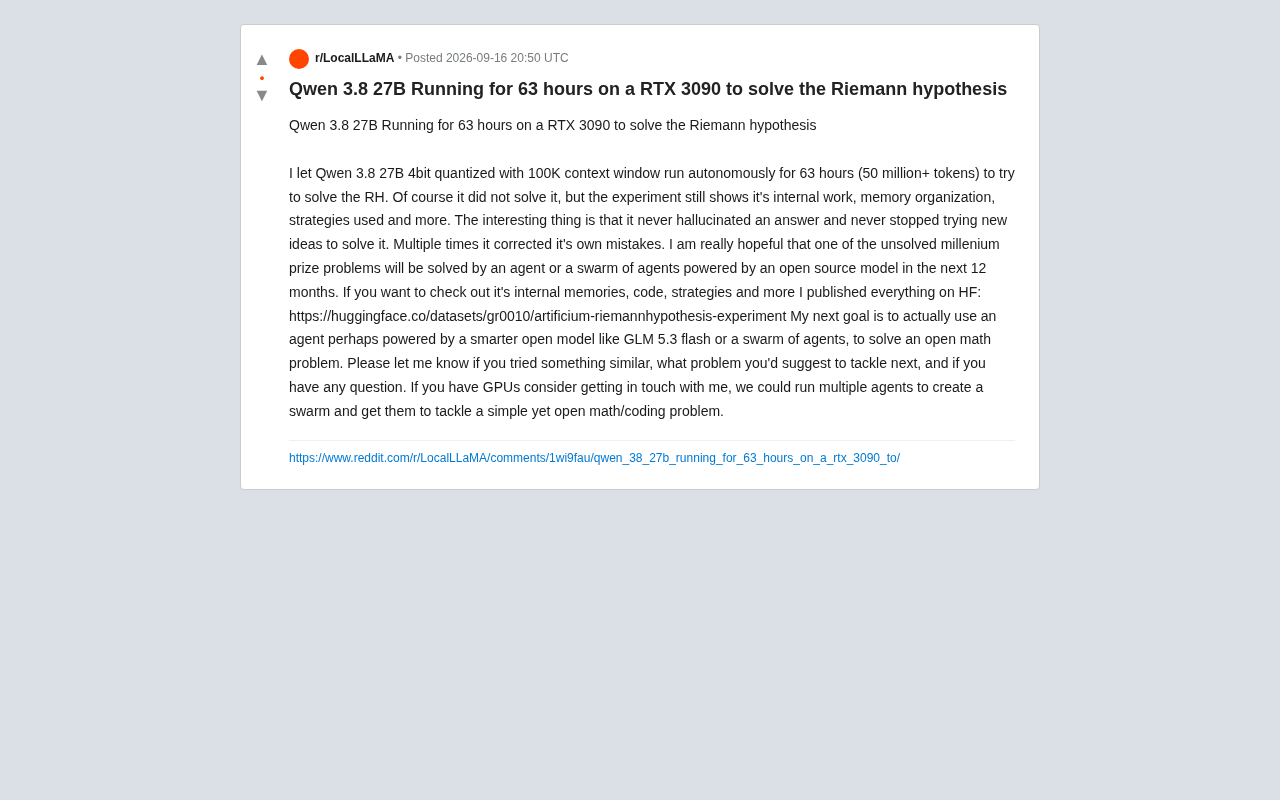
Running Qwen for 63 Hours to Tackle the Riemann Hypothesis: An Open-Source Model Autonomous Reasoning Experiment
A developer ran Qwen 3.8 27B autonomously on an RTX 3090 for 63 hours, generating 50M tokens in an attempt to prove the Riemann Hypothesis. The findings reveal open-source LLM reasoning stability.