The Price of Hard Coverage Constraints: An Analysis of Efficiency Costs in Online Conformal Prediction

Hard coverage constraints in online conformal prediction incur unavoidable efficiency costs, with the cost order increasing as the evaluation criterion becomes stricter.
This article examines the efficiency costs of hard coverage constraints in online conformal prediction. Hard coverage requires that the cumulative number of miscoverage events never exceeds a budget, rather than merely meeting average coverage. The study shows that even with i.i.d. data, known score distribution, and knowledge of the optimal prediction set, hard constraints inevitably lead to an increase in prediction set size. The order of the minimum cumulative excess prediction set size depends on the evaluation time setting: Θ(log T) for fixed known times, Θ(T^{1/3}) for the maximum over all fixed times, and Θ(√T) for the worst-case post hoc chosen time. These lower bounds are achievable by online algorithms that utilize only past scores, without requiring a known distribution. The stricter the evaluation criterion, the greater the efficiency penalty, which cannot be ignored in long-term deployment.
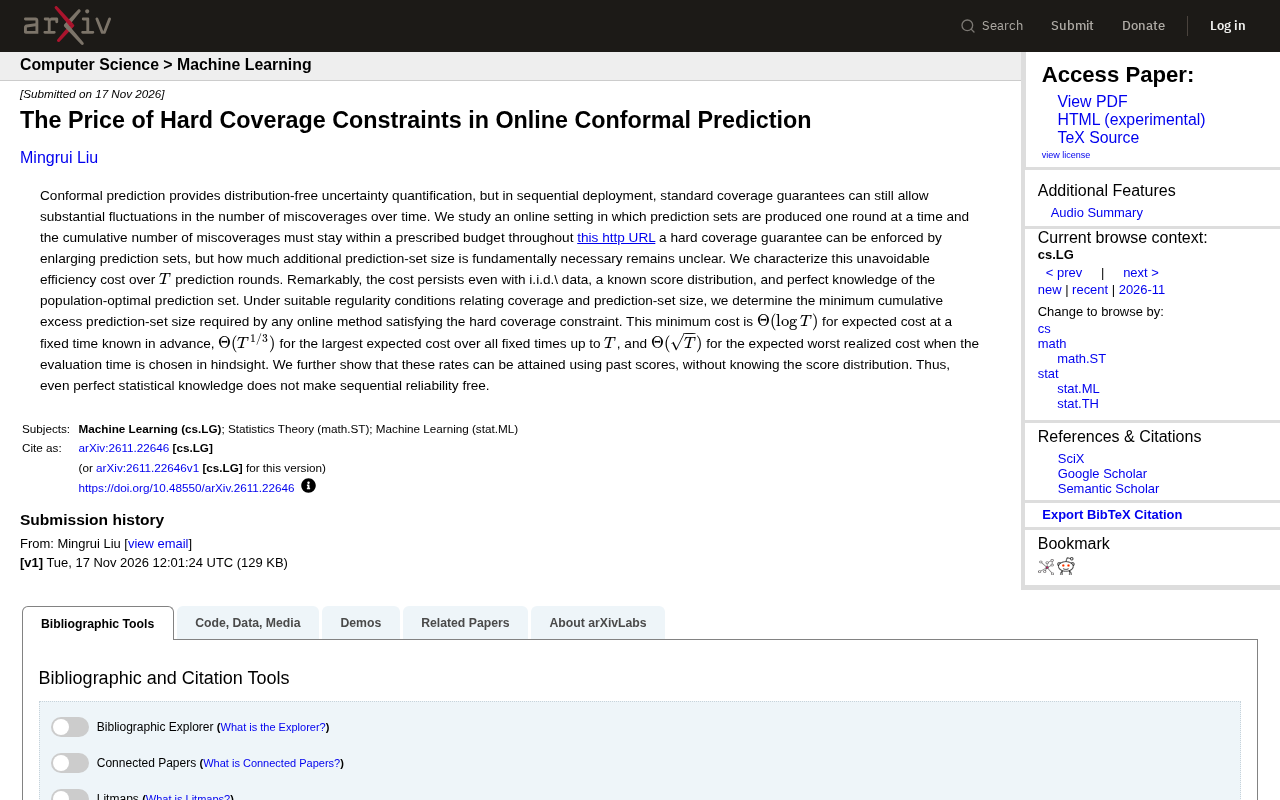
Conformal Prediction, as a distribution-free method for uncertainty quantification, has long been regarded as an important tool for the reliable deployment of machine learning models. However, when the prediction task shifts from static batch processing to online sequential decision-making, traditional coverage guarantees expose an essential flaw: even if the average coverage rate meets the target, the fluctuation of miscoverage counts over time may still far exceed expectations. A recent study delves into the efficiency costs imposed by hard coverage constraints in online conformal prediction, revealing the profound conclusion that sequential reliability is not a free lunch.
Background: From Average Coverage to Hard Constraints
Standard conformal prediction provides a marginal coverage guarantee—across a large number of predictions, the proportion of true labels falling into the prediction set is no less than a preset level. This guarantee performs well on independent and identically distributed (i.i.d.) data, but in online deployment scenarios, users often care not about the long-term average but whether the cumulative number of miscoverage events at any given moment is controllable. For example, in high-risk applications such as medical monitoring or autonomous driving, even if the average miscoverage rate is acceptable, several consecutive miscoverage events within a short period could cause serious consequences.
To address this, researchers proposed hard coverage constraints: requiring that throughout the entire deployment process, the cumulative number of miscoverage events never exceeds a preset budget. Intuitively, this can be achieved by enlarging the prediction set—a larger prediction set is naturally more likely to contain the true label. But the question is: how much efficiency cost must be paid for this enlargement? Is there a fundamental lower bound that no algorithm, no matter how clever, can break through?
The difference between marginal and conditional coverage: Marginal coverage only requires that the average inclusion probability of the prediction set over all samples is no less than 1-α, whereas conditional coverage requires that for any given feature X=x, the inclusion probability is no less than 1-α. Standard conformal prediction typically only guarantees marginal coverage, which in heterogeneous data may lead to insufficient coverage for certain subgroups. Hard coverage constraints can be viewed as a stricter form of sequential conditional coverage requirement, focusing on the temporal consistency of the cumulative miscoverage count rather than the pointwise conditional probability. Understanding this distinction helps grasp why hard constraints incur additional costs in online scenarios.
Core Finding: Unavoidable Efficiency Costs
The study provides a clear answer: hard coverage constraints inevitably lead to an increase in prediction set size, and this cost is theoretically irreducible. Under a framework of T rounds of prediction, the researchers characterize the minimum cumulative excess prediction set size required by any online method satisfying hard coverage constraints.
Surprisingly, this cost persists even under the most ideal conditions: i.i.d. data, known score distribution, and even complete knowledge of the population-optimal prediction set. In other words, perfect statistical knowledge does not make sequential reliability free. This conclusion breaks the common intuition that "as long as the distribution is known, the cost of online learning can be eliminated."
Under the assumption that coverage and prediction set size satisfy appropriate regularity conditions, the researchers determined the exact order of the minimum cumulative excess size, divided into three cases depending on the evaluation time setting:
- Fixed and pre-known evaluation time: The expected cost is Θ(log T), i.e., logarithmic growth.
- Maximum expected cost over all fixed times within T rounds: Θ(T^{1/3}), growing faster.
- Expected worst-case actual cost when the evaluation time is chosen post hoc: Θ(√T), the most significant growth.
These three orders reveal that the stricter the evaluation criterion (from pre-fixed to post hoc selection), the greater the efficiency penalty imposed by hard constraints. In particular, the √T order means that in the worst case, the cumulative excess of prediction set size grows with the square root of the number of rounds, which cannot be ignored in long-term deployment.
The Θ notation and order meanings: The article uses the Θ(·) notation to describe the growth rate of cost with the number of rounds T. Θ(f(T)) means the cost is of the same order as f(T), i.e., there exist constants c1, c2 > 0 such that for sufficiently large T, c1·f(T) ≤ cost ≤ c2·f(T). For example, Θ(log T) indicates logarithmic cost growth, far slower than linear; Θ(T^{1/3}) indicates cube-root growth; Θ(√T) indicates square-root growth. These orders characterize the asymptotic speed of the efficiency penalty under different evaluation criteria; a higher order means more severe cumulative excess prediction set size in long-term deployment.
Algorithmic Achievability: No Known Distribution Required
Theoretical lower bounds are only meaningful if they are achievable. The study further proves that these rates can be achieved by online algorithms that utilize only past scores, without prior knowledge of the score distribution. This result has important practical value: in real deployments, the data distribution is often unknown or time-varying, and requiring a known distribution is unrealistic. Adaptive methods based on historical information can achieve the theoretically optimal order of efficiency cost while satisfying hard coverage constraints.
This reflects the core tension of online conformal prediction: the cost of hard coverage constraints is inherent, but by cleverly exploiting sequential information, one can approach this limit under unknown distributions. The key to algorithm design lies in dynamically adjusting the prediction set size to strike a balance between coverage constraints and efficiency.
Utilizing past scores in online learning: Online conformal prediction algorithms typically maintain a sequence of historical scores and dynamically adjust the prediction set threshold based on it. Utilizing only past scores means the algorithm does not assume a specific form of the score distribution but adapts through sequential observations. This aligns with the spirit of distribution-free methods in online learning such as Follow-the-Regularized-Leader or exponentially weighted averaging, but is designed for the special structure of coverage constraints. This adaptability enables the algorithm to maintain theoretical guarantees even when the distribution is unknown or time-varying, and is the key to achieving optimal orders under hard coverage constraints.
Practical Implications and Open Problems
For practitioners engaged in uncertainty quantification research or deploying reliable machine learning systems, this study conveys several key messages. First, hard coverage constraints are not without cost—if the application scenario requires strict cumulative miscoverage control, one must accept an increase in prediction set size, and this increase accumulates over deployment time. Second, the choice of evaluation time strategy directly affects the cost order: if evaluation points can be fixed before deployment, the cost can be reduced to logarithmic level; if the worst moment can be chosen post hoc, the cost rises significantly.
The study also leaves several open problems. For example, do these orders still hold under non-i.i.d. data or distribution shift? How would the form of prediction set size constraints (e.g., average size instead of cumulative excess) change the lower bounds? Furthermore, how to translate theoretical results into guidelines for hyperparameter selection in practical algorithms still requires further exploration.
Conclusion
Hard coverage constraints in online conformal prediction reveal a fundamental trade-off: sequential reliability requires an efficiency cost, and this cost is theoretically irreducible even with perfect statistical knowledge. The three orders Θ(log T), Θ(T^{1/3}), and Θ(√T) provided by the study offer a precise yardstick for understanding the limits of online uncertainty quantification. For machine learning systems pursuing reliable deployment, this means making informed trade-offs between coverage strictness and prediction set efficiency.
One-line Summary
Hard coverage constraints in online conformal prediction incur unavoidable efficiency costs, and the order of the cost increases as the evaluation criterion becomes stricter.
Paragraph Summary
This article explores the efficiency costs of hard coverage constraints in online conformal prediction. Hard coverage requires that the cumulative number of miscoverage events never exceeds a budget, rather than merely meeting average coverage. The study shows that even with i.i.d. data, known score distribution, and knowledge of the optimal prediction set, hard constraints inevitably lead to an increase in prediction set size. The order of the minimum cumulative excess prediction set size depends on the evaluation time setting: Θ(log T) for fixed known times, Θ(T^{1/3}) for the maximum over all fixed times, and Θ(√T) for the worst-case post hoc chosen time. These lower bounds are achievable by online algorithms that utilize only past scores, without requiring a known distribution. The stricter the evaluation criterion, the greater the efficiency penalty, which cannot be ignored in long-term deployment.
Related articles

TechCrunch Mobility: The A/B Test Pitting Robots Against Humans
TechCrunch Mobility spotlights the future of transportation and AI's role, discussing A/B testing robots vs. humans in mobility scenarios, test design challenges, and industry implications.

Project Leonida: An Open-Source Attempt to Recompile Xbox GTA 6 for PC
Leonida is an open-source project attempting to recompile Xbox GTA 6 to run on PC. We analyze its technical approach, community controversy, and significance for the PC gaming ecosystem.

Sheherazaad's New Album 'Khudgarzi': A Reverb-Drenched New Voice in South Asian Folk
Sheherazaad releases debut album 'Khudgarzi,' produced after Arooj Aftab's EP 'Qasr.' Sung in Urdu, blending Carnatic and Hindustani traditions with reverb-drenched folk-noir.