The Real Challenge of Government AI Localization: How OpenGENAI Decouples Cloud Dependencies

OpenGENAI shows how to systematically strip cloud dependencies from government AI — not just swap the model.
OpenGENAI is an open-source project that reimagines Japan's Digital Agency AI application as a fully self-hosted system. Its core insight: true AI localization means decoupling every cloud dependency — authentication, backend logic, data storage, and model inference — not just replacing the LLM. A practical reference for teams navigating data sovereignty and compliance requirements.
A Misunderstood Open-Source Project
Recently, an unofficial project called OpenGENAI (search for firokuagaki-opengene on code platforms) has been drawing attention. Its goal sounds simple: transform Japan's Digital Agency government AI application into a fully localized version compatible with common LLM interfaces. But if you think this is just a "swap the model" side project, you're underestimating the real problem it's trying to solve.
The conclusion is straightforward: this is not a meme demo project — it's a practical reference for teams that don't want to feed internal documents into cloud services. The pain point it targets is precisely the part most often overlooked in government and enterprise AI deployments: not model capability, but the entire cloud-dependent architecture.
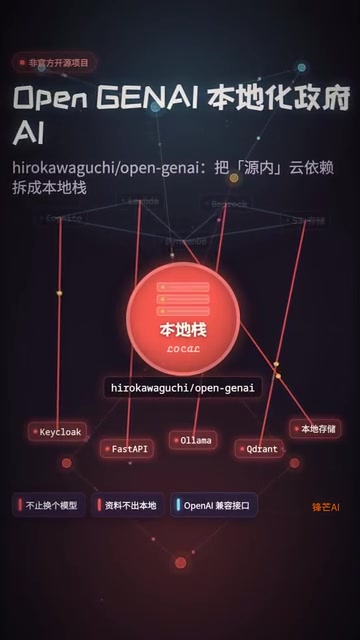
The Hard Part Isn't the Model — It's the Cloud Dependencies
When people talk about government AI localization, the first instinct is often "just swap in an open-source LLM." But the real complexity runs far deeper.
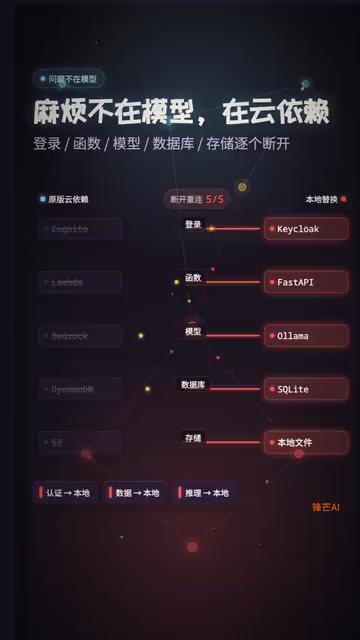
Modern cloud-native AI applications are built on a foundation of "services": identity authentication relies on cloud implementations of OAuth/OIDC, backend logic runs on Serverless platforms like AWS Lambda or Alibaba Cloud Function Compute, model inference is called through the OpenAI API or cloud-hosted endpoints, and data is scattered across managed databases (e.g., RDS, DynamoDB) and object storage (e.g., S3, OSS). This architecture enables rapid delivery and elastic scaling — but every single layer creates an implicit binding to a specific cloud vendor, the so-called "Vendor Lock-in."
According to the project documentation, the Digital Agency's original application depends on a full suite of cloud capabilities:
- Cloud-based login (identity authentication)
- Function Compute (Serverless backend)
- Managed model (cloud inference service)
- Cloud database and object storage (data and file persistence)
This means that even if you replace the model itself with a locally deployed one, login, backend logic, data storage, and file handling remain firmly tied to cloud services. For government scenarios that require data to never leave the internal network, replacing only the model is nowhere near sufficient.
This is precisely where OpenGENAI delivers its most valuable insight: AI localization is fundamentally about decoupling the entire cloud dependency stack — not replacing a single component.
Data Sovereignty: Why Government Scenarios Can't Tolerate Cloud Hosting
It's worth understanding the real-world pressure behind the concept of "Data Sovereignty" — the principle that data is subject to the laws of the country or region where it is generated. In recent years, the EU's GDPR, China's Data Security Law and Personal Information Protection Law, and various national data localization requirements have made it increasingly risky, from a compliance standpoint, to transfer sensitive data to overseas cloud services. Japan's Digital Agency, in pushing forward government AI, faces similar restrictions on cross-border data flows stemming from amendments to the Act on the Protection of Personal Information. This explains why "de-clouding" in government contexts is not merely a technical preference — it is a hard compliance requirement. Once citizen personal data or internal government documents are involved, routing that data to an external cloud service may constitute a direct legal violation.
Architecture Transformation: Three Critical Changes
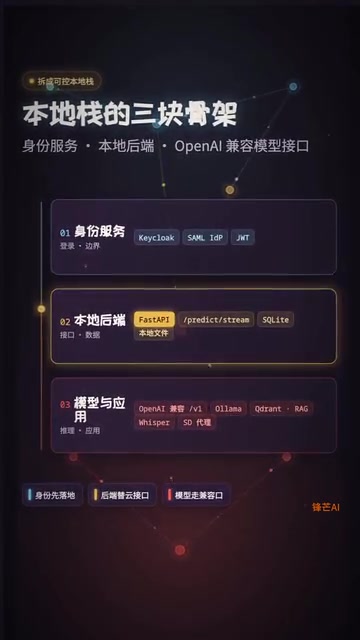
OpenGENAI's approach is to replace authentication, chat history, file handling, and the inference pipeline entirely with local components. From an architectural standpoint, there are three key transformation directions:
Local Identity Service
The original application relied on cloud-based login functions. OpenGENAI replaces the entire authentication flow with a local identity service. This step may seem basic, but it represents the first gateway to data sovereignty — user identities and login credentials no longer pass through an external cloud.
Local Backend Replacing Cloud Interfaces
Business logic that previously ran on Function Compute is migrated to a local backend, eliminating the hard dependency that Serverless architectures create on specific cloud platforms.
LLMs Through a Compatible Interface
Model integration is implemented via an interface compatible with common LLM APIs, giving teams the freedom to choose locally deployed open-source models without being locked into any hosted service.
It's worth noting that the Chat Completions API format released by OpenAI in 2023 has effectively become the industry standard for LLM interfaces. Major local inference frameworks — including Ollama, vLLM, LM Studio, and LocalAI — all provide interfaces compatible with this format, allowing upper-layer applications to freely switch underlying models (whether Llama 3, Mistral, Qwen, or other open-source models) without modifying business logic. OpenGENAI's design choice to use a "compatible common LLM interface" is essentially leveraging this de facto standard to achieve model-layer replaceability — one of the most effective design decisions for reducing migration costs in private deployment architectures.
In addition, knowledge base retrieval, speech transcription, and image generation are broken out into independent local applications. This modular design makes every layer of the system controllable and replaceable.
Don't Treat It as a Ready-to-Go Magic Solution
The direction is commendable, but the project documentation itself lists several prerequisites that need to be stated clearly:
- A container orchestration environment is required
- You must prepare your own model service and image generation service
- Developer accounts and local authentication are not suitable for direct public internet exposure
Container orchestration typically refers to container management platforms like Kubernetes (K8s), which automate deployment, scaling, service discovery, and failure recovery. Smaller teams may opt for Docker Compose or a lightweight K3s setup instead. This barrier alone rules out any "out-of-the-box" expectations, and clearly defines the target audience: engineering teams with solid DevOps capabilities who are comfortable with container image management, network configuration, and persistent storage mounting — not general business users.
OpenGENAI provides a migration roadmap for private deployment, not a production-ready out-of-the-box system. It reduces the cost of designing an architecture from scratch, but bringing it to production still requires substantial engineering effort. Treating it as a "download and run" solution will only lead to disappointment.

Still Early, But Worth Watching
In terms of traction, OpenGENAI is still at a very early stage. At the time of data collection, the repository shows only 110 stars and 8 forks — by open-source project standards, these are nascent numbers.
But its direction is worth following. What it accomplishes is breaking down the heavy burden of "government AI cloud lock-in" into three controllable components:
- Local authentication — identity never leaves the internal network
- Local data — chat history, files, and knowledge bases are all localized
- Local models — free model selection through a compatible interface
Why This Matters
As more government agencies and large enterprises adopt generative AI, "data sovereignty" and "compliance" are becoming unavoidable thresholds. Cloud-hosted solutions are certainly convenient, but for scenarios handling sensitive internal documents, routing data to an external cloud service is often unacceptable — not just as a security concern, but as a legally mandated constraint.
OpenGENAI's value lies in providing a referenceable de-clouding transformation paradigm: not simply swapping out the model, but systematically identifying and replacing every cloud dependency node — from identity authentication and business backend, to data storage and model inference — forming a complete local-first closed loop. This approach has meaningful reference value for any team looking to build a private AI system.
It may never go viral, but the direction it points to — liberating AI applications from cloud service lock-in — is precisely the most practical challenge in the wave of private AI deployments. For practitioners focused on AI localization, this project is worth adding to your watchlist.
Key Takeaways
Related articles

Gaussian Process Bandit Optimization: Exploration Strategies and Inference Regret Guarantees
Cumulative regret guarantees in Bayesian optimization fail to reflect final recommendation quality. This article examines a new study that provides inference regret guarantees for Gaussian process bandit optimization through exploration query strategies and fill distance analysis, validated on hyperparameter optimization and control tasks.
The Most Detailed Codex Guide on Bilibili: From Installation to Real-World Practice
The most detailed Codex guide on Bilibili: from app store installation to daily work mode configuration, with a real coffee shop project demonstrating file organization, data extraction, dashboard creation, and other practical tasks. Learn to use Plan Mode and desktop pets to leverage Codex efficiently.

Appearance Compensation in Volume Rendering: Why RGB Accuracy Cannot Guarantee Density Correctness
Volume rendering research reveals that volumetric data perfectly reproducing external RGB views may still contain density errors: appearance compensation can double central density and keep external rays unchanged even when L2 error exceeds 14.52%. Density recovery depends on appearance capacity, spatial resolution, and measurement design.