The Real Culprit Behind Deadlocked Multi-Agent Pipelines: Missing Handoff Rules

A real case reveals why multi-agent pipelines deadlock: missing state contracts and sync/async mismatches.
A developer shared a production failure in a three-agent pipeline (plan → code → review): the review agent got stuck in infinite waits because the coding agent's "completion" signals had inconsistent formats. Two root causes were identified: no shared completion status schema between agents, and delegation logic written for synchronous execution running on an async runtime. The fix involved introducing explicit state contracts and a timeout/retry layer. The core lesson: multi-agent reliability depends more on protocol design than individual agent intelligence — and failures almost always happen at the overlooked handoff seams, not within the models themselves.
When Agents Start "Ghosting" Each Other: A Real-World Pipeline Failure
A developer shared their experience debugging a multi-agent pipeline on Reddit — a case that perfectly captures the core pain points of building production-ready AI Agent systems today.
The vision was elegant: a planning agent, a coding agent, and a review agent would pass work to each other in sequence, with the entire pipeline running automatically without human intervention. The reality, however, was far messier — the review agent frequently got stuck in infinite waits because the "completion" signal sent by the coding agent had a different structure on every single run.
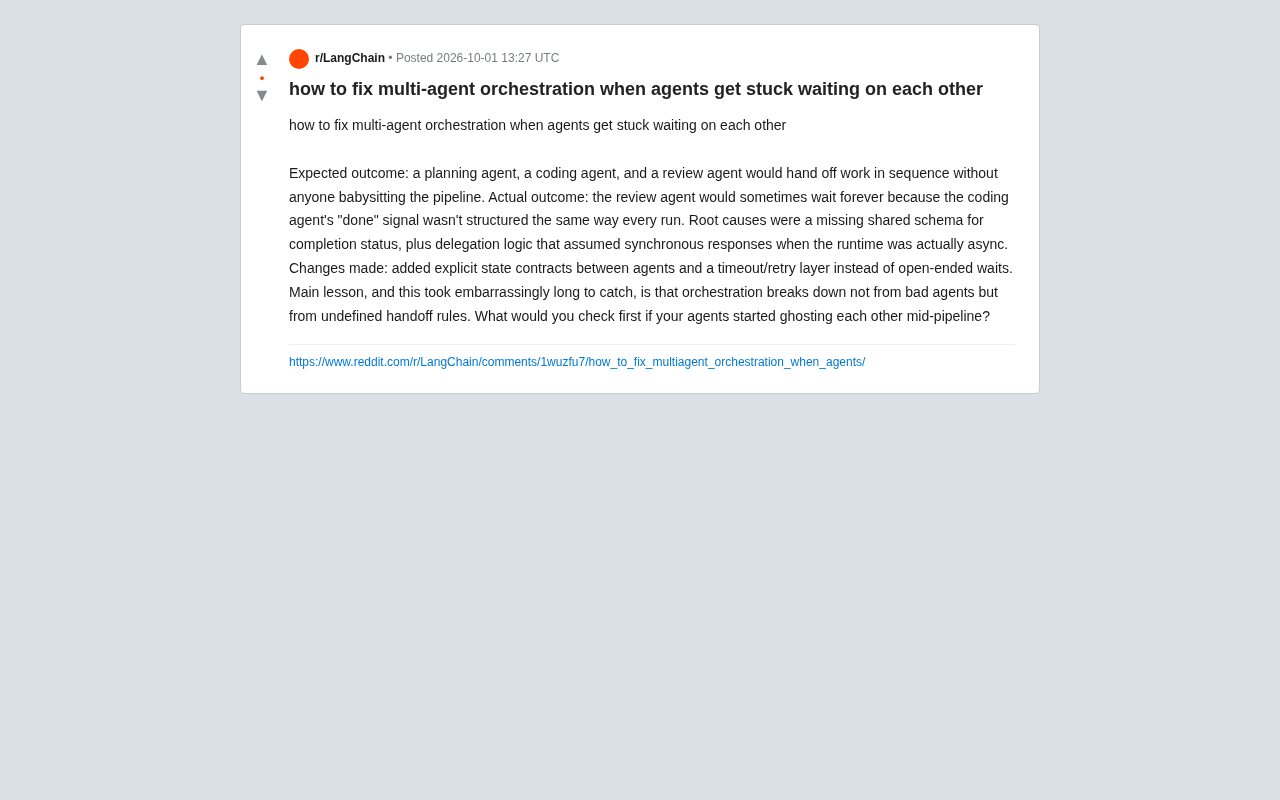
This phenomenon of "agents ghosting each other mid-pipeline" is the first wall many teams hit when moving from demo to production.
The Root Cause Isn't the Agents — It's the Handoff Contract
The developer performed a root cause analysis and identified two key issues — both worth writing down if you're doing any kind of agent orchestration.
Missing a Shared Schema for Completion Status
The first root cause: there was no shared schema for completion status between agents. The coding agent expressed "I'm done" in an inconsistent way every time — sometimes as natural language, sometimes as a structured field, sometimes with ambiguous semantics. The downstream review agent had no reliable way to parse this signal, so it just kept waiting indefinitely.
This exposes an underappreciated truth: in multi-agent systems, what agents pass to each other isn't just "content" — it's state. If that state isn't formally defined as a machine-readable contract, every handoff becomes a guessing game.
A schema is a formal agreement about data structure and field semantics — think of it like an API spec or a database table definition. In multi-agent systems, a completion status schema typically defines: which field represents task status (e.g.,
status: "completed" | "failed" | "pending"), where error messages live, and how output artifacts are referenced. Common implementations include JSON Schema, Pydantic models (Python), or TypeScript type definitions. Without this layer of agreement, LLM-generated output is inherently non-deterministic — the same intent might be expressed as{"done": true},"Task completed", or{"result": "finished"}. All three are human-readable, but to a downstream system that depends on a specific field, they're completely different — which is exactly why the review agent ended up waiting forever.
Treating an Async Runtime as Synchronous
The second root cause is more insidious: the delegation logic assumed synchronous responses, but the actual runtime was asynchronous. When code is written with the expectation of "call and immediately receive a result," but the underlying execution is asynchronous, the wait logic becomes an open-ended block that is never satisfied.
The developer admitted this took "an embarrassingly long time" to track down — which speaks to just how hard this class of bug is to catch by intuition in distributed agent systems.
Synchronous calls block the caller until the callee returns a result. Asynchronous calls let the caller continue immediately after making the request, with the result arriving later via callbacks, Promises, events, or polling. In agent orchestration frameworks (like LangGraph, AutoGen, or CrewAI), each agent typically runs as an independent asynchronous task, with calls to external APIs, code execution, or human review introducing unpredictable delays. If the orchestration code is written with a synchronous mindset — assuming "the line after I call the coding agent will have its output" — then in an async runtime, that next line executes before the result is ready, leading to empty reads or permanent blocks. These bugs often don't appear in local single-threaded tests; they only surface under concurrent or distributed deployment, making them one of the hardest classes of bugs to reproduce and diagnose in multi-agent systems.
The Two-Part Fix: State Contracts + a Timeout/Retry Layer
The developer made two targeted changes — both conceptually clear and broadly reusable.
First, add explicit state contracts between agents. Instead of letting each agent "freestyle" its completion report, define a unified, structured status format. As long as all agents conform to the same contract, downstream agents can deterministically answer the question: "did upstream actually finish?"
Second, introduce a timeout/retry layer to replace open-ended waits. Rather than letting the review agent hang indefinitely, set a reasonable timeout threshold: when it's exceeded, trigger a retry or a graceful fallback. This effectively installs a "circuit breaker" on the pipeline, preventing a single blocked point from taking down the whole system.
Both fixes share the same engineering philosophy: replace implicit assumptions with deterministic rules.
Timeout/retry mechanisms have well-established patterns in distributed systems engineering. Timeouts prevent single-point infinite blocking and typically come in two flavors: connection timeout and read timeout. Retry strategies include immediate retry, fixed-interval retry, and exponential backoff — the last being especially important when dealing with overloaded downstream services. The Circuit Breaker pattern goes further: when an agent fails consecutively beyond a threshold, the breaker temporarily "opens," causing the system to fail fast rather than keep waiting, then automatically retries once recovery is detected. These patterns are widely used in microservices but remain infrastructure that developers must implement themselves in agent orchestration — they're rarely out-of-the-box features in most frameworks.
The Core Lesson: Brittle Orchestration Comes from Undefined Handoff Rules
The developer's key takeaway cuts straight to the point: orchestration doesn't break because the agents aren't capable enough — it breaks because handoff rules were never defined.
This insight is broadly relevant across the AI Agent landscape. Many teams spend endless cycles tuning individual agent prompts, model selection, and capability boundaries, while overlooking the "glue" between agents — handoff protocols, state synchronization, and error handling. Production failures almost always happen at these neglected seams, not within the agents themselves.
Put another way: the reliability of a multi-agent system depends more on protocol design than on individual intelligence. A system built from three "mediocre but contract-compliant" agents will likely be far more stable than one built from three "brilliant but mutually incomprehensible" agents.
If Your Agents Start Ghosting Each Other, Where Do You Look First?
The developer closed with an open question: if your agents start ghosting each other mid-pipeline, what's the first thing you'd check?
Based on this case, here are the highest-priority areas to investigate:
- Does the handoff signal have a unified schema? Do all agents express "completed / failed / pending" consistently and in a machine-parseable format?
- Is the runtime synchronous or asynchronous? Does the wait logic match the underlying execution model? Are there any blocks that can never be satisfied?
- Is there a timeout fallback? Do all wait points have timeout and retry mechanisms to prevent open-ended hangs?
- Is state observable? When an agent gets stuck, can you quickly identify what it's waiting for and what the upstream agent actually sent?
For developers pushing agent systems toward production, this real-world failure provides a low-cost checklist. The next bottleneck in multi-agent orchestration almost certainly isn't model capability — it's engineering contracts.
Related articles

Chain of Thought Isn't Just for AI: How Humans Can Use CoT to Improve Thinking Quality
Chain of Thought isn't just a prompt trick for large models. Starting from a Hacker News discussion, this article analyzes why CoT works for human thinking too, breaks down actionable ways to transfer it, and highlights the key differences between human CoT and machine CoT.
Cloudflare Teams Up with OpenAI: Closi…
Cloudflare Teams Up with OpenAI: Closing the Loop from Vulnerability Discovery to Defense with AI
Cloudflare uses OpenAI Daybreak to investigate security vulnerabilities and generate reviewable remediation plans, while developers use Codex to boost coding efficiency and quality.

Orca Multi-Agent Orchestration in Practice: A Guide to Parallel Collaboration with Claude and Codex
Orca is Stable AI's free open-source agent workbench supporting 34 agents like Claude Code and Codex in parallel. Learn its Git worktree isolation, multi-model orchestration, and mobile management.