The Real Meaning of NVIDIA RTX Spark: Arm Will Run Everything

NVIDIA returns to Arm PCs with RTX Spark, betting ecosystem advantages can rewrite the Surface RT defeat.
The article traces the Arm PC dilemma from the 2012 Surface RT failure, arguing the real bottleneck was always the app ecosystem, not hardware. Now NVIDIA's RTX Spark re-enters the race, betting that Arm is becoming the default computing platform thanks to mobile ecosystem scale, mature translation layers, and AI's energy-efficiency demands. It analyzes NVIDIA's shift from GPU supplier to platform definer, replicating CUDA's ecosystem lock-in on the client side. Victory hinges on whether developers treat Arm as a first-class platform.
Fourteen years ago, Microsoft released a Windows PC powered by an NVIDIA Tegra chip — the original Surface RT. Running a stripped-down version of Windows, the device became one of the most spectacular failures in modern tech history, forcing Microsoft to write down $900 million in inventory. The problem wasn't "can Arm run Windows" — it was "can Windows apps run on Arm."
Now NVIDIA is charging back into the Arm PC race with RTX Spark. This time, the answer may be completely different.
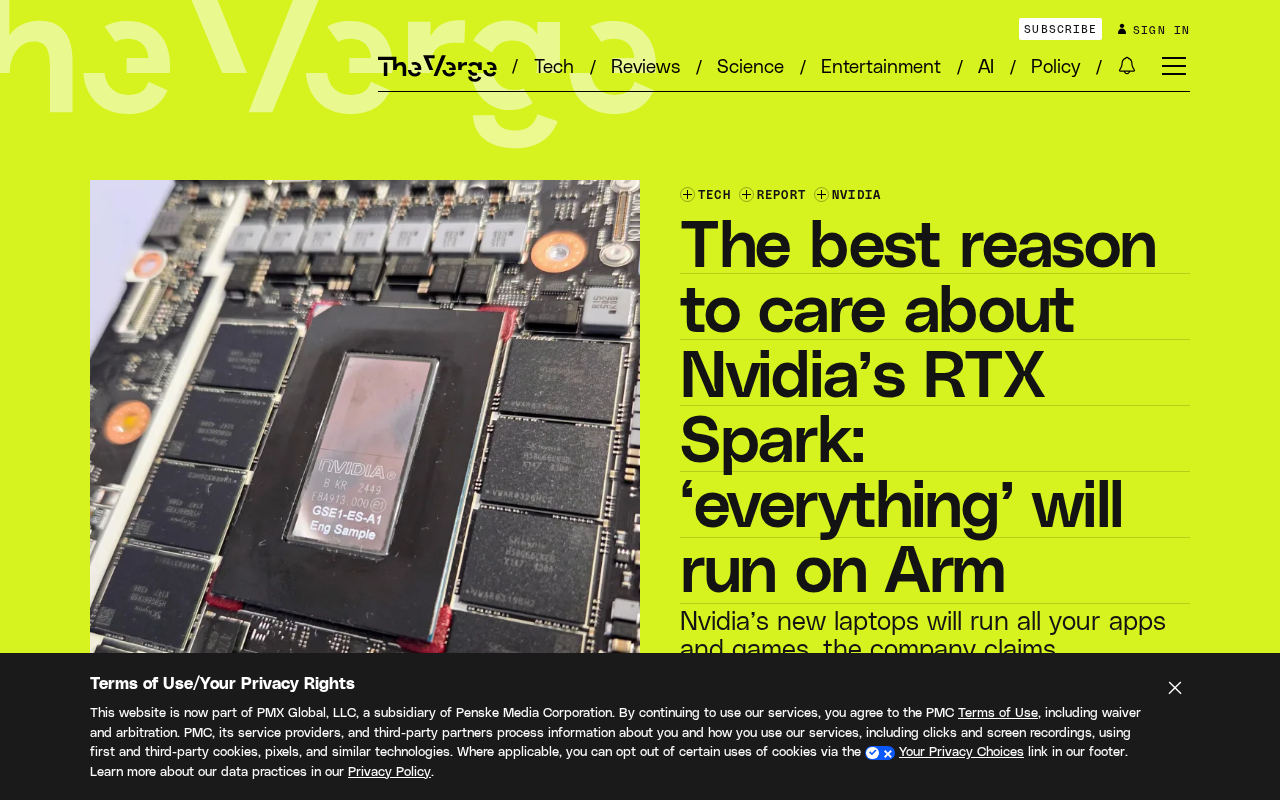
Starting from the Surface RT Failure: The App Ecosystem Is the Deciding Factor
The 2012 Surface RT exposed the fundamental dilemma of Arm PCs. The hardware itself wasn't bad — the Tegra chip was power-efficient with long battery life — but Windows RT couldn't run x86 applications, and users who fired up the device found all their familiar software missing. No Photoshop, no iTunes, not even Chrome. Microsoft tried to fill the gap with store apps, but developers responded with a shrug.
This failure left the entire industry with a stereotype: Arm PCs are doomed to be second-class citizens.
But NVIDIA clearly believes the times have changed.
Windows RT was a stripped-down version of Windows that Microsoft built specifically for Arm-based devices, sharing the same lineage as the contemporaneous x86 version of Windows 8 but kept isolated from it. It only allowed apps from the Windows Store that had been recompiled for Arm; traditional x86 desktop programs couldn't be installed. The design was intended to leverage Arm's low-power advantages to extend battery life and lower prices, but it ignored the backward compatibility that PC users value most. Developers who wanted to support Windows RT had to recompile and adapt their apps for a touch interface, with an extremely poor return on investment, leaving the store chronically underpopulated. Users only discovered after buying the device that they couldn't install familiar .exe software, and its reputation collapsed quickly. Windows RT ultimately stopped receiving updates around 2015, becoming a classic cautionary tale of "sacrificing compatibility for architecture," and for a long time it made "Arm PC" synonymous with "crippled functionality."
The Logic Behind RTX Spark: "Everything" Can Run on Arm
The core proposition of RTX Spark isn't about improved hardware performance — it's about a more fundamental shift: the Arm architecture is becoming the default platform for "everything to run on."
That may sound like marketing speak, but there are several structural changes worth noting:
The overwhelming scale of the mobile ecosystem. Android and iOS together cover the vast majority of computing devices worldwide. Developers optimizing apps for Arm first has long been the norm — x86 is now the one that requires "extra adaptation."
The maturation of translation technology. Apple's Rosetta 2 demonstrated that Arm can run x86 code almost seamlessly. Qualcomm and Microsoft have also continued investing in compatibility layer technology for Windows on Arm. The deadlock that doomed Surface RT — "hardware without apps" — is being gradually untied at the software level.
The push from AI workloads. This is NVIDIA's strongest domain. More and more AI inference tasks are being deployed to edge devices, and Arm's performance-per-watt advantage is amplified in this scenario. If RTX Spark can provide full CUDA ecosystem support on the Arm platform, it sends a signal developers cannot afford to ignore.
Binary translation is the key technology that lets Arm devices run x86 programs. It doesn't modify the original program; instead, it dynamically translates x86 instructions into Arm instructions at runtime and caches the translated results to reduce repeated overhead. Apple's Rosetta 2 can run most x86 Mac apps on Apple Silicon at near-native speeds thanks to this mechanism combined with Apple's unified encapsulation of system APIs. Qualcomm's compatibility layer and Microsoft's Prism take a similar approach, but the Windows ecosystem is far more complex — drivers, anti-cheat systems, professional plugins, and other low-level components often bypass the translation layer to call hardware directly, resulting in uneven compatibility. The maturation of translation means Arm PCs have a "transitional bridge," but how much weight that bridge can bear still depends on the specific software stack, not the architecture itself.
NVIDIA's Calculation: From GPU Supplier to Platform Definer
NVIDIA's role in the PC market has long been that of a "graphics card supplier" — it provides RTX GPUs, but the CPU and platform are dominated by Intel or AMD. The arrival of RTX Spark means NVIDIA is no longer content to be just a component maker.
The deeper logic of this move: if all devices in the future run on Arm, then whoever defines the GPU and AI acceleration standards on Arm will hold the power to shape the next computing era.
NVIDIA has already proven the power of this "platform lock-in" strategy in the data center market — the CUDA ecosystem makes it nearly impossible for competitors to dislodge its position. Now it's trying to replicate the same playbook on the client side.
The risks are real too. Intel and AMD still have deep roots in the x86 camp, and Microsoft's commitment to Windows on Arm has repeatedly been called into question. The shadow of Surface RT hasn't fully lifted, and consumer trust in "Arm PCs" will take time to rebuild.
CUDA is the parallel computing platform and programming interface NVIDIA has built since 2006; developers use it to harness GPUs for general-purpose computing rather than just graphics rendering. After more than a decade of accumulation, mainstream AI frameworks, scientific computing libraries, and industry software almost all prioritize CUDA support, creating extremely high migration costs. Competitors with comparable hardware performance would still need to rewrite code or rely on conversion layers for compatibility — this is the foundation of NVIDIA's "platform lock-in." If RTX Spark can retain CUDA support on Arm clients, developers can reuse their existing AI code and toolchains on laptops and edge devices, extending the data center ecosystem advantage all the way to the endpoint. This also explains why NVIDIA describes RTX Spark as a platform-level move rather than simply the launch of a chip.
What's Different This Time
The root cause of Surface RT's failure was that it was too early: the ecosystem wasn't ready, the technology wasn't ready, and user habits weren't ready. Today, mobile-first development patterns, mature translation layers, and AI's hard demand for energy efficiency together form a far more hospitable soil.
Whether RTX Spark succeeds ultimately comes down to one question: are developers willing to treat Arm as a "first-class platform" rather than a "compatibility target"? If the answer is yes, then NVIDIA's bet isn't just about a chip — it's about rewriting the entire power structure of computing platforms.
The lesson from fourteen years ago: hardware alone isn't enough — the ecosystem decides life or death. The variable fourteen years later: the ecosystem itself has already chosen Arm's side.
One-line Summary
NVIDIA returns to Arm PCs with RTX Spark, attempting to use ecosystem advantages to rewrite the Surface RT defeat from fourteen years ago.
Paragraph Summary
Starting from the disastrous 2012 Surface RT, the article argues that the real bottleneck for Arm PCs was never hardware but the app ecosystem. The original Surface RT failed because it couldn't run x86 software and had a barren app store, leaving the industry with the stereotype that "Arm PCs are second-class citizens." Now NVIDIA is re-entering the race with RTX Spark, betting on the logic that Arm is becoming the default platform for "everything to run on": the mobile ecosystem's overwhelming scale, increasingly mature translation technology, and AI inference's demand for energy efficiency are all pushing in that direction. The article further analyzes NVIDIA's strategic intent — upgrading from GPU supplier to platform definer, replicating CUDA's data center ecosystem lock-in on the client side. Ultimately, victory depends on whether developers treat Arm as a "first-class platform" rather than a "compatibility target."
Related articles

Amphibious Transforming Drone: Beyond 100x Power Savings, What Are the Real Needs?
Is the amphibious transforming drone just a gimmick? Starting from the 100x power difference of the M4 Morphobot, explore real application scenarios and thesis topic ideas, analyzing boundary conditions where pure drones and pure ground robots both fail.

Warhound Raises $200 Million: Genetically Engineered "War Dogs" Paired with Anduril Gear
Warhound raises $200M, backed by Ben Lamm and Palmer Luckey, to genetically engineer dogs for military and law enforcement use and equip them with Anduril gear. This article analyzes its technology direction, funding logic, and ethical controversy.

Claude API Comes to Google Cloud: IAM Integration and SDK Access Guide
Anthropic hosts the full Claude API on Google Cloud with IAM-controlled permissions and unified billing. This guide covers the Vertex AI and Anthropic-hosted entry points, IAM role configuration, and SDK access.