The Real Situation of Machine Learning PhDs: Hypercompetition, Luck, and Sense of Value

A Reddit discussion reflects the divergent views on the value of AI PhDs amid intensifying competition and the need for expectation management.
The article revolves around a Reddit question: in the context of white-hot AI research competition and research positions increasingly depending on luck, is a machine learning PhD still worth pursuing? Supporters argue that PhD training shapes research taste and the ability to independently drive projects, which are scarce across roles; realists note that the supply of research positions lags behind PhD graduates, slots at top labs and star startups are limited, and luck factors are amplified. Recent graduates' feedback diverges and is highly correlated with research direction, publications, and advisor resources. The article concludes with a judgment framework, emphasizing that a PhD is a high-risk, high-investment choice and that uncertainty should be factored into expectations.
When "Pursuing a PhD" Meets "AI Hypercompetition"
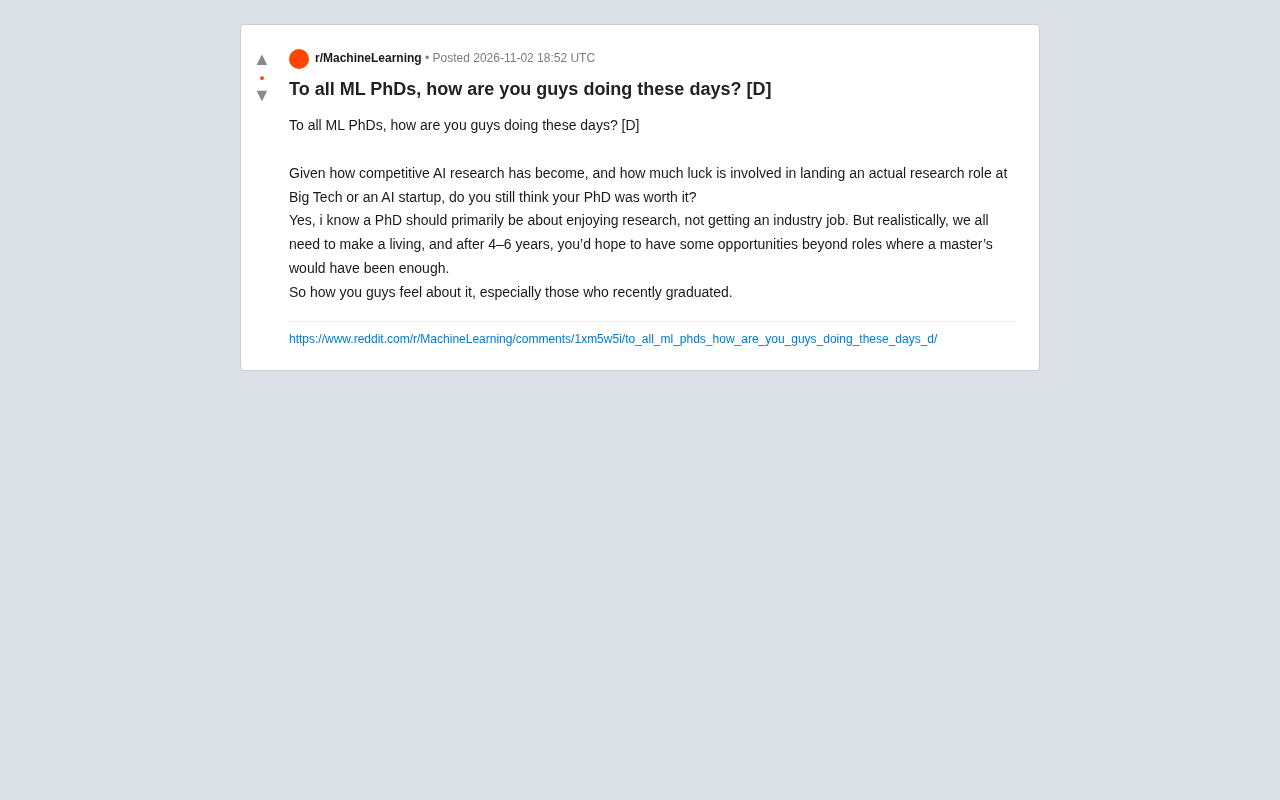
A question from a Reddit user struck a nerve for many: at a time when AI research competition is white-hot and landing a research role at a big tech company or startup increasingly depends on luck, do machine learning PhDs still feel the experience was worth it? He admitted that he understood pursuing a PhD should primarily be about enjoying research, but the reality is that everyone needs to make a living, and after four to six years of investment, one hopes to have more opportunities than they would have had with just a master's degree. The resonance this post generated is itself an industry signal worth carefully unpacking.
The Supportive Camp: PhD Training Shapes "Research Taste"
Some current and recently graduated PhDs gave affirmative answers. Their reasons centered on several dimensions: what the PhD stage truly trains is the ability to ask good questions, design experiments, and critically evaluate results—these are hard currency in research-oriented positions. Some mentioned that even if one ultimately does not enter a core research team, the domain depth and experience in independently driving projects accumulated during the PhD are equally scarce in engineering and product roles.
These responses generally did not deny the existence of competition, but emphasized that the value of a PhD should not be measured solely by one's "first job." One respondent said that the PhD gave him a framework for looking at problems, and this framework has repeatedly come into play in his subsequent career path.
"Research taste" is a term that appears frequently in AI and academia but is rarely clearly defined. It roughly refers to the intuition and judgment to determine, among a large number of open problems, which ones are worth investing in, which experimental designs can truly validate hypotheses, and how to assess whether results are credible. This ability is difficult to acquire through short-term training; it typically comes from long-term reading of frontier papers, repeated trial and error, and discussions with senior researchers. In industry research positions, research taste directly determines the direction of topic selection and the success or failure of projects, and is therefore often regarded as the most core and hardest-to-replace output of PhD training.
The Realist Camp: The Window of Opportunity Is Narrowing, and the Luck Factor Is Amplified
Another set of voices was more sober. They pointed out that the growth in the number of AI research positions cannot keep up with the growth in PhD graduates, especially since slots at top labs and star startups are limited, and factors in the hiring process such as referrals, timing, and the popularity of one's research topic are difficult to control. Some said bluntly that if the goal is simply to enter a big tech research position, then the return on investment of a PhD is already worse than it was a few years ago.
Interestingly, this concern does not equal regret. Multiple respondents emphasized that the problem lies in the expectation of "treating a PhD as a ticket to a specific position," rather than in the PhD training itself.
"Research positions" in industry are not a single concept. Big tech research institutes, core algorithm teams, applied research roles, and ordinary engineering roles differ greatly in hiring thresholds, work content, and promotion paths: the former usually require top-conference papers and a strong match in research direction, while the latter place more emphasis on engineering implementation ability. The "limited slots" mentioned in the discussion mainly refers to the former, and the absolute number of such positions is inherently far smaller than that of engineering roles. Understanding this stratification helps explain why, among AI PhDs, the employment experience shows enormous divergence.
The Divergent Experiences of Recent Graduates
Feedback from the recently graduated group showed clear divergence. Some smoothly landed research positions and felt their efforts were rewarded; others said the application process was long and full of uncertainty, and the position they ultimately chose differed from what they had envisioned during their PhD. This divergence is highly correlated with specific conditions such as research direction, publication record, and advisor resources.
One point that was repeatedly mentioned: a master's degree is already sufficient for many applied positions, and the incremental advantage brought by a PhD is mainly reflected in research-oriented positions—and the supply of such positions is relatively limited.
In the AI field, the most commonly used metric for measuring PhD output is top-conference papers, such as NeurIPS, ICML, ICLR, CVPR, ACL, and others. The acceptance rates of these conferences typically range from 20% to 30%, and the review cycle is long—from submission to publication often takes more than half a year. The popularity of a research direction significantly affects the visibility and citation speed of papers, which in turn affects market evaluation during job hunting. This is also one reason why "topic popularity" is regarded as an uncontrollable factor in the discussion: the same effort, placed in different directions, can yield vastly different returns.
A Judgment Framework for Those Who Follow
Drawing on the experiences in the discussion, several questions are worth thinking through before pursuing a PhD:
- Do you truly enjoy digging deeply into a problem over the long term and independently, rather than just liking the label "AI"?
- Does your target position really require a PhD, or would a master's degree plus project experience suffice?
- Can you accept the misalignment between your research direction during the PhD and the demands of the job market?
- How high is your tolerance for uncertainty?
The discussion did not provide a unified answer, but the consensus is: pursuing a PhD is a high-risk, high-investment choice, and its returns include both the accumulation of knowledge and abilities and an experience that cannot be fully priced by employment outcomes. For those preparing to embark on this path, incorporating "luck" into expectation management may be more practical than agonizing over whether it is worth it.
One-line Summary
A Reddit discussion reflects the divergent views on the value of AI PhDs amid intensifying competition and the need for expectation management.
Paragraph Summary
The article revolves around a question on Reddit: in the context of white-hot AI research competition and research positions increasingly depending on luck, is a machine learning PhD still worth pursuing? Supporters believe that PhD training shapes research taste—the ability to ask good questions, design experiments, and critically evaluate—as well as the capacity to independently drive projects, which are scarce across various roles; realists point out that the supply of research positions cannot keep up with the growth of PhD graduates, slots at top labs and star startups are limited, and luck factors such as referrals, timing, and topic popularity are amplified. Feedback from recent graduates is clearly divergent and highly correlated with research direction, publication record, and advisor resources. The article concludes with a judgment framework for before pursuing a PhD, emphasizing that it is a high-risk, high-investment choice and that uncertainty should be incorporated into expectation management.
Related articles

Qwen 3.8 Beats Opus at Coding—But Can Your Mac Run It?
Open-source Qwen 3.8 beats Opus 4.6 at coding at just 18GB, but how much Mac memory do you need? 24GB crashes; 32GB is the sweet spot. Full config guide inside.

Claude Code + Agent: Building a Fully Automated AI Testing Loop
Bilibili course breakdown: how test developers can use Claude Code terminal-based Agents to build a fully automated AI testing loop. Compares permission boundaries of terminal vs. device Agents, explains why enterprise projects choose Claude Code over Open Claude-type tools, and outlines the Node.js environment setup and DeepSeek model integration path.

Working with AI Agents Requires Nerves of Steel
The more autonomous AI agents become, the heavier the user's psychological burden. Drawing from a Hacker News discussion, this article analyzes black-box anxiety, behavior drift, and monitoring fatigue in agent collaboration, and offers practical approaches like sandbox isolation, permission control, and task granularity management to reduce cognitive load.