The Rise of AI Agents: Using a Computer May Become Optional

AI agents are turning computer operation from a necessity into an option, fundamentally reshaping work.
AI agents powered by large language models are rapidly evolving from assistive tools into autonomous executors capable of operating computers independently. This shift promises to transform knowledge work by moving humans from the role of operators to commanders who delegate tasks via natural language. While the vision of making computer use optional is compelling, challenges around reliability, security, and complex task handling mean full realization will take longer than the most optimistic predictions suggest.
A Bold Prediction: Computers Will Become Optional
Recently, a tweet has sparked heated discussion across the tech community: "By next year, using a computer will be optional. Work will radically change."
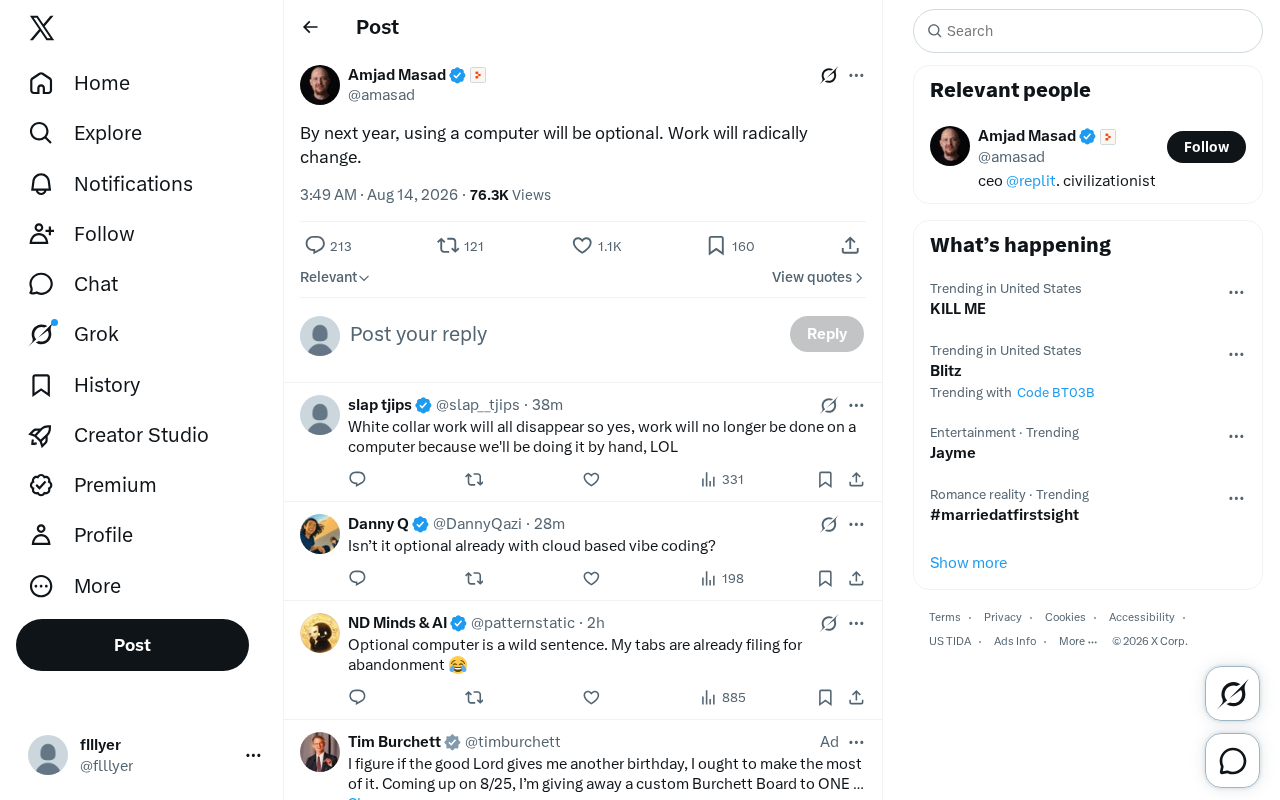
This short but provocative statement points to a trend that is accelerating rapidly — AI agents are evolving from "assistive tools" into "autonomous executors." An AI agent refers to an artificial intelligence system capable of perceiving its environment, making autonomous decisions, and taking actions to achieve specific goals. Unlike traditional chatbots, AI agents possess a closed-loop capability of "planning-executing-feedback": they can decompose a complex objective into multiple subtasks, execute them sequentially, and dynamically adjust their strategy based on intermediate results. This concept originates from the "intelligent agent" theory in AI research, tracing back to multi-agent systems research in the 1990s. But the real turning point that brought it into practical use was the breakthrough of large language models like GPT-4 and Claude since 2023, which gave agents powerful language understanding, reasoning, and tool-calling capabilities.
When AI can independently complete tasks that previously required humans to sit in front of a computer and perform manually, the act of "using a computer" itself may indeed become dispensable for many knowledge workers.
This article takes this prediction as a starting point to deeply analyze the underlying technical logic, real-world feasibility, and potential controversies.
Why AI Agents Could Make Computer Operation Optional
The Paradigm Shift from "Humans Operating Computers" to "AI Operating Computers"
Over the past few decades, productivity improvements have essentially been optimizations of "human-computer collaboration": faster processors, smarter software, more intuitive interfaces. But no matter how tools evolved, humans have always been the ones sitting in front of the screen, typing on keyboards and clicking mice.
The current turning point is that AI agents powered by large language models are beginning to acquire the ability to "autonomously operate computers." Take features like Anthropic's Computer Use and OpenAI's Operator as examples — the underlying principle of these technologies combines computer vision (for understanding pixel information from screenshots) with the reasoning capabilities of large language models (for determining what action to execute next). Unlike traditional RPA (Robotic Process Automation), Computer Use doesn't rely on pre-written fixed scripts. Instead, it makes real-time decisions through visual understanding and semantic reasoning, offering greater flexibility and generalization capabilities.
Specifically, AI agents can already:
- Directly understand screen content and simulate clicks and input operations
- Complete multi-step tasks across applications (such as researching information, filling out forms, and sending emails)
- Autonomously plan execution paths based on high-level goals
It's worth noting that before the rise of AI agents, enterprise automation mainly relied on RPA. RPA works by recording human operation steps and then replaying them precisely — it is essentially "hard-coded" automation that performs well in highly standardized processes but easily breaks when interfaces undergo minor changes or encounter unexpected scenarios. AI agents represent the next paradigm of automation: they dynamically plan action paths by understanding goal semantics and observing the current state, with the resilience to handle changes and anomalies. This is why the industry regards AI agents as "RPA with cognitive capabilities."
This means the human role is shifting from "operator" to "commander." You simply issue instructions in natural language, and the AI agent handles all the tedious computer operations for you.
Voice and Natural Language as the Primary Interaction Interface
If AI can operate computers on our behalf, then the interaction between humans and AI doesn't necessarily require traditional graphical interfaces. Voice and text-based conversations are becoming the new entry points. Imagine this scenario: during your commute, you dictate, "Organize this week's sales data, generate a report, and send it to the team." The AI agent completes all operations in the cloud. At that point, "opening a computer" truly becomes unnecessary.
This trend is closely tied to the broader vision of "Ambient Computing." The core idea of ambient computing is that computational power is everywhere yet invisible — users no longer need to face a specific device (like a computer or phone screen) but instead interact with intelligent systems embedded in the environment through natural means — voice, gestures, or even brain-computer interfaces. Major players like Apple, Google, and Amazon have been heavily investing in smart speakers, AR glasses, and smart wearable devices in recent years, precisely paving the way for this vision. The maturation of AI agents provides exactly the missing puzzle piece that ambient computing has long needed — a "brain" that can truly understand complex intentions and execute multi-step tasks.
This is the core logic behind the assertion that "using a computer will become optional" — computers are still running, but the one operating them no longer has to be a human.
How Work Will Fundamentally Change
A Comprehensive Restructuring of Knowledge Work
If this prediction comes true, the most deeply affected area will be the vast amount of repetitive, process-driven knowledge work. Data entry, report generation, email handling, and information retrieval are all quintessential "sitting in front of a computer" tasks. When AI agents can take over these workflows end-to-end, human labor will be freed up to focus on areas that require more judgment, creativity, and interpersonal collaboration.
In fact, the automation of knowledge work is not a new topic. Management guru Peter Drucker introduced the concept of "knowledge workers" back in the 1960s and predicted that improving knowledge work productivity would be the core management challenge of the 21st century. Since then, from spreadsheets to ERP systems, from search engines to collaboration platforms, each wave of technology has reshaped the landscape of knowledge work. But these tools were fundamentally still "efficiency amplifiers operated by humans." The transformation brought by AI agents is more fundamental because it is the first time the "execution" component has been taken out of human hands — the role of knowledge workers is simplified from "operator + decision-maker" to purely "decision-maker." This is a qualitative leap, not merely a quantitative improvement.
The criteria for measuring work value will also change accordingly: from "how many operations were completed" to "how well were objectives defined and how accurate were the decisions made." Managers will need to learn how to "delegate tasks" to AI, much like assigning work to team members today.
The Democratizing Effect of Lowered Technical Barriers
A noteworthy positive implication: when operating a computer is no longer a prerequisite skill, people who aren't proficient with complex software — whether older adults, those without technical backgrounds, or digitally disadvantaged groups — may be able to leverage AI agents to equally accomplish tasks that were previously out of reach. This could represent a significant leap forward in technological inclusion.
A Rational Perspective: The Gap Between Prediction and Reality
The Timeline May Be Overly Optimistic
"Next year" is a fairly aggressive timeline. Despite rapid progress in AI agents, current Computer Use-type technologies still face numerous challenges:
- Insufficient reliability: Prone to errors or deviation from intended goals in multi-step tasks
- Security and permission risks: Allowing AI to autonomously operate computers involves serious issues around data security, unintended actions, and privacy breaches
- Limited generalization for complex tasks: AI still struggles with non-standardized work that requires deep contextual understanding
On the security front, the issues are far more complex than they appear on the surface. First is the "permission boundary" problem: AI agents need to log into user accounts, access sensitive files, and operate enterprise systems — this essentially means partially surrendering control of one's digital identity to AI. If an agent is compromised by a Prompt Injection attack, it could lead to data breaches or unauthorized operations. Prompt injection is a novel attack method where attackers embed malicious instructions in web pages, documents, or emails to trick AI agents into performing unintended actions. Second is the "auditability" challenge: in industries with strict compliance requirements like finance and healthcare, every operation needs traceable audit records, yet AI agent decision-making processes often lack transparency. Additionally, "liability for erroneous actions" remains a legal gray area — when an AI agent sends the wrong email or deletes important files, who bears the consequences? Solving these problems requires coordinated progress across technology, institutional frameworks, and legal systems.
Therefore, a more pragmatic assessment would be: In specific, standardized scenarios, AI agents will indeed proliferate rapidly; but achieving "comprehensive replacement of humans operating computers" will require a longer maturation cycle.
Moving from "Optional" to "Normal" Requires a Complete Ecosystem
Technical capability is only one aspect. Truly making "not using a computer" a work norm also requires enterprise process restructuring, security and compliance frameworks, and the establishment of user trust. The evolution of these softer factors is often slower than the technology itself.
Conclusion: The Turning Point of the AI Agent Era Has Begun
Regardless of whether "next year" is a precise timeline, the direction this prediction points to is clear and certain: AI agents are liberating humans from tedious computer operations, and the very nature of work is being redefined.
For individuals, rather than agonizing over "whether computers will disappear," it's better to think ahead: when execution-level work is taken over by AI, where does my irreplaceable value lie? The answer likely lies in strategic thinking, creativity, emotional communication, and complex decision-making — precisely the areas that AI agents will find difficult to match in the near term.
The transformation is here. Only by proactively embracing it can we avoid being left behind by the wave.
Related articles

Cross-App Access for AI Agents: Three Identity Vendors Converge on the Same Architecture Pattern in 8 Days
Okta, Auth0, and Descope all shipped Cross App Access within 8 days. This article breaks down the two-layer access pattern behind AI Agent identity management.

Dense Models Too Slow to Run Locally? How MoE Architecture Breaks Through the Performance Bottleneck
Dense models are slow on local hardware due to memory bandwidth limits. Learn how MoE sparse activation architecture dramatically boosts local inference speed and the future of local AI deployment.

Storm Summoner: A MIDI Controller Built Specifically for Guitar Effects Pedals
A deep dive into the Storm Summoner open-source MIDI controller for guitar effects pedals—covering design philosophy, technical architecture, and how it compares to commercial solutions.