The Rise of Chinese AI Models: How Cost-Efficiency Is Reshaping Tech Choices for Small Teams

Chinese AI models are closing the quality gap with paid tools, forcing developers to weigh cost savings against data trust.
Chinese AI models like DeepSeek are rapidly closing the quality gap with premium alternatives, fundamentally changing the cost calculus for indie developers and small teams. While the cost compression at the model layer is making previously unviable products feasible, data trust and privacy compliance remain unresolved concerns. Developers are adopting a layered approach—using cheaper models for non-sensitive tasks while exercising caution with user data—signaling a broader cognitive shift from treating these models as backups to considering them as defaults.
A Quiet Turning Point
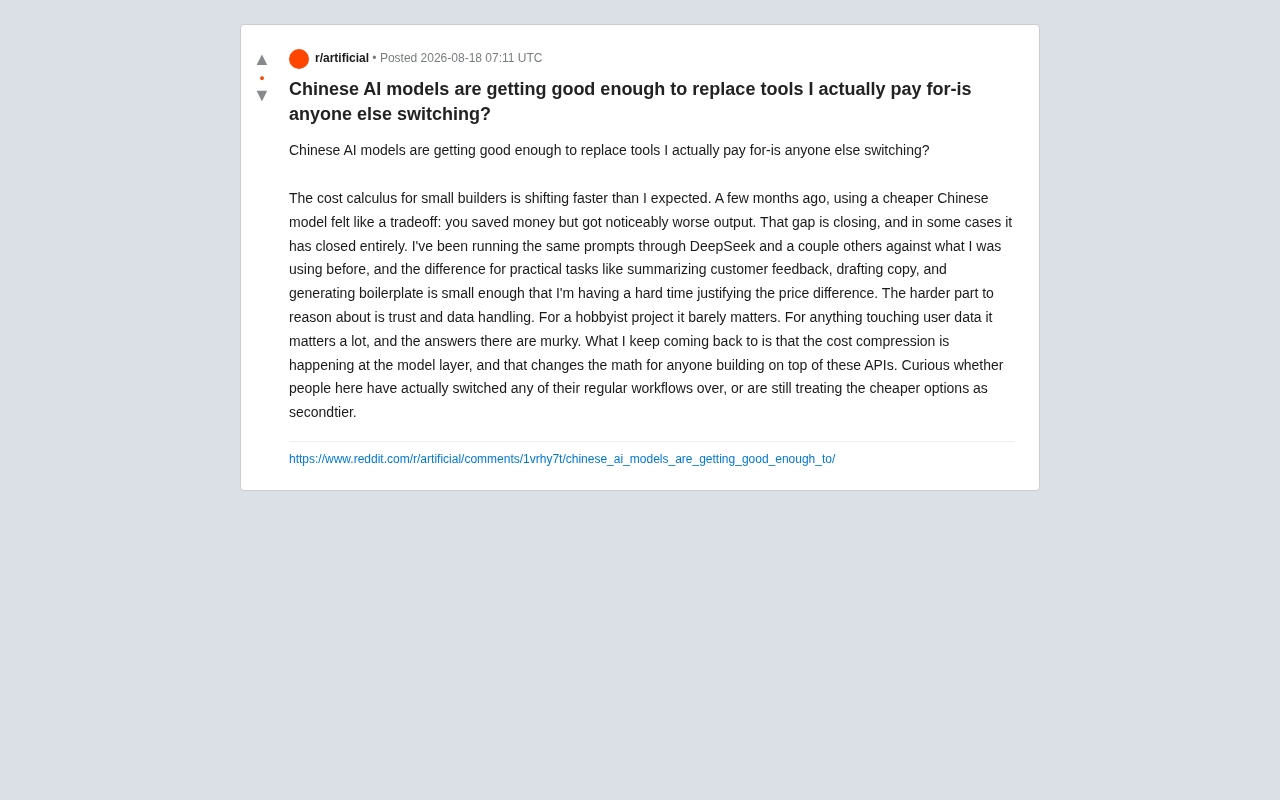
For indie developers and small teams, the cost calculus of AI tools is shifting faster than anyone expected. A Reddit developer recently shared a telling experience: just a few months ago, opting for cheaper Chinese AI models meant an obvious trade-off—you saved money, but the output quality was noticeably worse. Today, that quality gap is closing rapidly, and in some use cases, it has vanished entirely.
This developer ran a pragmatic comparison: feeding the same prompts into Chinese models like DeepSeekAd and the paid tools he had been using, then comparing the results side by side. The conclusion was striking—for everyday tasks like summarizing customer feedback, drafting copy, and generating boilerplate code, the difference had shrunk to the point where he could no longer justify the price gap.
Cost Compression at the Model Layer: Rewriting the Business Equation for AI Applications
The most noteworthy insight from this discussion is that cost compression is happening at the model layer. The statement sounds simple, but it strikes at a core variable in today's AI application ecosystem.
For anyone building products on top of these APIs, falling costs at the model layer directly rewrite their business equation. Previously, model inference costs were a critical constraint on product pricing, gross margins, and even the viability of entire business models. When comparable output quality becomes available at a fraction of the price, it's not just about saving money—it suddenly makes product ideas feasible that were previously killed by unit economics.
Why Low-Cost AI Models Matter Especially for Small Teams
Large enterprises typically have ample budgets, and model costs represent a small fraction of their overall spending. But for indie developers and early-stage startups, API call costs can directly determine whether a project lives or dies. When models like DeepSeek push the "good enough" threshold down to an extremely low price point, small teams gain unprecedented freedom to experiment—they can more boldly try new features, serve more user requests, and stop constantly worrying about runaway bills.
This is exactly why these discussions tend to ferment first among individual developers and hobbyists: they're the most price-sensitive, and the most willing to validate with real workflows whether "the cheaper alternative actually works."
The Unavoidable Challenge: Data Trust and Privacy Compliance
Cost, however, is not the only variable. The original poster candidly acknowledged that the truly difficult part to weigh is trust and data handling.
His assessment was clear-eyed: for a hobby project, where the data flows is nearly irrelevant; but the moment user data is involved, the stakes spike dramatically—and the current answers remain "murky." This precisely mirrors the real psychological state of many developers when making the decision to switch.
A Layered Decision Framework: Choosing AI Models by Scenario
From this discussion, a pragmatic decision framework emerges:
- Scenarios with no sensitive data (personal tools, content drafts, prototype validation): Cost-efficiency is the overriding consideration, and there's almost no reason to resist switching to a cheaper model.
- Scenarios involving user data (production environments, enterprise clients, highly regulated industries): Data handling policies, legal jurisdiction, and compliance transparency carry far more weight and demand much more careful evaluation.
In other words, "Is it cheap enough?" and "Do I dare use it?" are two questions that need to be answered separately. The disappearing quality gap addresses the first, but it doesn't automatically resolve the second.
A Shift in Developer Mindset: From "Second-Tier Backup" to "Default Choice"
The original post closed with an open question directed at the broader developer community: Have you actually switched your regular workflows over? Or are you still treating these cheaper options as "second-tier" backups?
The value of this question lies in how it captures a cognitive migration that's actively underway. When a product delivers a "good enough and cheap" experience for long enough, the default option in users' minds quietly shifts. What was once "settling for less" gradually becomes "why wouldn't you use it?"
Practical Advice for AI Product Builders
For developers building products on top of these APIs, this shift carries several actionable implications:
- Re-evaluate your cost structure: If your product's pricing was based on a particular model a few months ago, there may now be significant room for optimization.
- Build a swappable model architecture: Abstract the model layer to be replaceable, avoid vendor lock-in, and stay nimble enough to follow the cost-efficiency curve as it shifts.
- Define clear data boundaries: Apply different model strategies to tasks at different sensitivity levels—capture the cost dividend while controlling data risk.
Conclusion: After Cost-Efficiency, Trust Is the Next Battleground
This discussion from a frontline developer resonated not because it declared any model the winner, but because it honestly described a gap that is narrowing and a concern that remains unresolved.
Chinese AI models have caught up enough on practical tasks to make even loyal paying developers seriously recalculate costs. What will ultimately determine the scope of the switch is no longer "Is it good enough?" but rather "In which scenarios am I willing to trust it?" As costs at the model layer continue to compress, the boundary of trust will become the next critical competitive battleground.
Related articles

"Black October": Did AI Uncover 3% of All Critical Vulnerabilities Ever?
A Reddit post claims 3% of all critical software vulnerabilities ever were found in the past month, dubbed 'Black October.' We break down the statistical issues, how AI-assisted code auditing accelerates discovery, and how developers should respond.

Microsoft Project Gecko: Using AI to Bridge Language Gaps for African Farmers
Microsoft's Project Gecko launches PharmaChat, letting African farmers ask questions in their native language and get precise video clips and farming book chapters via AI. The project also releases three interactive manuals to advance inclusive AI.

Musk's Space Dominance: How Starlink Throttling Undermines Ukraine's Defense
SpaceX's Starshield throttling disabled Ukraine's high-speed interceptor drones, exposing how Musk's private control over low Earth orbit communications affects battlefield dynamics and national security, and highlighting the risks of commercial space militarization and space governance dilemmas.