The Risk of Data-Driven Policies: Sample Risk Premium from a CVaR Perspective

The paper uses CVaR to decompose data-driven policy risk, revealing that the sample risk premium can account for 74%-97% of total regret.
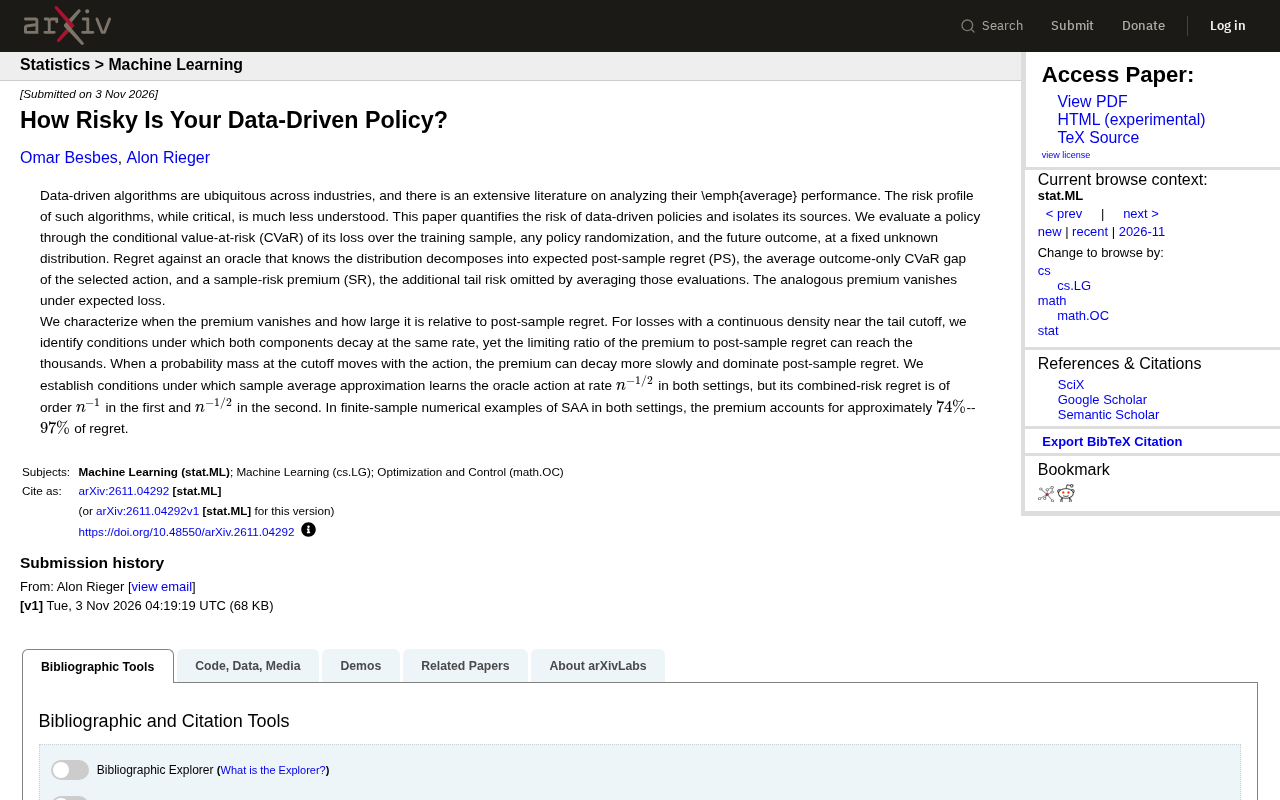
This paper uses Conditional Value-at-Risk (CVaR) to measure the tail risk of data-driven policies, decomposing regret into expected post-sample regret, outcome-only CVaR gap, and sample risk premium. The sample risk premium vanishes under the expected-loss criterion but can dominate regret under CVaR, with limiting ratios reaching thousands of times. When cutoff-point probability mass varies with the action, the premium decays more slowly, and SAA's combined risk regret order shifts from n^{-1} to n^{-1/2}. In finite samples, the premium accounts for about 74%-97% of total regret, showing that tail risk is often masked by average evaluation. Practitioners should include the sample risk premium in routine risk assessment, especially in risk-sensitive domains like finance and healthcare.
Title
Data-Driven Policy Risk: Sample Risk Premium from a CVaR Perspective
Meta Description
Paper "How Risky Is Your Data-Driven Policy?" quantifies the CVaR risk of data-driven policies, decomposing it into post-sample regret and sample risk premium. The premium can account for 74%-97% of total regret, with analysis of its vanishing conditions and learning rates.
Article Content
Data-driven algorithmic decision-making has permeated every industry, yet academia has analyzed its average performance far more than it has understood its risk profile. A recent paper, "How Risky Is Your Data-Driven Policy?" quantifies the risk of data-driven policies in depth and breaks down the sources of that risk. This article, based on the paper's core conclusions, explains its analytical framework and key findings.
A New Framework for Risk Measurement: CVaR and Regret Decomposition
Traditionally, policy evaluation tends to focus on expected loss or average performance. This study instead uses Conditional Value-at-Risk (CVaR) to characterize tail losses over training samples, policy randomization, and future outcomes. Specifically, the researchers decompose the policy's regret relative to an "oracle" that knows the true distribution, yielding three components:
- Expected post-sample regret (PS): the average performance gap of the policy on unseen data.
- Outcome-only CVaR gap: the tail-risk gap of the chosen action over the outcome distribution.
- Sample risk premium (SR): the additional tail risk ignored by averaging-based evaluation.
This decomposition reveals two independent sources of risk: first, the policy's suboptimality in the average sense; second, the "hidden cost" of tail risk.
You may not have noticed that under the expected-loss criterion, the sample risk premium vanishes; but under the CVaR criterion, it can become the dominant factor.
When Does the Sample Risk Premium Vanish? When Does It Dominate?
The paper further characterizes the conditions under which the sample risk premium vanishes, as well as its magnitude relative to post-sample regret. For loss distributions with continuous density near the tail cutoff point, the researchers find that even when the two components decay at the same rate, the limiting ratio of the sample risk premium to post-sample regret can still reach thousands of times. This means that a policy whose average performance appears near-optimal may have its tail risk severely underestimated.
When there is action-dependent probability mass at the cutoff point, the sample risk premium may decay more slowly and even dominate post-sample regret. This finding challenges the intuition that "good average performance means low risk" and suggests that practitioners need to examine tail risk separately.
Learning Rates and Finite-Sample Performance
Under both settings, sample average approximation (SAA) can learn the oracle action at a rate of (n^{-1/2}). However, the order of its combined risk regret differs: (n^{-1}) under the first setting and (n^{-1/2}) under the second. This indicates that when the probability mass at the cutoff point varies with the action, the convergence rate of SAA slows down.
Finite-sample numerical experiments further confirm the theoretical analysis: under both settings, the sample risk premium accounts for about 74% to 97% of total regret. This proportion is far higher than many practitioners would expect, indicating that in risk-sensitive scenarios, ignoring the sample risk premium can lead to serious decision-making bias.
Implications for Practitioners
This study sends a clear signal: risk assessment of data-driven policies cannot stop at average performance. Especially in domains sensitive to tail risk—such as finance, healthcare, and autonomous driving—the sample risk premium should become a standard metric in policy evaluation. Practitioners can explicitly quantify tail risk through risk measures such as CVaR and weigh average performance against risk premium during model selection.
At the same time, the paper's decomposition framework provides a tool for diagnosing the sources of risk: if the sample risk premium accounts for too high a proportion, it may be necessary to increase the sample size or improve the sampling strategy; if post-sample regret dominates, attention should be paid to the policy's generalization ability on unknown distributions.
In short, the risk of data-driven policies is not single-dimensional. The decomposition from a CVaR perspective reveals tail risk that is masked by averaging, and it deserves close attention from algorithm designers and decision-makers alike.
One-line Summary
The paper uses CVaR to decompose the risk of data-driven policies, revealing that the sample risk premium can account for 74%-97% of total regret.
Paragraph Summary
This paper uses Conditional Value-at-Risk (CVaR) to measure the tail risk of data-driven policies and decomposes regret into three parts: expected post-sample regret, outcome-only CVaR gap, and sample risk premium. The study finds that the sample risk premium vanishes under the expected-loss criterion but can dominate regret under the CVaR criterion, with limiting ratios reaching thousands of times. When the probability mass at the cutoff point varies with the action, the sample risk premium decays more slowly, and the order of SAA's combined risk regret changes from n^{-1} to n^{-1/2}. In finite-sample experiments, the sample risk premium accounts for about 74%-97% of total regret, indicating that tail risk is often masked by average-based evaluation. Practitioners should incorporate the sample risk premium into routine risk assessment, especially in risk-sensitive domains such as finance and healthcare.
Related articles

Deleted Reddit Post Sparks Debate Over AI Content Moderation
A Reddit post removed with only a 'Removed by Reddit' notice highlights AI content moderation's transparency gaps, misjudgment risks, and appeal challenges for platforms and creators.

DSH + Ollama Local LLM Deployment in Practice: Free Chat with Da Fei Yu
Bilibili creator tests DSH + Ollama local LLM deployment end to end: Ollama install, Xunlei-accelerated downloads, ModelScope GGUF model import, DSH custom API address setup, and a comparison of Qwen 3.5 4B, 8B, Gemma, and other models on 8GB VRAM, with advice on choosing local deployment vs. API calls.

Tested: A $899 Mac Mini vs. a $200/Month AI Subscription
Real-world test of whether an M4 Mac mini can replace a $200 AI subscription: 16GB can't fit large models, and both speed and quality fall short—but privacy, no caps, and near-zero running costs make it an ideal host for an always-on agent. Includes buying advice per configuration and money-saving strategies.