The Robustness Dilemma of LLM Social Agents: Context Enrichment and a Selective Robustness Framework

Study proposes controlled context enrichment and selective robustness framework to test LLM social agent behavioral stability under prompt perturbations.
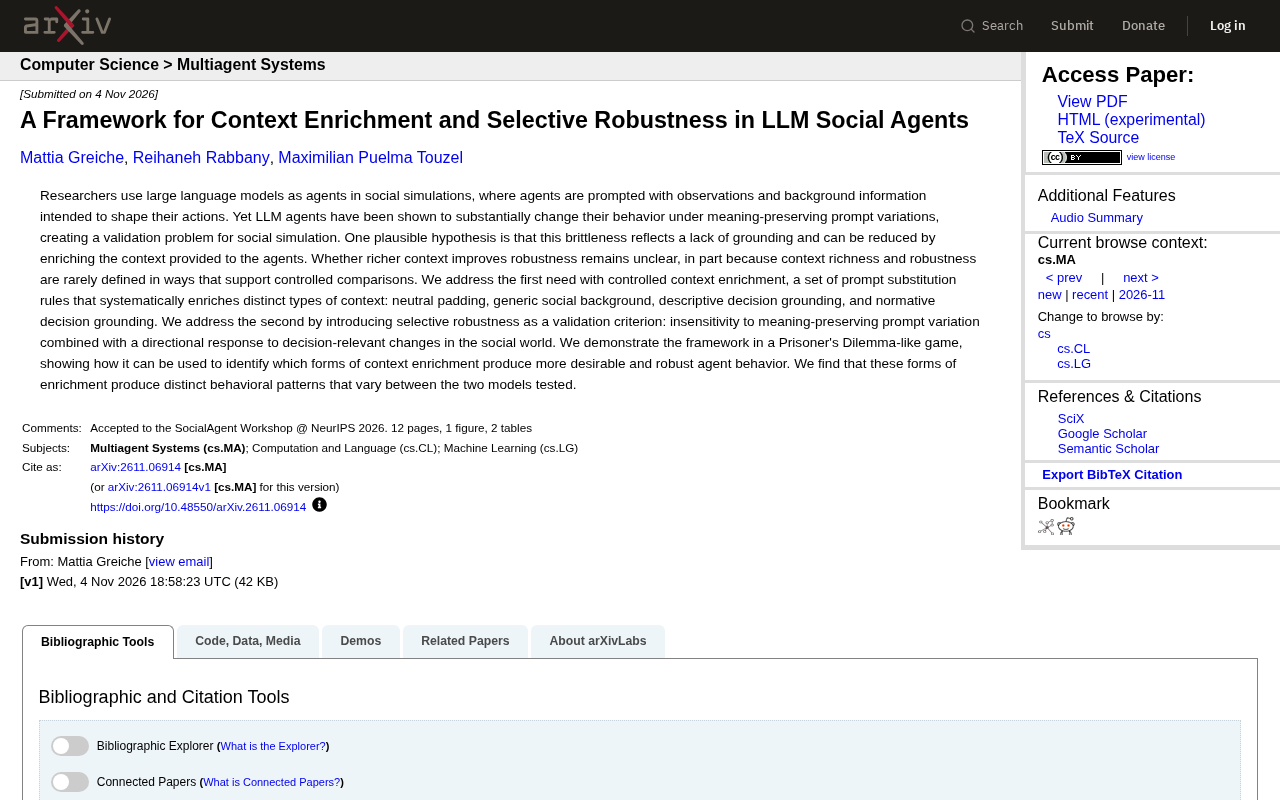
This article addresses the validation challenge of behavioral drift in LLM social simulation caused by semantically equivalent prompt variations and proposes a systematic analytical framework. Researchers design "controlled context enrichment" to decompose context injection into four levels—neutral padding, generic social background, descriptive decision grounding, and normative decision grounding—making "richer context" quantitatively comparable. They also propose "selective robustness" as a validation criterion: agents should be insensitive to semantically equivalent changes yet directionally responsive to decision-relevant changes. In Prisoner's Dilemma-like experiments, different enrichment methods produce different behavioral patterns, with effects varying by model, showing that enrichment type matters more than amount. The framework offers a reusable controlled validation process for LLM social simulation.
Large language models are increasingly being used as agents in social simulations. Researchers provide them with observations and background context, expecting this information to shape credible behavior. Yet a fundamental validation challenge remains unresolved: when prompts undergo semantically equivalent minor variations, LLM agent behavior drifts significantly. This fragility undermines the credibility of LLM-based social simulations.
A recent study proposes a systematic analytical framework that attempts to answer two interrelated questions: Can richer context improve agent robustness? And how should we define and measure such robustness?
Behavioral Drift Under Semantically Equivalent Variations: A Validation Challenge
The core requirement of social simulation is that agent behavior should reflect the social situation it inhabits, not the surface wording of a prompt. But prior research has shown that LLM agents are highly sensitive to "semantics-preserving" prompt rewrites—rephrase the prompt, and behavior can change drastically.
This is not merely an engineering instability. For work that uses social simulation as a research tool, it directly undermines the credibility of conclusions: if an agent's tendency to cooperate or defect depends on the specific wording of a prompt, then what do simulation results actually reveal—social mechanisms, or the surface preferences of a language model?
A reasonable hypothesis is that this fragility stems from insufficient contextual grounding. Agents lack enough situational information to anchor their judgments, and thus can only rely on surface cues in the prompt. If so, providing richer context to agents should alleviate the problem. But this hypothesis previously lacked a means of controlled testing.
Contextual grounding is a term in the AI and language model field referring to anchoring a model's judgments or generated content in concrete, verifiable external information, rather than relying solely on surface wording in a prompt or the model's internal priors. In social simulation, grounding means that agent behavior should arise from the social situation it inhabits—roles, relationships, norms, historical interactions, and so on—rather than from the accidental choice of an adjective in the prompt. When grounding is insufficient, the model lacks sufficient situational cues to constrain its output and can only rely on surface statistical patterns of language, so semantically equivalent rewrites may trigger behavioral drift. This concept is in line with the "grounding" tradition in natural language processing, which emphasizes that linguistic symbols need to establish correspondences with the external world or task situation in order to produce stable, interpretable behavior.
Controlled Context Enrichment: Four Types of Prompt Substitution Rules
The researchers' first contribution is proposing "controlled context enrichment"—a set of systematic prompt substitution rules for quantitatively controllable injection of different types of context.
These four types of context correspond to different levels of enrichment:
- Neutral padding: adding content unrelated to the decision, as a control baseline used to isolate the effect of "increased information volume" itself;
- Generic social background: providing generalized social situation descriptions that do not directly point to the decision;
- Descriptive decision grounding: providing descriptive information directly relevant to the current decision;
- Normative decision grounding: further introducing normative behavioral expectations or social norm information.
The value of this layered design lies in decomposing the vague notion of "richer context" into operational, comparable variables. Researchers can observe whether it is the increase in information volume, the introduction of social background, or the injection of decision relevance and normativity that affects the stability of agent behavior.
Selective Robustness: A New Validation Criterion
Enrichment methods alone are not enough; a criterion for measuring "good" robustness is also needed. The researchers' second contribution is proposing "selective robustness" as a validation criterion—it includes requirements in two directions.
First, agents should be insensitive to semantically invariant prompt variations. This is the traditional meaning of robustness: change the wording, and behavior should not change accordingly.
Second, agents should respond directionally to decision-relevant changes in the social world. This is the key to "selective": robustness is not rigidity. If an agent is indifferent to all changes, it is equally not a good social simulator—it has simply lost responsiveness. An ideal agent needs to remain stable in the face of irrelevant changes and make reasonable adjustments in the face of relevant ones.
This dual standard elevates robustness from a single "insensitivity" to "selective insensitivity," providing a criterion for evaluating social simulation agents that better fits practical needs.
Prisoner's Dilemma Experiment: Different Enrichment Methods Produce Different Behavioral Patterns
The researchers demonstrated the practical use of this framework in a Prisoner's Dilemma-like game, showing how it can be used to identify which forms of context enrichment produce more desirable and robust agent behavior.
The core finding of the experiment is that the above types of context enrichment give rise to distinct behavioral patterns, and these patterns differ between the two models tested. In other words, the effects of enrichment methods are not universally consistent but are model-specific.
The significance of this result is twofold. First, it shows that "more context" does not automatically equal "better behavior"—the type of enrichment matters more than the amount. Second, differences across models suggest that context enrichment strategies need to be calibrated for specific models rather than applying a one-size-fits-all recipe.
The paper does not offer a simple conclusion about which enrichment method is optimal in all situations; the value of the framework lies precisely in providing a reusable methodology: define enrichment types, set selective robustness criteria, and compare behavioral responses of different models under controlled conditions.
The Prisoner's Dilemma is a classic model in game theory: two players each choose to cooperate or defect. If both cooperate, each receives a moderate payoff; if one defects while the other cooperates, the defector receives the highest payoff and the cooperator the lowest; if both defect, each receives a lower payoff. Its core tension is that individual rationality (defection) leads to collectively suboptimal outcomes. In social simulation research, the Prisoner's Dilemma is often used as a standardized scenario for testing agents' cooperative tendencies, because the choice between cooperation and defection directly reflects agents' sensitivity to social situations. This study adopts a "Prisoner's Dilemma-like" game precisely because it allows clear observation under controlled conditions of whether agent behavior changes systematically with context enrichment, thereby testing the effectiveness of the selective robustness framework.
Methodological Implications for Social Simulation Research
This work touches on a long-neglected methodological gap in LLM social simulation. Prior research has often focused on whether agents can produce "seemingly reasonable" behavior, but has rarely systematically tested whether this reasonableness remains stable under prompt perturbations.
The selective robustness framework offers a more rigorous validation approach: it requires researchers to distinguish "irrelevant changes" from "relevant changes" and separately test whether agents' responses are appropriate. This is both a check on the credibility of simulation results and a clarification of the design goals for agents—a good social agent should be neither a weathervane that sways with every wind nor a stone that is impervious to all influence.
For researchers using LLMs for social simulation, this framework can be directly incorporated as part of the validation process: before reporting simulation results, first test the selective robustness of agents under controlled context enrichment. This may serve as a pragmatic starting point for improving the reproducibility and persuasiveness of research in this field.
One-line Summary
This study proposes a controlled context enrichment and selective robustness framework to systematically test the behavioral stability of LLM social agents under prompt perturbations.
Paragraph Summary
This article addresses the validation challenge of behavioral drift in LLM social simulation caused by semantically equivalent prompt variations and proposes a systematic analytical framework. The researchers first design a "controlled context enrichment" method that decomposes context injection into four levels: neutral padding, generic social background, descriptive decision grounding, and normative decision grounding, making "richer context" a quantitatively comparable variable. Second, they propose "selective robustness" as a validation criterion, requiring agents to be both insensitive to semantically equivalent changes and directionally responsive to decision-relevant changes. In a Prisoner's Dilemma-like experiment, different enrichment methods produce different behavioral patterns, and effects vary by model, indicating that the type of enrichment matters more than the amount. The framework provides a reusable controlled validation process for LLM social simulation.
Related articles
 Tech Frontiers
Stylome Bot Slammed as Useless Junk: Why Do AI Detection Tools Keep Failing?
Reddit users test the Stylome AI detection bot: Gemini-rewritten text judged human-written, consistently low confidence. An analysis of AI text detection's technical dilemmas, privacy concerns, and credibility crisis in community governance.
 Tech Frontiers
When AI Becomes a Productivity Divide: Clarity or "AI Psychosis"?
A civil engineer's deep use of agentic AI boosted efficiency but bred contempt for peers who refuse to learn. Is this clarity or AI psychosis? An analysis of the cognitive and psychological challenges behind the AI productivity divide.
 Tech Frontiers
Opus 5.5 Benchmark Scores Climb, Community Says Its "Weights Are Blessed"
Reddit community discusses Opus 5.5's rising scores on the Benchmaxxing Bench, with users describing its performance as "weights are blessed." This article interprets the community reaction and cautions against conflating benchmark scores with real capability.