The Schrödinger Equation Explained Intuitively: The Physical Intuition Behind the Wave Function

An intuitive guide to the Schrödinger equation, from wave function basics to quantum computing implications.
This article re-examines the Schrödinger equation from a physical intuition perspective, explaining how the wave function ψ encodes probability rather than certainty, why the imaginary unit i ensures oscillation over decay, and how visualization tools like 3Blue1Brown's Manim are making quantum mechanics accessible. It connects these foundations to quantum computing and argues that intuition-first teaching is the key to demystifying complex concepts.
Introduction: A Misunderstood Equation
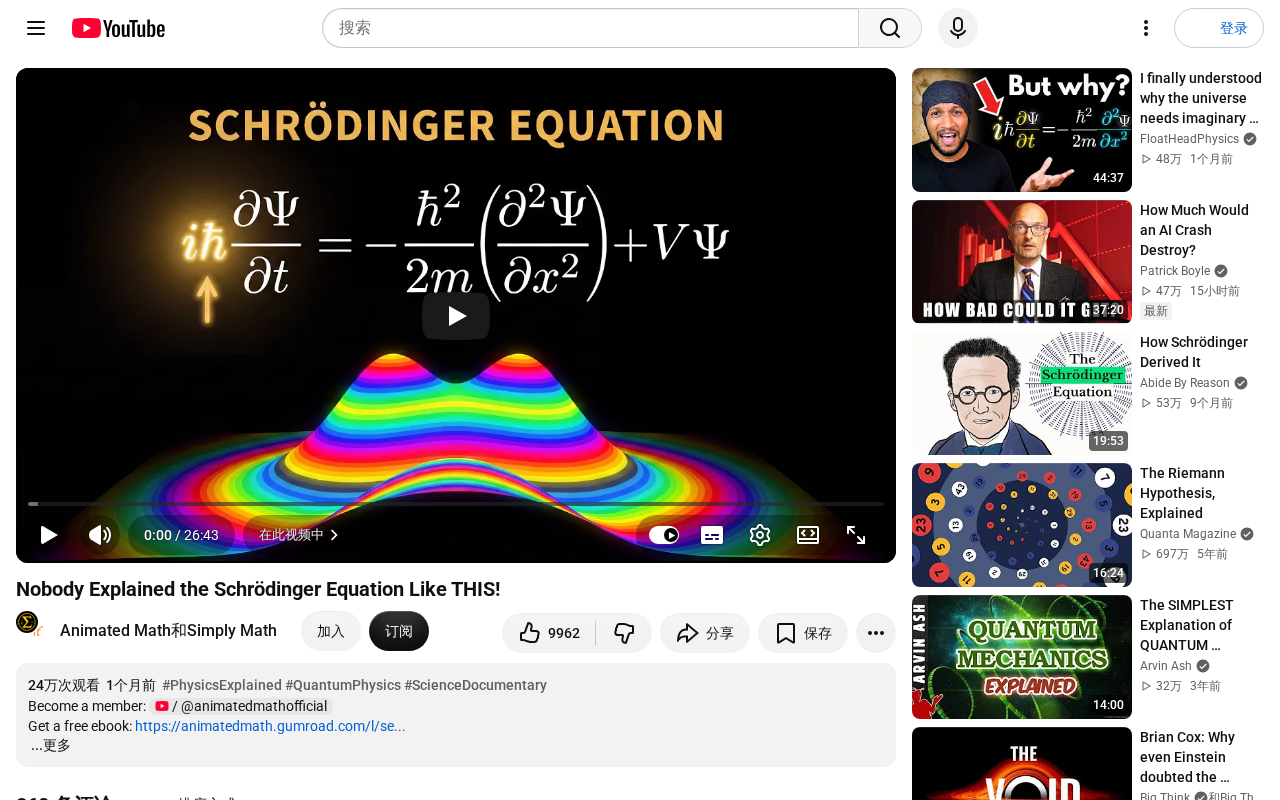
The Schrödinger Equation is often regarded as one of the most intimidating formulas in quantum mechanics. Recently, a video that sparked heated discussion on Hacker News attempted to explain this equation in a completely new way, with a title boldly claiming "No one has ever explained the Schrödinger equation like this before." This reminds us that the difficulty of many classical physics concepts often lies not in the mathematics itself, but in the lack of deep exploration of the underlying physical intuition.
This article will re-examine the meaning of the Schrödinger equation from an intuitive perspective, why it matters so much, and why a good explanation can fundamentally transform a learner's understanding.
What Does the Schrödinger Equation Actually Describe?
From Classical Waves to Quantum Wave Functions
At the core of the Schrödinger equation is the wave function ψ (psi). Unlike classical physics, which describes particles with definite positions and velocities, the state of a quantum system is completely characterized by its wave function. The wave function itself does not directly correspond to an observable quantity—instead, the square of its modulus |ψ|² gives the probability density of finding a particle at a particular location.
This probabilistic interpretation of the wave function was proposed by Max Born in 1926, a contribution that earned him the 1954 Nobel Prize in Physics. Before this, Schrödinger himself had tried to interpret the wave function as a distribution of charge density, but this interpretation proved inconsistent in multi-particle scenarios. Born's probabilistic interpretation means that quantum mechanics is fundamentally a statistical theory—even with complete knowledge of a system's wave function, we can only predict the probability distribution of measurement outcomes, not deterministic results. This stood in sharp opposition to Einstein's philosophical stance that "God does not play dice," and sparked the long-running debate over the interpretation of quantum mechanics.
This is precisely what makes the Schrödinger equation counterintuitive: it doesn't tell you where a particle "is," but rather where it "might be," and how that possibility evolves over time. The time-dependent Schrödinger equation is essentially a partial differential equation describing how the wave function changes over time. Its structure shares similarities with both the wave equation and the diffusion equation, but the introduction of the imaginary unit i gives its solutions oscillatory, wave-like characteristics.
Mathematically, the time-dependent Schrödinger equation takes the form iℏ∂ψ/∂t = Ĥψ, where ℏ is the reduced Planck constant and Ĥ is the Hamiltonian operator. The presence of the imaginary unit i is one of the equation's most distinctive features—it ensures that solutions oscillate rather than decay, thereby guaranteeing conservation of probability. By contrast, the heat diffusion equation ∂u/∂t = α∇²u has no imaginary unit, and its solutions tend toward a uniform distribution over time. The Schrödinger equation involves a first-order time derivative (like the diffusion equation) rather than a second-order time derivative (unlike the classical wave equation), meaning that given an initial wave function, the future evolution is uniquely determined without requiring additional initial velocity conditions.
Why Intuitive Explanations of the Schrödinger Equation Are So Rare
Traditional teaching often jumps straight into complex operators and eigenvalue problems, trapping learners in mathematical manipulations while neglecting the physical picture. In the mathematical framework of quantum mechanics, all observable physical quantities (such as position, momentum, and energy) correspond to linear Hermitian operators. The eigenvalue equation Âψ = aψ has a physical meaning: when a system is in an eigenstate ψ of operator Â, measuring that physical quantity will necessarily yield the definite value a. This formalized system originated from Dirac and von Neumann's axiomatic reconstruction of quantum mechanics in the 1930s. The problem is that while this highly abstract mathematical language is logically complete and elegant, it often obscures physical intuition for beginners—students can calculate the energy levels of a hydrogen atom but cannot articulate what the electron is actually "doing."
Excellent science communication videos stand out precisely because they start from physical motivation—first explaining why we need such an equation, then introducing the mathematical formalism, rather than the other way around.
How Visual Science Communication Is Reshaping Quantum Mechanics Understanding
The Power of Wave Function Visualization
The abstract nature of quantum mechanics makes it an ideal subject for visual teaching. When wave functions are presented as dynamic images—such as wave packets bouncing back and forth in a potential well, or probability leaking through a barrier during tunneling—learners can intuitively grasp the behavior of the equation's solutions. This kind of "visible" understanding is far more durable than rote memorization of formulas.
Quantum Tunneling is one of the most counterintuitive predictions of the Schrödinger equation, and also one of the most impactful cases in visual teaching: a particle can pass through a potential barrier that classical physics deems impassable. This isn't because the particle "gains extra energy," but because the wave function decays exponentially inside the barrier without reaching zero, leaving a non-zero probability amplitude on the other side. Tunneling has widespread applications in modern technology—scanning tunneling microscopes (STM) use electron tunneling current to image atomic-scale surface structures, flash memory chips use Fowler-Nordheim tunneling for data writing and erasing, and nuclear fusion reactions in the sun's core can occur at "too low" temperatures thanks to quantum tunneling of protons.
A group of science communicators, exemplified by 3Blue1Brown, has proven that through carefully designed animations and step-by-step derivations, even graduate-level physics concepts can be understood by a broad audience. 3Blue1Brown was founded by Grant Sanderson in 2015 as a mathematics education channel, with its self-developed open-source animation engine Manim as its core tool. Manim uses Python programming to generate precise mathematical animations and has been adopted by hundreds of educators worldwide. This "programmable animation" methodology represents an important direction in educational technology: by transforming abstract mathematical objects into continuous visual transformation sequences, it leverages the human visual system's natural sensitivity to motion and change to convey mathematical structures. Similar projects include channels like Veritasium and MinutePhysics, which together form a thriving STEM science communication ecosystem on YouTube.
The sustained attention from the Hacker News community toward this type of content reflects a strong demand among technology professionals for high-quality, in-depth science communication.
From Formula to Physical Meaning: Understanding Every Term in the Schrödinger Equation
Truly excellent explanations answer several key questions:
- What physical quantity does each term represent?
- How do the kinetic energy and potential energy terms compete?
- Why is the normalization condition so important?
When these questions are addressed one by one, the Schrödinger equation transforms from a pile of symbols into a clear picture of how the microscopic world operates. Specifically, the kinetic energy term (proportional to the second spatial derivative of the wave function) reflects the "curvature" of the wave function—the greater the curvature, the higher the corresponding kinetic energy. The potential energy term describes the constraints imposed on the particle by its external environment. The competition between these two terms determines the specific shape of the wave function: at the bottom of a potential well, the wave function extends smoothly, while in barrier regions it decays sharply.
Implications for Quantum Computing and Technology Communication
Quantum Intuition Is the Foundation of Quantum Computing
With the rapid development of quantum computing, understanding the fundamentals of quantum mechanics has become more practical than ever. The superposition and entanglement of qubits, and the operation of quantum algorithms, are all rooted in the principles described by wave functions and the Schrödinger equation. For engineers hoping to enter the quantum computing field, building solid physical intuition is an indispensable first step.
The state of a qubit can be represented as |ψ⟩ = α|0⟩ + β|1⟩, where α and β are complex amplitudes satisfying |α|²+|β|²=1. This is a direct manifestation of the superposition principle described by the Schrödinger equation. The core advantages of quantum computing come from two aspects: first, n qubits can simultaneously exist in a superposition of 2ⁿ basis states, forming an exponential state space; second, quantum entanglement creates correlations between multiple qubits that classical bits cannot simulate. Shor's factoring algorithm and Grover's search algorithm exploit wave function interference to amplify the probability amplitudes of correct answers while suppressing those of incorrect answers, thereby achieving speedups beyond classical computers. Understanding how these algorithms work is essentially understanding how the Schrödinger equation controls the evolution of probability amplitudes.
Methodology for Effective Communication of Complex Concepts
The viral success of this video also offers methodological insights for technology communicators: whether it's backpropagation in deep learning or the attention mechanism in Transformers, effective communication of complex concepts follows the same principle—build intuition first, then introduce formalism, supplemented by visualization. This "intuition-first" teaching philosophy is becoming the dominant paradigm in technology education.
Conclusion
The difficulty of the Schrödinger equation is largely a matter of how it's explained, not the concept itself. When we start from physical intuition and pair it with appropriate visualization tools, even the core equations of quantum mechanics can become accessible. This is meaningful not only for physics learners but also sets a worthy example for the entire field of technology communication.
For anyone hoping to deeply understand cutting-edge science and technology, seeking out those "no one has ever explained it like this" pieces of quality content is often the key to opening the door to a new world.
Related articles

Uber Deploys ChatGPT Work Company-Wide: AI in the Workplace Enters the Scaled Implementation Phase
Uber deploys ChatGPT Work to 30,000+ employees, extending it from engineering to all roles. We analyze its expert-engineer pairing, end-to-end automation, and questions of AI control and power concentration—insights for scaling AI in the workplace.

Shift at Midnight Hands-On: When "ID Verification" Becomes Alien Hunting
Shift at Midnight blends ID verification with horror survival in a four-player co-op game. We break down its inspection mechanics and chaotic humor.

Zelensky Recounts the Outbreak of War: I Need Ammunition, Not a Ride
Zelensky recalls the first day of war in a YouTube interview: farewell to family, rejecting Biden's evacuation offer with "I need ammunition, not a ride," and how Bucha shaped his stance on compromise and peace talks.