The Security Nightmare of Cheap Smart Cameras: A Firmware Backdoor Intrusion Story
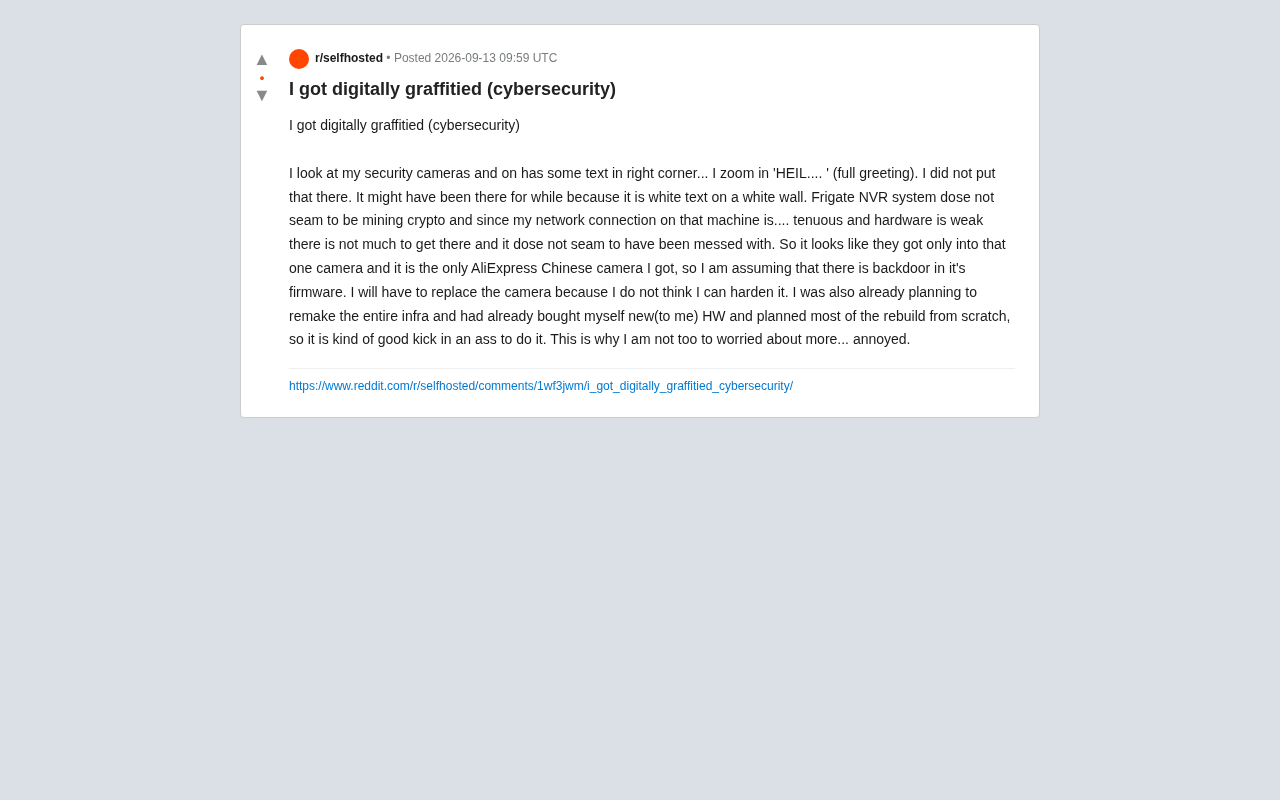
A cheap AliExpress camera was backdoored, letting attackers overlay Nazi text via OSD — a stark reminder to isolate IoT devices.
A Reddit user discovered Nazi-style greeting text silently overlaid on their security camera footage, traced to a suspected firmware backdoor in a single cheap AliExpress camera — while the NVR host remained untouched due to its weak network connection accidentally acting as isolation. The article highlights how budget IoT cameras commonly ship with open debug interfaces, hardcoded credentials, and vendor backdoors, making them easy targets for automated scanners. The key lessons: treat IoT devices as untrusted by default, segment them onto dedicated VLANs, replace rather than patch compromised firmware-level devices, and routinely audit footage and logs for subtle signs of intrusion.
An AliExpress Camera's "Digital Graffiti" Incident
A Reddit user recently made an unsettling discovery while reviewing footage from their home security camera: a line of text had appeared in the upper-right corner of the frame — text they had never added themselves. Zooming in revealed it was a Nazi-style "HEIL..." greeting. Because the white text was overlaid against a white wall, it blended almost seamlessly into the background, meaning it had likely been lurking in the footage for quite some time before anyone noticed.
The user coined this kind of intrusion "digitally graffitied" — the attacker hadn't stolen data or demanded a ransom, but instead left their mark on someone else's "digital wall," much like a street graffiti artist. What looks like a prank on the surface actually exposes a pervasive security vulnerability in cheap IoT devices.
The Root Cause: A Suspected Firmware Backdoor
What's particularly notable is how the user traced the intrusion vector. They were running Frigate NVR, an open-source local network video recorder, and after investigation confirmed:
- Frigate itself had not been compromised or infected with a crypto miner;
- The machine running the system had a "tenuous" network connection and weak hardware, making it of little value to an attacker;
- The host machine appeared to be untouched.
In other words, the attacker hadn't taken over the whole network or the NVR host — they had only compromised a single camera. And that camera happened to be the one and only cheap Chinese-made unit sourced from AliExpress. Based on this process of elimination, the user concluded the problem almost certainly pointed to a firmware backdoor in that specific device.
This kind of finding is hardly surprising in the IoT security world. Many low-cost IP cameras cut corners by using generic firmware of dubious origin, leaving debug interfaces open, hardcoding default credentials, and even including vendor-side remote access channels. Once connected to the internet, these devices can be discovered and taken over en masse by automated scanning tools. Overlaying text on camera footage is typically done through the device's built-in OSD (On-Screen Display) function — which means the attacker had obtained a relatively high level of control over the device.
Why "Replacing" Often Beats "Hardening"
Faced with this compromised camera, the user's conclusion was straightforward: replace it, don't try to harden it. This might seem like an abrupt call, but it aligns perfectly with sound security practice.
When the problem is rooted in the firmware itself, ordinary users have almost no effective remediation options. You can't audit a closed-source firmware to see what's been planted inside, and vendors rarely push timely security updates for budget devices. Even if you change the default password and reboot the device, any backdoor channels may still be intact. For this class of device, attempting to "patch" things is largely futile — physical isolation or outright replacement is the more reliable path.
Network Isolation: The First Line of Defense for IoT Security
This incident also reinforces a principle that gets repeated constantly: never put untrusted IoT devices on the same network segment as your primary network.
The ideal approach is to place smart cameras, sensors, and other IoT devices on a dedicated VLAN or guest network, blocking them from initiating outbound internet connections and only allowing the NVR system to pull video streams inward over the local network. The reason the user's NVR host wasn't further compromised was, ironically, that its "tenuous" network connection accidentally served as an isolation mechanism — a reminder that network segmentation often only reveals its value after something goes wrong.
From "Getting Graffitied" to Rebuilding: A Silver Lining
Interestingly, the user's reaction was more annoyance than alarm. That's because they had already been planning to rebuild their entire infrastructure from scratch, having purchased new (secondhand) hardware and mapped out most of the plan. The intrusion turned out to be the nudge that finally pushed them to get it done.
This mindset is worth adopting. Security incidents are unpleasant, but if an attacker only left behind a line of text without causing any real damage, it amounts to a very low-cost "security drill" — one that pinpointed the weakest link in the system and provided a clear direction for improvement.
For anyone building a home security or smart home system, this case offers several practical takeaways:
- Be selective about the source of connected devices, and be especially wary of no-brand, ultra-cheap cameras that come with no firmware update commitment;
- Treat IoT devices as untrusted by default, and isolate them through network segmentation;
- When a compromise is discovered, prioritize replacing rather than patching devices with firmware-level issues;
- Regularly review device footage and logs — subtle signs like white text on a white wall can go undetected for a long time.
A line of text silently appearing in security camera footage might look like a harmless prank, but it's a real-world wake-up call about IoT security. Nothing was stolen — but it made one thing unmistakably clear: someone could get in.
Related articles

Can 'Your Mother' Make Us Forget Marvel's Blade Disaster?
Marvel's Blade reboot starring Mahershala Ali collapsed due to mismanagement. We explore why its failure may not be the worst outcome — and what 'Your Mother' has to do with it.
SHIUI: A Minimalist Ink-Wash UI Kit Inspired by Japanese Hinomaru Aesthetics
SHIUI is a flat ink-wash Web UI kit inspired by Japanese Hinomaru poster aesthetics, built around paper, sumi ink, and vermilion with zero shadows. A design breakdown.

Kirokune: An iPhone Work Incident Logger That Requires No Account
Kirokune is an iPhone app for logging workplace incidents — no account required. Combines text, audio, and photos in a timeline. Ranked #9 on Product Hunt with 86 votes.