The Silent Trap in LangGraph Interrupt Recovery: Why Wrong Answers Get Swallowed
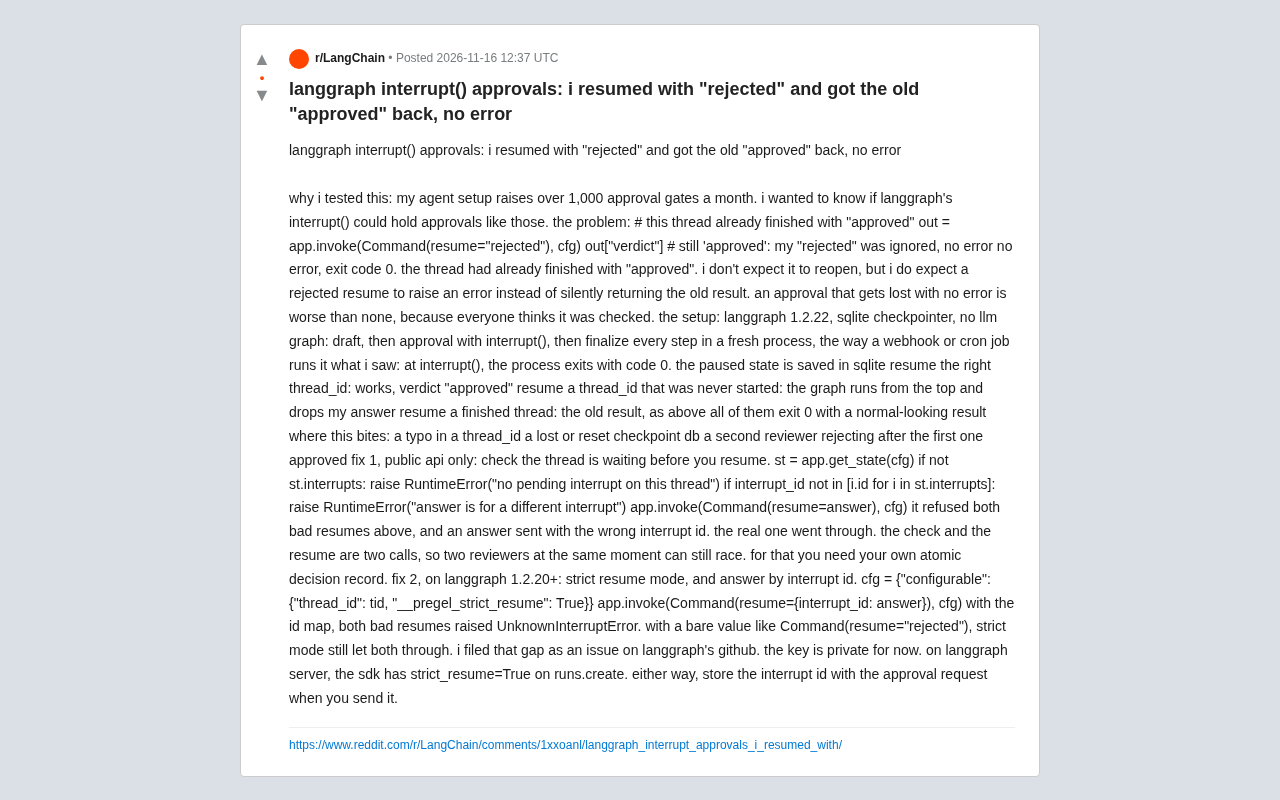
LangGraph's interrupt() silently returns old results on erroneous resumes, requiring explicit validation of thread state and interrupt id.
The article documents a silent failure in LangGraph approval workflows: resuming an already-ended thread with a new value raises no error, exits with code 0, yet returns the old result. Using langgraph 1.2.22 and sqlite checkpointer, the author reproduces three silent paths and highlights risks like misspelled thread_ids, lost checkpoints, and sequential dual approvals. Two fixes are offered: validate get_state().interrupts and match interrupt_id before resuming, or enable __pregel_strict_resume with answer-by-id (which still has a gap for bare values). The core takeaway: don't treat "no error" as "successfully processed"—add explicit validation and an atomic decision log at the application layer.
When Approvals Are Silently Swallowed: A Real-World Discovery in a High-Concurrency Scenario
A developer who processes over 1,000 approval nodes per month chose LangGraph's interrupt() to build an approval workflow. During testing, he tried to resume execution on a thread that had already ended with "approved" and passed in "rejected" as the resume value. The result was surprising: the old "approved" result was returned, no error was raised, and the exit code was 0.
This phenomenon reveals an easily overlooked problem: in your approval workflow, a lost approval decision may not trigger any exception at all—instead, it silently returns the old result. This is more dangerous than a direct error, because both upstream and downstream systems will assume the approval was handled correctly.
Reproducing the Problem: Three Silent Failure Paths
The developer used langgraph version 1.2.22 with a sqlite checkpointer to build a minimal graph: draft -> approval (with interrupt()) -> finalize. Each step ran in a new process to simulate triggers from webhooks or cron jobs.
The test results exposed three silent failure paths:
- At
interrupt(), the process exits with code 0, and the paused state is written to sqlite. - Resuming with the correct thread_id works as expected, returning "approved".
- Resuming with a thread_id that was never started causes the graph to run from the beginning and discard the passed-in answer.
- Resuming with a thread_id that has already ended returns the old result, as described at the beginning.
All these scenarios return exit code 0 and produce results that look normal. This means the caller has no way to determine from the return value or error code whether the resume operation actually took effect.
Real-World Business Risks
This silent behavior directly causes business problems in several situations: misspelled thread_ids, lost or reset checkpoint databases, and two approvers acting in sequence (the first approves, then the second rejects but is ignored). The last case is especially typical—the system retains the first approval result, and the second person's decision leaves no trace.
LangGraph's checkpointer mechanism: LangGraph persists the graph's execution state as checkpoints to external storage (such as sqlite, Postgres, Redis). Each checkpoint is bound to a thread_id and records the node position, channel values, and pending interrupts for that thread at that moment. interrupt() essentially throws an internal signal within the current node; the graph engine catches it, writes the paused state to the checkpointer, and then the process can exit normally. On resume, the engine finds the most recent checkpoint by thread_id and continues from that point. The problem is that when the thread_id does not exist or the thread has already reached END, the engine does not throw an exception—instead, it defaults to either "create a new thread" or "reuse the terminal checkpoint." This is the root cause of the silent failures. Understanding that a checkpoint is a "state snapshot + pointer" rather than a "transaction log" helps clarify why the old result is returned as-is.
Fix 1: Check Thread State Before Resuming
A solution using only public APIs is to check whether the thread is actually in a waiting state before resuming.
st = app.get_state(cfg)
if not st.interrupts:
    raise RuntimeError("no pending interrupt on this thread")
if interrupt_id not in [i.id for i in st.interrupts]:
    raise RuntimeError("answer is for a different interrupt")
app.invoke(Command(resume=answer), cfg)
This check rejects two kinds of erroneous resume requests: the thread has no pending interrupts, and the answer corresponds to a mismatched interrupt id. Correct resume requests pass through normally.
However, this solution has an inherent limitation: checking and resuming are two separate calls, so a race condition can still occur when two approvers act simultaneously. To solve this, you need to maintain your own atomic decision record.
get_state() and the interrupts field: app.get_state(cfg) returns a StateSnapshot object, in which interrupts is a tuple listing all unanswered interrupts on the current checkpoint. Each element has a unique id (i.e., interrupt_id), a value (the payload passed to interrupt()), and a resumable flag. When the thread has not started or has already ended, interrupts is an empty tuple, so if not st.interrupts accurately distinguishes between "there is a pending approval" and "there is none." Note that get_state() reads the most recently persisted snapshot, which itself is not atomic under concurrent writes. Therefore, Fix 1 can only intercept "obviously wrong" resumes and cannot completely eliminate races—this is also why the author recommends layering an application-level atomic decision log on top.
Fix 2: Strict Resume Mode and Answering by ID
Starting from langgraph 1.2.20+, a strict resume mode is available. Configure it as follows:
cfg = {"configurable": {"thread_id": tid, "__pregel_strict_resume": True}}
app.invoke(Command(resume={interrupt_id: answer}), cfg)
When using the resume-by-interrupt_id-map approach, both kinds of erroneous resume requests raise UnknownInterruptError. But the developer found a gap: if a bare value is passed, such as Command(resume="rejected"), strict mode still lets both erroneous requests through. He has filed an issue on langgraph's GitHub about this.
Currently, __pregel_strict_resume is a private configuration key. On LangGraph Server, the SDK's runs.create provides a strict_resume=True parameter. Regardless of which solution is used, the key practice is: store the interrupt id when issuing the approval request, and use that id for matching when resuming.
The two payload forms of Command(resume=...): Command is the object in LangGraph used to inject control instructions into the graph, and the resume parameter determines how to answer an interrupt. When a bare value (such as "rejected") is passed, the engine treats it as "answer the only interrupt at the current position" without verifying identity, so even if the interrupt has already ended or never existed, the value is silently discarded. When a dictionary {interrupt_id: answer} is passed, the engine precisely matches pending interrupts by id, and unmatched keys trigger UnknownInterruptError in strict mode. This "answer by id" design resembles a message queue's ack mechanism: only acknowledgments carrying the correct receipt handle are accepted, turning "resume" from a blind write into a verifiable, targeted operation. __pregel_strict_resume is a double-underscore private key whose semantics may change across versions; in production, watch whether it becomes a public configuration or is uniformly carried by the Server-side strict_resume parameter.
Implications for Building Highly Reliable Approval Workflows
The value of this case lies not in the specific behavior of a particular langgraph version, but in the general hidden pitfall it exposes in asynchronous approval systems: the illusion of "idempotency" in resume operations. The system appears to accept all inputs, but actually processes only some of them.
For systems processing thousands of approval nodes per month, it is recommended to add explicit state validation at the application layer and record an atomic log of every approval decision. Do not equate "no error" with "successfully processed"—in approval scenarios, silently ignoring a rejection can cause greater business losses than a direct crash.
One-line Summary
LangGraph's interrupt() silently returns old results on erroneous resumes, requiring explicit validation of thread state and interrupt id.
Paragraph Summary
The article documents a silent failure problem a developer discovered while building a high-concurrency approval workflow with LangGraph: when passing a new resume value to an already-ended thread, the system raises no error, exits with code 0, yet returns the old approval result. Using langgraph 1.2.22 and a sqlite checkpointer, the author reproduces three silent paths—thread never started, thread already ended, and resume value discarded—and points out real business risks such as misspelled thread_ids, lost checkpoints, and two-person sequential approvals. Two fix routes are offered: validate state with get_state().interrupts and match interrupt_id before resuming, or enable __pregel_strict_resume strict mode with answer-by-id; the latter still has a gap for bare values. The core conclusion is not to treat "no error" as "successfully processed," and to add explicit validation and an atomic decision log at the application layer.
Related articles

Michael Nielsen Takes Down His Classic Neural Network Textbook, Sparking Community Discussion
Michael Nielsen's classic free textbook Neural Networks and Deep Learning has been taken offline, sparking discussion on Hacker News about the reasons and impact.

Inside the AI Training Data Market: The Trade-off Between Exclusivity and Discounts
G2i founder Gabe Greenberg reveals the dual-track pricing of the AI training data market: labs pay a premium for exclusive data or accept discounts that allow others to buy it.

SessionGraph: Unifying All Coding Agent Sessions in One Interactive Graph
SessionGraph aggregates coding agent sessions into an interactive graph, helping developers review, debug, and manage AI coding workflows across sessions. This article examines its positioning, value, and open questions.