The Softmax Defect Warning: How Lean Formal Verification Can Rescue Expensive Software
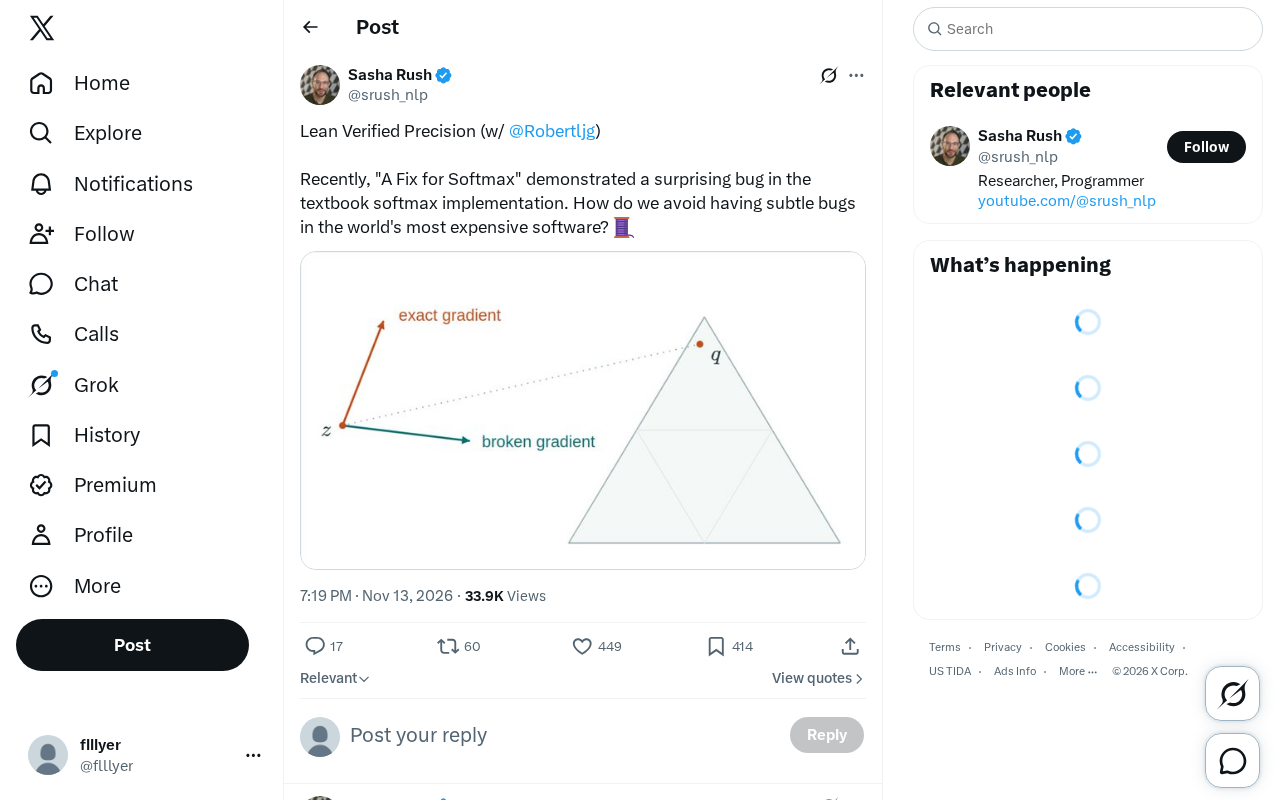
Textbook Softmax implementations contain hidden defects; Lean formal verification provides machine-checkable correctness contracts for AI foundational operators.
Starting from the textbook-level Softmax implementation defect revealed by "A Fix for Softmax," the article notes that hidden errors in foundational operators are amplified along the software stack and are hard for conventional tests to catch. It discusses Lean, an interactive theorem prover that can encode Softmax's mathematical semantics and floating-point error bounds as machine-checkable theorems, offering guarantees testing cannot provide. Formal verification does not pursue complete floating-point exactness but turns allowed error into explicit contracts. Challenges include modeling numerical stabilization tricks, tedious floating-point proofs, and engineering integration. The conclusion is that starting with clearly defined, widely impactful operators is a cost-effective path to improving AI engineering reliability.
AI researchers recently discovered a surprising flaw in a classic Softmax implementation, a finding that comes from work titled "A Fix for Softmax." This defect is not a corner case of floating-point error, but a easily overlooked logical oversight in a textbook-level implementation. When the world's most expensive software—from large-model training frameworks to autonomous-driving perception modules—reuses such foundational components, a subtle bug can bring cascading costs and risks. The discussion between Twitter users and @Robertljg turns the focus to Lean: using formal verification to establish machine-checkable correctness proofs for core numerical operators may be a realistic path to avoiding "cheap errors in expensive software."
The Softmax Defect Exposes a Crack in Trust in Numerical Computation
Softmax is one of the most common normalization functions in deep learning, appearing in almost every classification network and attention mechanism. Precisely because it is so fundamental, the community has long assumed its implementation is "obviously correct." However, "A Fix for Softmax" points out that the textbook-style implementation contains an inconspicuous but substantively impactful bug. Such problems are dangerous because they are not easily caught by conventional unit tests: test cases often cover typical inputs, while the defect may only manifest under extreme distributions or specific boundary conditions.
More critically, errors in foundational operators propagate downstream through the software stack. The training stability of upper-layer models, inference consistency, and even behavior in safety-critical scenarios may deviate from expectations as a result. When the cost of software is measured in compute, data, and engineering labor, the cost of a hidden defect in a low-level operator is amplified across the entire technology stack.
Why Formal Verification Is Back in the Spotlight
Traditional software engineering relies on testing, code review, and fuzzing to improve reliability, but these methods can only provide evidence that "no errors have been found"; they cannot guarantee that "no errors of a certain kind exist." Formal verification takes a different path: it describes the expected behavior of a program with mathematical propositions, then uses machine-assisted proof tools to verify that the implementation satisfies those propositions.
Lean is an interactive theorem prover that has attracted attention in this line of work in recent years. It is both a dependently typed programming language and a proof assistant, allowing developers to write the correctness of an algorithm as theorems and prove them step by step. For operators like Softmax with clear mathematical definitions, the entry point for formal verification is quite natural: first formalize the semantics of Softmax over the real numbers, then prove the error bound between the concrete implementation (including floating-point approximation) and the semantics.
It is worth emphasizing that formal verification is not equivalent to "proving that a floating-point implementation is completely exact"—that is usually false under finite precision. Its value lies in turning the "allowed error range" into a provable contract, making implementation-level trade-offs explicit and auditable.
Dependent types and the Curry-Howard correspondence are key to understanding why Lean can "prove" program properties. In a dependently typed language, types can carry information about values (for example, "a vector of length n"), and propositions can be encoded as types: proving a proposition is equivalent to constructing a term of that type. This correspondence makes it possible to write programs and write proofs within the same language, and the proof checker kernel only needs to check whether the type is correct, thereby guaranteeing the reliability of proofs. Lean's theorem-proving capability is built on this foundation, making "the implementation satisfies the specification" a machine-checkable fact rather than a human argument.
Floating-point error-bound proofs usually involve analysis of accumulated rounding error under IEEE 754 semantics. Unlike real-number arithmetic, floating-point addition is not associative, and each operation may introduce relative error. Formal proofs need to explicitly track upper bounds on these errors and derive them using lemmas such as "unit roundoff." The exponential operations and division in Softmax further amplify the complexity of the analysis, so practical verification often needs to combine interval arithmetic or error-propagation frameworks—one reason this path has high engineering costs.
Key Challenges in Bringing Lean Verification into Engineering Practice
Introducing Lean into real software stacks is not frictionless. The first barrier is semantic modeling: Softmax's mathematical definition is concise, but industrial implementations often include numerical stabilization tricks (such as subtracting the maximum), which change the computation path without changing the mathematical semantics; verification needs to characterize both at the same time.
The second barrier is floating-point arithmetic. Floating-point formalization in the Lean ecosystem is still evolving, and proving floating-point error bounds is usually much more tedious than proving real-number properties. The third barrier is engineering integration: how verified code interfaces with existing frameworks, and how proof maintenance costs are controlled as code evolves, are questions that must be answered for adoption. What @Robertljg and the discussants focus on is precisely whether this chain from theorem proving to production-usable code can be made to work.
Numerical stabilization tricks are typically represented by "subtracting the maximum": first compute the maximum value M of the input vector, then compute exp(x_i - M) for each element, and finally normalize. This transformation is mathematically equivalent to the original definition but avoids exponential overflow. In formal verification, one needs to prove that the transformed expression still preserves the same mathematical semantics under floating-point semantics, and that the error bound does not worsen because of the transformation. This requires the verifier to characterize both the "ideal real-number semantics" and the "actual floating-point computation path," and to establish a provable bridge between them.
Implications for the AI Engineering Stack
The intersection of "A Fix for Softmax" and the Lean verification discussion yields a more general judgment: the reliability of AI systems cannot be achieved solely by piling on larger test sets. Foundational operators should be treated as components that require contracts—their mathematical semantics, numerical error, and boundary behavior should all have clear and checkable specifications.
Formal verification will not cover the entire deep learning stack overnight, but starting with operators like Softmax that are clearly defined and widely impactful is a cost-effective starting point. Once an operator has a machine-checkable correctness proof, it can become an anchor of trust for downstream components, reducing the risk of repeated review and hidden regressions. For teams building "the world's most expensive software," the certainty gained from this upfront investment may be far cheaper than debugging after the fact.
One-line Summary
Textbook Softmax implementations contain hidden defects; Lean formal verification provides machine-checkable correctness contracts for AI foundational operators.
Paragraph Summary
The article starts from the textbook-level Softmax implementation defect revealed by "A Fix for Softmax" and points out that hidden errors in foundational operators are amplified along the software stack and are difficult for conventional tests to catch. To address this, the discussion turns to the Lean interactive theorem prover, which can write the mathematical semantics of Softmax and the error bounds of floating-point implementations as machine-checkable theorems, providing guarantees that "no errors of a certain kind exist" that testing cannot give. The article emphasizes that formal verification does not pursue complete floating-point exactness, but instead turns allowed error into explicit contracts. Practical challenges include semantic modeling of numerical stabilization tricks, the tedium of floating-point arithmetic proofs, and engineering integration. The conclusion is that starting with clearly defined and widely impactful operators is a highly cost-effective path to improving the reliability of the AI engineering stack.
Related articles

Gemini 4 Hydrogen vs Sonnet Comparison Test: Uses Only 1% of Weekly Quota, Performance on Par
Hands-on test: Gemini 4 Hydrogen vs Sonnet on the same CRUD task—Hydrogen used only 1% weekly quota with comparable performance and better UI details, while Anthropic's model used 7%. Developer says daily tasks don't require expensive models.

Gemini 4 Neon Released: Beats Opus 5.5 on Multiple Benchmarks, Google Returns to the Top Tier
Google DeepMind releases Gemini 4 Neon: 61 on the Artificial Analysis intelligence index (3rd) and 1st on the coding index, beating Opus 5.5 on multiple benchmarks. $3/$15 per million tokens; available in the Gemini API and AI Studio.
Gemini 4 Neon Review: Benchmark Scores Rival Carbon, API Cost-Performance Analysis
Full review of Google Gemini 4 Neon: benchmark scores rival Carbon, API priced at 2x Hydrogen, yet Antigravity quota consumption is only 1x (vs Carbon's 3x). Real tests show it replaces 90% of Carbon use cases. Includes channel restrictions, ban risks, and combination strategy analysis.