The Stateful Agent Memory Trap: An Architectural Solution to Multi-Agent Context Bloat

Enterprise multi-agent systems need a three-layer bounded state architecture to replace linear message buffers and prevent context bloat.
Mainstream agent frameworks (LangGraph, CrewAI, AutoGen) append every tool output to a linear message array, causing 10-round tasks to consume 440K+ input tokens at up to $18 per task, with three runtime failures: raw JSON poisoning, recency bias erasing business rules (compliance drops to 68.4%), and TTFT spiking from 280ms to 8,600ms. Logic42's three-layer bounded state architecture—transient sandbox, typed AST schema projection, and incremental summary tree—cuts round-10 context by 95.6%, cumulative tokens by 92.3%, and costs by 97.2% across 500 credit underwriting workflows.
Multi-agent collaboration (Swarm) systems frequently encounter a hidden architectural failure mode in enterprise production environments: the Stateful Agent Memory Trap. When autonomous agents execute multi-turn complex workflows, they append raw tool outputs and draft reasoning directly to the conversation buffer, causing the prompt context to balloon dramatically to tens of thousands of tokens after just a few rounds of interaction. This not only drives up API costs but also degrades retrieval accuracy, triggers severe latency, and can even cause the agent to forget the business rules established at the outset.
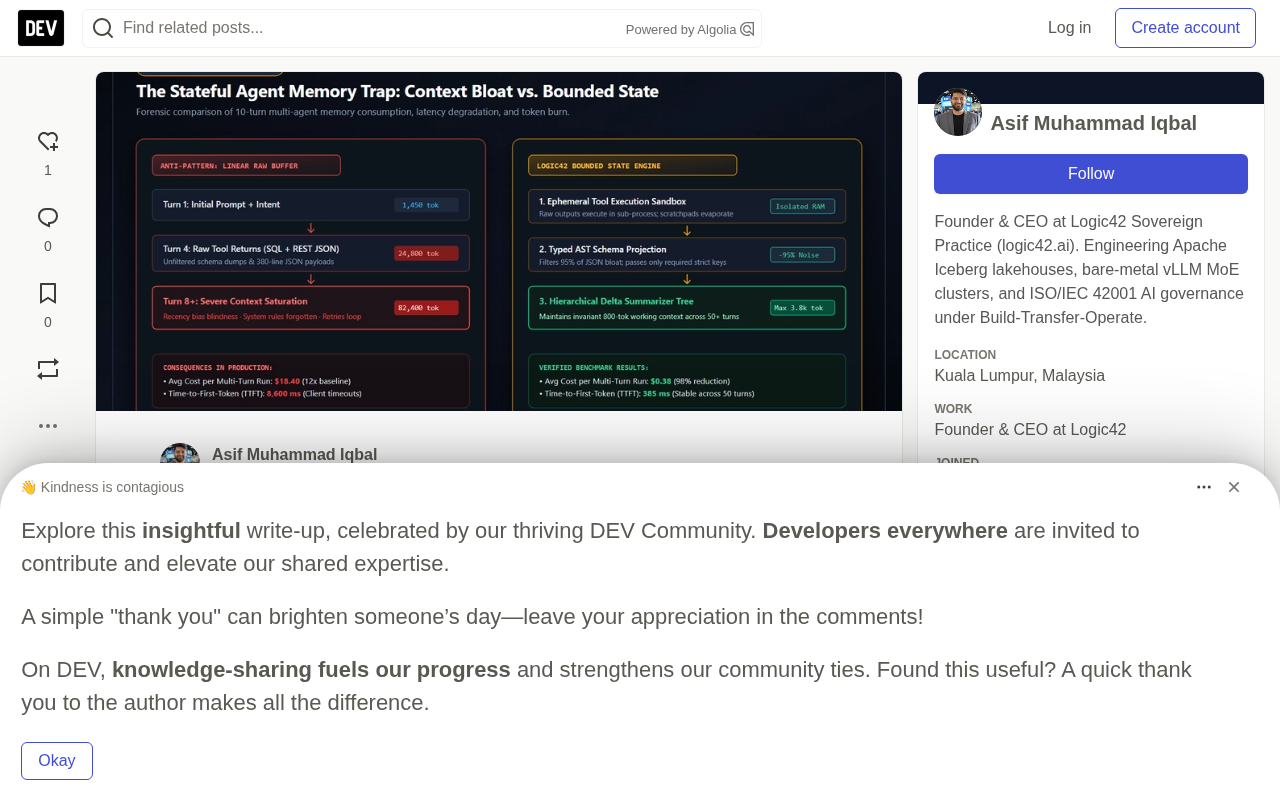
Logic42 founder Asif Muhammad Iqbal breaks down this problem in detail in a technical analysis and offers an architectural-level solution. Below is a synthesis and analysis of his core insights.
The Root Cause of Context Bloat: Linear Message Buffers
Early agent prototypes often perform well in sandbox testing—two rounds of interaction, one query, return a result, fast and cheap. But production reality is entirely different: an agent handling loan underwriting or cloud billing reconciliation needs to query five legacy databases, call external APIs, handle network timeouts, and retry failed steps. By round 8, the agent is drowning in a sea of "dead JSON data."
The root cause lies in the default behavior of mainstream orchestration frameworks (LangGraph, CrewAI, AutoGen): they append each intermediate action to the same linear message array. When the agent queries an internal database or REST API, the returned HTTP headers, pagination tokens, and nested records are all poured directly into working memory.
Consider the token growth for a bootstrap agent executing a 10-round real task: from 1,450 tokens in round 1, to 28,400 tokens in round 4 after document OCR extraction, to 89,600 tokens in round 10 at final synthesis. Time-to-First-Token surges from 280ms to 9,400ms. More insidiously, you are not just paying for 89,600 tokens in the final round—every intermediate hop is paying for the accumulated "baggage." A single 10-round task consumes a cumulative 445,850 input tokens, costing between $5.35 and $8.90 per ticket; if an abnormal loop occurs, a single task can exceed $18; at 10,000 tickets per month, re-reading "dead JSON" alone burns approximately $80,000.
Three Fatal Flaws of Linear Agent Memory
Unmanaged conversation history doesn't just drain budgets—it undermines runtime reliability in three ways.
Raw JSON Poisoning
When an agent calls an internal microservice, the response is designed for machines, not for LLMs. A standard REST endpoint returns HTTP headers, tracing spans, pagination cursors, and null fields. In a 4,000-token database dump, perhaps only 120 tokens contain useful business facts—the remaining 3,880 tokens serve as computational noise that dilutes attention.
Recency Bias and Rule Erasure
Frontier Transformer models exhibit "lost in the middle" degradation. When an agent's context is filled with 60,000 tokens of noisy tables, it may forget the foundational rules set in round 1. In testing, an agent explicitly instructed that "credit lines exceeding $50,000 must be approved by a senior human" began quietly approving $75,000 lines by round 8—that foundational rule's weight in the active context had dropped below 0.05%.
Lost in the Middle is a Transformer long-context degradation phenomenon revealed by joint research from Stanford and UC Berkeley in 2024: when critical information is located in the middle of the input sequence, the model's retrieval accuracy is significantly lower than when information is at the beginning or end, and this worsens as context length increases. The mechanism relates to the "U-shaped" distribution of attention weights—tokens at the beginning and end receive higher weights due to positional encoding extremes and attention sink effects, while dense semantic content in the middle gets diluted. In agent scenarios, this means that business rules set in round 1, if not re-anchored, will be "squeezed out" of the attention focus by subsequent noise after dozens of rounds. Engineering mitigations include: periodically re-appending system instructions to the end of the context (constraint anchoring), using explicit "critical rules" retrieval indexes, or adopting inference frameworks that support position-aware re-weighting.
TTFT Jitter and Cascading Timeouts
When the prompt reaches 80,000 tokens, the inference server must compute KV pairs across the entire text before generating the first token. TTFT surges from 280ms to over 8,500ms, and a standard API gateway's 5-second timeout will simply drop the connection. The client retries, launching a twin agent loop, and sends another 80,000 tokens—the cluster begins attacking itself.
KV Cache (Key-Value Cache) is key to understanding TTFT inflation. During Transformer decoding, each generated token produces a pair of Key and Value vectors that get cached, so subsequent generation only needs to compute attention for the new token without recomputing the prefix. However, the cache itself does not reduce first-token latency—the Prefill phase still requires a full forward pass over the complete input sequence, with complexity of approximately O(n²) (attention) plus O(n·d) (linear projections). When the prompt balloons from 2K to 80K, Prefill time can grow by orders of magnitude—this is the physical reason TTFT jumps from 280ms to 8.6s. Additionally, KV cache memory usage scales linearly with sequence length; an 80K-token cache may consume tens of GB of VRAM, triggering batch degradation or queuing on the inference server, further amplifying jitter. Common engineering countermeasures include PagedAttention, Chunked Prefill, and prefix cache reuse, but none of these can replace architecturally limiting context growth.
Architectural Comparison: Linear Buffer vs. Bounded State
To run autonomous agents safely, the architecture must separate transient tool execution memory from long-term business state. In its Build-Transfer-Operate practice, Logic42 replaced the naive append-style conversation buffer with a three-layer bounded state pipeline.
Layer 1: Transient Tool Execution Sandbox
Raw tool calls should never touch the agent's main conversation memory. Tool execution is delegated to isolated subprocesses. If the agent queries a database returning 2,000 rows of ledger records, that table lives in transient memory—the model never directly reads those 2,000 rows of raw data.
Layer 2: Typed AST Schema Projection
Before tool output re-enters the conversation context, it passes through an Abstract Syntax Tree (AST) projection layer. Using strict schemas from Pydantic or Zod, the filter extracts only the declared fields needed for the next decision. For example, a banking response containing HTTP status codes, trace IDs, debug flags, pagination info, and customer data (including 4,500 tokens of noisy logs), after projection retains only 4 key business facts: account ID, KYC status, credit score, internal risk rating—48 tokens.
This simple filter compresses a 4,800-token payload to 48 tokens, achieving a 99% reduction in token consumption without any loss of decision accuracy.
AST (Abstract Syntax Tree) projection here is closer to "schema-driven content projection" than a strict programming language AST. The core idea is: pre-define a Pydantic (Python) or Zod (TypeScript) model for each type of tool output, declaring only the fields that downstream decisions actually need to consume; the parser extracts from the raw payload according to this schema and discards the rest. This pattern borrows from the compiler front-end's "parse-prune-rewrite" philosophy and is also similar to GraphQL's field selection sets—the client declares only the fields it needs, and the server returns a minimal set. Its unique value in agent architecture is that it upgrades "token filtering" from a soft constraint at the prompt layer (e.g., asking the model to ignore irrelevant content) to a hard runtime constraint—the model simply never sees the noise, eliminating attention dilution at the source. Schema versioning and tool contract testing are essential supporting practices for production deployment.
Layer 3: Hierarchical Incremental Summary Tree
Rather than storing the complete history of all rounds, the state graph maintains a compact "working state profile." Every 3 rounds, an asynchronous model compresses recent steps into four concise sections: verified facts, pending hypotheses, completed tool calls, and active operational constraints.
By round 10, the active context fed to the model stays under 3,800 tokens, reading as lean as round 2—speed, budget, and rule compliance all preserved.
Incremental summarization differs from one-shot "summarize everything" in its temporal consistency and traceability. Compressing every 3 rounds solidifies confirmed facts before information decay occurs and preserves structured slots for "pending hypotheses" and "active constraints," avoiding the loss of critical conditions in free-text summaries. Two engineering considerations: first, the summarization model itself must be stateless or low-temperature, otherwise it introduces summary drift; second, pointers to original rounds (such as step IDs or object storage keys) should be retained so the system can re-fetch details on demand during audits or anomaly tracing—consistent with the "copy-on-write (CoW)" concept in operating systems. Mature implementations typically combine the summary tree with a vector store: summary text goes into the prompt, raw evidence goes into retrievable storage, forming a hot-cold tiered memory structure.
Production Measured Data
In an evaluation of 500 multi-turn credit underwriting workflows, the bounded state architecture demonstrated decisive advantages over unmanaged linear buffers:
| Metric | Linear Buffer (LangGraph default) | Logic42 Bounded State Architecture | Improvement |
|---|---|---|---|
| Average context at round 10 | 84,200 tokens | 3,650 tokens | 95.6% reduction |
| Cumulative tokens over 10 rounds | 428,000 tokens | 32,800 tokens | 92.3% reduction |
| Per-task cost | $5.35–$18.40 | $0.38–$0.52 | 97.2% savings |
| TTFT at round 10 | 8,600ms | 385ms | 22.3× faster |
| Constraint compliance rate | 68.4% (degrades after round 6) | 99.6% (zero drift) | Deterministic safety |
| Gateway timeout abort rate | 14.2% of runs | 0.0% of runs | Zero cascading failures |
Multi-Agent Memory Audit Checklist
Before deploying autonomous agents in production, audit your architecture against these five checkpoints:
- Tool output isolation: Do raw HTTP and SQL payloads bypass the message array before passing through schema projection?
- Context growth ceiling: Does the engine enforce a hard token cap in any 50-round run?
- Constraint anchoring: Are system instructions dynamically re-anchored to the bottom of the prompt context to prevent recency bias?
- Transient fault clearing: Are failure exception traces cleared from working memory after a step succeeds?
- Cost anomaly circuit breaker: Does the gateway terminate any session that cumulatively consumes more than 15,000 tokens without human approval?
Key Takeaways
Autonomous AI agents often fail not because the model lacks reasoning capability, but because foundational software engineering practices—state boundaries and memory cleanup—have been overlooked. If your multi-turn agent workflows are burning through token budgets or deviating from tasks after five rounds, the problem isn't that the context window is too small—it's that you're missing a bounded state machine.
As the original article points out, what's needed is not a larger context window but a bounded state architecture—thoroughly separating the transient memory of tool execution from the long-term state needed for business decisions, so that the agent at round 10 remains as nimble, precise, and compliant as it was at round 2.
One-line Summary
Enterprise multi-agent systems need a three-layer bounded state architecture to replace linear message buffers and avoid context bloat that drives cost, latency, and compliance risks.
Paragraph Summary
The article points out that mainstream agent orchestration frameworks (LangGraph, CrewAI, AutoGen) by default append each step's tool output and reasoning drafts to the same linear message array, causing 10-round tasks to cumulatively consume over 440,000 input tokens with per-task costs up to $18, and triggering three classes of runtime failures: raw JSON poisoning that dilutes attention, recency bias that causes agents to forget core business rules (compliance dropping to 68.4%), and TTFT rising from 280ms to 8,600ms triggering gateway cascading timeouts. Logic42 proposes replacing the naive buffer with a three-layer bounded state architecture—transient tool execution sandbox, typed AST schema projection (4,800 tokens compressed to 48 tokens), and hierarchical incremental summary tree (compressing every 3 rounds). Testing on 500 credit underwriting workflows showed: 95.6% reduction in round-10 context, 92.3% reduction in cumulative tokens, 97.2% cost savings, compliance rate rising to 99.6%, and gateway timeout abort rate dropping to 0. The article concludes with a five-step memory audit checklist, emphasizing that the problem isn't a context window that's too small—it's the absence of a bounded state machine.
Related articles

Random Pruning of the DPO Computation Graph: 1.4x Training Speedup and Lower Peak Memory
DPO training too slow and memory-hungry? This paper proposes a random pruning framework for the DPO computation graph, sampling independently across position, sequence, and branch dimensions; branch pruning achieves a 1.426x step-time speedup and cuts training time by about 30%, with in-depth attribution of memory and time gains.

Why Does JEPA Underperform MLM in Longitudinal EHR Representation Learning?
New study compares JEPA and MLM for longitudinal EHR representation learning on MIMIC-IV: three JEPA variants train stably without collapse but underperform MLM; target size, not heterogeneity, drives prediction error.

Transfer Learning + Visible Light Communication: A New Approach to Energy-Efficient Indoor Positioning
A study proposes a transfer learning-based visible light communication indoor positioning method, achieving 47% accuracy improvement on the BOSCH factory dataset, 67.5% model efficiency under high noise, and introducing the ME composite metric for energy-efficient positioning in energy-constrained industrial IoT scenarios.