The Sylvester–Gallai Theorem: Why Every Finite Point Set Must Have an Ordinary Line

The Sylvester–Gallai Theorem proves every finite non-collinear point set has a line through exactly two points.
The Sylvester–Gallai Theorem states that any finite set of non-collinear points in the plane must contain an ordinary line—one passing through exactly two points. First posed by Sylvester in 1893 and proved by Gallai in 1944, the theorem's most elegant proof uses Kelly's minimal distance argument. The article explores why the result depends on real-number properties, its failure in the complex plane via the Hesse configuration, and modern extensions including the Green–Tao optimal bound of n/2 ordinary lines.
A Seemingly Simple Geometric Problem
The most fascinating theorems in mathematics often have extremely concise statements yet conceal profound ideas. The Sylvester–Gallai Theorem is a perfect example. Its statement can be summarized in a single sentence:
Given a finite set of points in the plane, if they are not all collinear, then there must exist a line that passes through exactly two of the points.
Such a line is called an "ordinary line." At first glance, this conclusion seems obvious—but rigorously proving it stumped some of the most brilliant mathematicians of the time.
Historical Origins of the Problem
This problem was first posed by the British mathematician James Joseph Sylvester (J.J. Sylvester) in 1893. He published it as a problem in the Educational Times without providing a proof.
Sylvester (1814–1897) was one of the most influential mathematicians of the Victorian era, co-founding matrix theory and invariant theory with Arthur Cayley. At Johns Hopkins University, he established the American Journal of Mathematics, the first pure mathematics journal in the United States. The Educational Times was a British publication aimed at mathematics teachers that featured a problem-solving column where many important mathematical problems were first posed informally. During his later years teaching at Oxford, Sylvester frequently published conjectures in such periodicals, many of which later became significant mathematical theorems.
For several decades afterward, the problem was nearly forgotten by the mathematical community. It wasn't until 1933 that the Hungarian mathematician Paul Erdős rediscovered the problem and realized it was not as easy as it appeared.
Erdős (1913–1996) was one of the most prolific mathematicians of the 20th century, publishing over 1,500 papers spanning number theory, combinatorics, probability theory, and many other fields. He was famous for his unique nomadic lifestyle—having no fixed home, traveling the world to collaborate with mathematicians everywhere. Erdős had an extraordinary taste for problems, with a gift for uncovering deep mathematical structures within seemingly elementary questions. His rediscovery of Sylvester's problem was no accident—it reflected the historical process of combinatorial geometry emerging as an independent discipline during the 1930s.
After Erdős raised the problem again, Tibor Gallai—a colleague of Erdős in Budapest and a central figure in the Hungarian mathematical school—provided the first correct proof in 1944. The theorem is therefore now named after both mathematicians.
Why the Existence of Ordinary Lines Is Not So Obvious
Intuitively, we might feel that "surely we can find a line passing through only two points." But intuition is often unreliable in mathematics. The key question is: what happens if we try to construct a set of points where every connecting line passes through at least three points?
Interestingly, in the complex plane or certain extensions of the projective plane, such configurations do exist—for example, the famous Hesse configuration, where 9 points are arranged on 12 lines, each line passes through exactly 3 points, and no ordinary line exists.
The Hesse configuration is a classical object in projective geometry, discovered by the German mathematician Otto Hesse in the 19th century while studying inflection points of elliptic curves. Specifically, consider the 9 inflection points of an elliptic curve in the complex projective plane: they are arranged on exactly 12 lines, with 3 points on each line and 4 lines through each point—forming a perfectly symmetric (9₄, 12₃) configuration. The fundamental reason this configuration cannot be realized in the real plane lies in the fact that the real number field lacks the algebraic closure of the complex number field: an elliptic curve has at most 3 real inflection points, while in the complex plane it has exactly 9. The projective plane is an extension of the Euclidean plane that eliminates the exceptional case of parallel lines by adding "points at infinity" and a "line at infinity," making geometric theorem statements more unified.
This shows that the theorem depends on special properties of the real number field and is not a purely combinatorial conclusion. It is precisely this subtlety—"holds over the reals, fails over the complex numbers"—that makes the Sylvester–Gallai Theorem a classic and profound case in combinatorial geometry.
Kelly's Minimal Distance Proof
The most celebrated proof comes from L. M. Kelly, employing an ingenious "minimal distance" argument that stands as a textbook example of elegant simplicity in mathematical proofs.
The proof strategy is as follows:
- Proof by contradiction: Assume the conclusion is false—that is, every line connecting two points passes through at least three points.
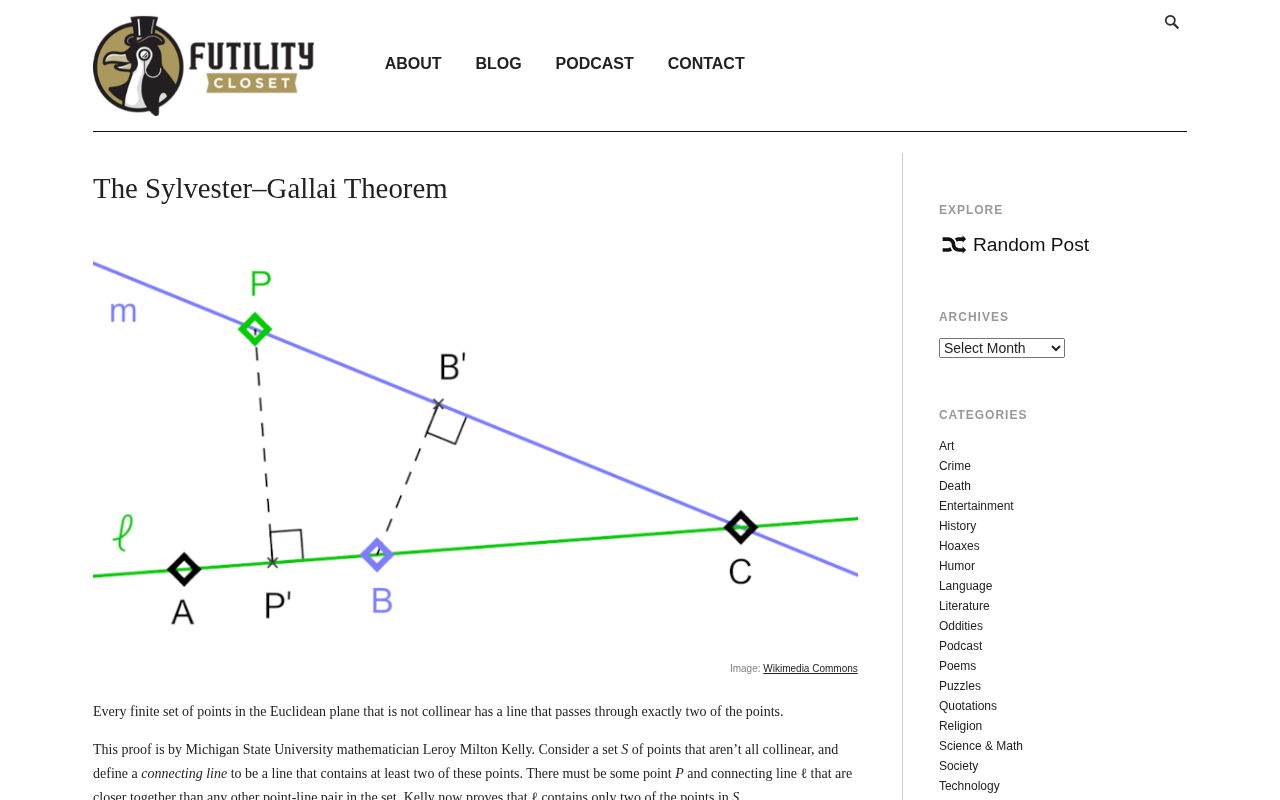
- Construct a finite collection: Consider all "point-line" pairs $(P, \ell)$ where point $P$ does not lie on line $\ell$. Since the points are finite, such pairs are also finite.
- Take the minimum: Among all such pairs, select the one $(P, \ell)$ with the smallest point-to-line distance.
- Apply the pigeonhole principle: By our assumption, line $\ell$ contains at least three points. Projecting $P$ onto $\ell$ gives a foot of perpendicular, and at least two of these three points must lie on the same side of this foot.
- Derive a contradiction: Through simple geometric analysis, one can show that there exists another "point-line" pair whose distance is strictly less than our chosen minimum distance—contradicting the minimality assumption.
More specifically, the key geometric step in deriving the contradiction is as follows: Let H be the foot of the perpendicular, and let A, B, C be at least three given points on line ℓ, where at least two (say A and B) lie on the same side of H, with A closer to H than B. Now consider the distance from point A to line PB: since the projection H of P onto ℓ lies between A and B (or A lies between H and B), using the basic area-to-base relationship, one can prove that the distance from A to PB is strictly less than the distance from P to ℓ. Moreover, PB is also a line determined by given points (since both P and B are given points), and A does not lie on PB (otherwise A, P, B being collinear would imply ℓ coincides with PB, a contradiction). Therefore (A, PB) constitutes a point-line pair with a smaller distance, producing a contradiction. The elegance of this argument lies in its complete reliance on the properties of Euclidean metric.
The contradiction means our initial assumption was wrong, so an ordinary line must exist. The entire argument requires no complex tools—only elementary geometry and an ingenious extremal strategy.
Far-Reaching Impact and Generalizations
Despite its simple statement, the Sylvester–Gallai Theorem has spawned an entire research direction in combinatorial geometry.
Lower Bounds on the Number of Ordinary Lines
A natural follow-up question is: given $n$ non-collinear points, exactly how many ordinary lines must exist? This is known as the quantitative version of the Sylvester–Gallai Theorem.
Research on this question spans nearly 80 years. In 1951, Motzkin proved that at least 3 ordinary lines exist; Melchior then used Euler's formula to give a better lower bound. Kelly and Moser proved in 1958 that at least $3n/7$ ordinary lines exist. The true breakthrough came in 2013, when Ben Green and Terence Tao used structure theorems from algebraic geometry to prove that for sufficiently large $n$, $n$ non-collinear points determine at least $n/2$ ordinary lines. This bound is optimal, as configurations achieving exactly $n/2$ exist—for example, placing $n/2$ points uniformly on an ellipse with the other $n/2$ points at specific positions. The Green–Tao proof combines algebraic curve theory, Melchior's inequality, and refined combinatorial analysis, making it one of the most important results in combinatorial geometry in recent years.
Generalizations to Higher Dimensions and Other Structures
The theorem has been generalized in multiple directions:
- Higher-dimensional spaces: In three or higher dimensions, do analogous "ordinary hyperplanes" exist?
- Colored versions: If points are colored with different colors, must there exist a line connecting only two points of a specific color?
- Connections to algebraic geometry: The problem has established deep connections with results in algebraic geometry and complex geometry.
In recent years, the Polynomial Method has become one of the most revolutionary tools in combinatorial geometry. Its core idea is to use algebraic curves or algebraic surfaces to constrain the combinatorial properties of discrete point sets. In 2010, Larry Guth and Nets Katz used the polynomial partitioning method (polynomial ham-sandwich theorem) to solve the near-optimal lower bound for the Erdős distance problem, proving that $n$ points determine at least $\Omega(n/\log n)$ distinct distances. The philosophy of this method has a deep connection to the Sylvester–Gallai Theorem: if a set of points has too many collinearity relations (i.e., too few ordinary lines), then these points must possess some algebraic structure—most of them lie on low-degree algebraic curves. This "structure vs. randomness" dichotomy has become a core paradigm in modern combinatorial mathematics.
Mathematical Thinking Lessons from the Theorem
The Sylvester–Gallai Theorem remains relevant not only because of its elegant conclusion, but also because it embodies several core modes of mathematical thinking:
The power of the extremal principle. The technique of "selecting the minimum distance pair" in Kelly's proof is a powerful strategy that recurs throughout mathematics—when direct construction is difficult, examining the extremal value of some quantity often pries open the problem. This idea manifests in variational methods in analysis, duality in optimization theory, and even the principle of least action in physics. The common philosophy is that extreme cases often possess additional structural properties, and these properties are precisely what can be used to derive contradictions or complete constructions.
The value of counterexamples. The Hesse configuration in the complex plane reminds us that a seemingly universal proposition may depend strongly on the properties of the underlying structure. Understanding "when something fails" often deepens comprehension more than memorizing "when it holds."
The depth of simple problems. A problem that can be explained to a high school student may require top mathematicians decades to solve, spawning rich modern mathematical theories. This is precisely the charm of pure mathematics.
Conclusion
From Sylvester's casually posed puzzle in 1893, to Gallai's rigorous proof in 1944, to Green and Tao's establishment of the optimal lower bound on the number of ordinary lines in 2013, the Sylvester–Gallai Theorem has traveled a journey spanning more than a century. It reminds us that in the world of mathematics, the most unassuming questions often lead to the most profound ideas. Next time you casually dot a few points on paper and draw some lines between them, perhaps you'll think about the secret that puzzled mathematicians for half a century hidden beneath.
Related articles

Gaussian Process Bandit Optimization: Exploration Strategies and Inference Regret Guarantees
Cumulative regret guarantees in Bayesian optimization fail to reflect final recommendation quality. This article examines a new study that provides inference regret guarantees for Gaussian process bandit optimization through exploration query strategies and fill distance analysis, validated on hyperparameter optimization and control tasks.

The Most Detailed Codex Guide on Bilibili: From Installation to Real-World Practice
The most detailed Codex guide on Bilibili: from app store installation to daily work mode configuration, with a real coffee shop project demonstrating file organization, data extraction, dashboard creation, and other practical tasks. Learn to use Plan Mode and desktop pets to leverage Codex efficiently.

Appearance Compensation in Volume Rendering: Why RGB Accuracy Cannot Guarantee Density Correctness
Volume rendering research reveals that volumetric data perfectly reproducing external RGB views may still contain density errors: appearance compensation can double central density and keep external rays unchanged even when L2 error exceeds 14.52%. Density recovery depends on appearance capacity, spatial resolution, and measurement design.