The Team Collaboration Trap for AI Agents: Why Individual Efficiency Gains Lead to Negative ROI
AI coding agents save individuals 2 hours but add 3 hours of team alignment cost—isolated chats are a structural flaw.
The article highlights that AI coding agents deliver strong individual efficiency gains but can yield negative ROI in team settings: agents generate code quickly yet lack awareness of existing team architecture decisions and naming conventions, forcing extra time for alignment, review, and conflict resolution. The root issue is that agent conversations are isolated and private, unable to access team consensus context, creating a cycle of missing context, conflicting solutions, extra corrections, and continued information silos. Kylon attempts to solve this with a multi-user shared agent environment for Claude Code and Codex, giving agents real-time visibility into team consensus. The article recommends factoring team alignment costs into ROI evaluations and notes that vendor competition will shift from model capability to team context understanding, redefining products from personal assistants to team collaborators.
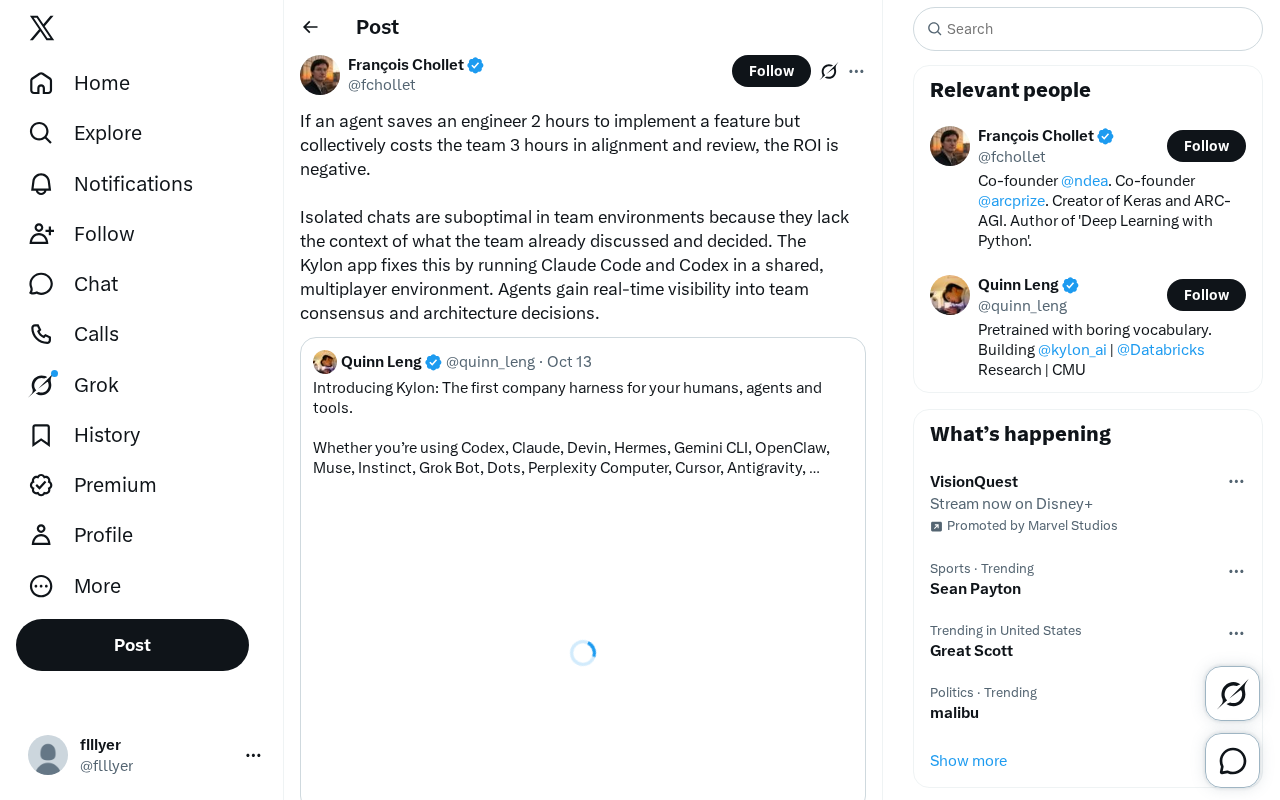
An engineer saves 2 hours of development time using an AI agent, but the team spends 3 hours on alignment and review—by any measure, this is a losing proposition. This observation from Twitter hits the most awkward weak spot in the current enterprise adoption of AI coding tools.
Why Does Individual Efficiency Actually Drag Down the Team?
AI coding agents (such as Claude Code and Codex) perform impressively when used by individuals, but once they enter team collaboration scenarios, problems surface. The core contradiction is this: an agent's output saves individual execution time, but it may increase the team's communication, alignment, and review burden.
Specifically, Engineer A quickly generates a feature implementation using an agent, but the context of this code—architecture decisions the team previously discussed, naming conventions, rejected approaches—is completely unknown to the agent. So A needs to explain to the team "why it was done this way," the team needs to re-review "whether this aligns with our previous consensus," and discussions that could have been avoided are replayed.
The 2 hours saved is individual time; the 3 extra hours is team time. From an ROI perspective, team time is typically more expensive than individual time because it involves multi-person coordination costs.
ROI (Return on Investment) in a software engineering context typically refers to the ratio of returns to investment, but "investment" in team scenarios is often underestimated. The cost structures of individual time and team time are not equivalent: an engineer's 2 hours can be directly measured by hourly wage, while 3 hours of team time involves multi-person coordination, context switching, and meeting overhead—its opportunity cost is usually 2 to 3 times that of individual time. More critically, the output of AI coding agents is "seemingly complete code," which triggers a stricter review process than human-written code—because reviewers need to reconstruct the assumptions made when the agent generated the code, whereas the assumptions behind human-written code are often implicit in the author's thought process. Therefore, when measuring the value of AI tools, "coordination cost" must be included as an independent variable in the model, rather than simply extrapolating team efficiency from individual efficiency.
Why Are Isolated Chats a Suboptimal Solution?
The original article points out a key problem: isolated chats are suboptimal in team environments. Each engineer's conversation with AI is private and isolated; the agent cannot access what the team has already discussed and decided.
This creates a vicious cycle:
- The agent lacks the context of team consensus
- Generated solutions may conflict with existing team decisions
- The team needs extra time to discover and correct conflicts
- Corrected information cannot be fed back to the agent, so it repeats the same mistakes next time
This is not a problem of model capability, but of information architecture. No matter how powerful the agent is, if it is isolated in individual conversations, it cannot become a true team asset.
Context in large language model-driven agents refers to all the information the model can access when generating responses, including system prompts, conversation history, tool call results, and externally retrieved content. The context window of current mainstream AI coding tools (such as Claude Code and Codex CLI) is "session-level"—each session is maintained independently, and state is not shared between sessions. This means that consensus the team previously formed in Slack, GitHub PR comments, or architecture documents is completely invisible to the agent unless manually pasted into the current conversation. This design is fine for individual use, because the individual developer is themselves the carrier of all historical decisions; but in a team, knowledge is distributed across multiple people and channels, making session-level context a structural flaw. There are usually two solution paths: one is to inject the team knowledge base into each conversation through retrieval-augmented generation (RAG), and the other is to build a cross-session shared memory layer that allows the agent to read and write team-level state.
Kylon's Approach: A Multiplayer Shared Agent Environment
The Kylon app mentioned in the original article attempts to solve this problem with a "multiplayer mode"—letting Claude Code and Codex run in a shared, multi-person environment.
The core idea is: the agent gains real-time visibility into team consensus and architecture decisions. When an engineer interacts with the agent, the agent not only knows the current conversation, but also the team's previous discussion conclusions, architectural constraints, and existing decisions.
This sounds simple, but implementation involves changes at several levels:
- Context sharing: The team's discussion records and decision documents become inputs for the agent
- Real-time synchronization: Interactions between multiple engineers and the agent need to be coordinated to avoid conflicts
- Consensus awareness: Before generating solutions, the agent first checks whether they align with existing team decisions
If this "multiplayer agent" model works, it could theoretically eliminate the repeated alignment costs caused by information isolation.
The technical challenge of a multiplayer shared agent environment lies in concurrency control and state consistency. When multiple engineers interact with the same agent simultaneously, problems similar to those in distributed systems need to be solved: who can see whose conversations? Which point in time of team consensus should the agent's responses be based on? If two engineers simultaneously ask the agent to generate conflicting solutions, how should the system arbitrate? A viable architecture is a hybrid model of "shared memory + private sessions": team consensus and architecture decisions are written to a shared memory layer, and each agent response first reads the latest state of that layer; intermediate discussions between individuals and the agent remain in private sessions, and are only committed to the shared layer after conclusions are formed. This model is similar to Git's branch-and-merge workflow, but it requires the agent to have the ability to judge "when to synchronize." There is currently no mature product in this direction—Kylon's attempt is more of a proof of concept.
How Should the ROI of Team AI Tools Be Calculated?
This case serves as a reminder to all teams adopting AI coding tools: when evaluating ROI, you cannot look only at individual efficiency gains.
A more reasonable evaluation framework should include:
Individual benefits: Execution time saved by engineers Team costs: Additional time for alignment, review, and conflict resolution Long-term benefits: Whether the agent accumulates team context over time, reducing future communication costs
If the agent always operates in isolation, long-term benefits may be zero or even negative—because the team constantly corrects the agent's "ignorance." Only when the agent is connected to the team knowledge system and becomes a carrier of consensus rather than a source of noise can ROI turn positive.
Implications for AI Coding Tool Vendors
The design assumption behind most current AI coding tools is still "one developer facing one AI." This assumption holds for individual projects, but is clearly insufficient in team scenarios.
The next stage of competition may not be about model capability, but about:
- Whether it can understand the team's decision history
- Whether it can coordinate agent behavior in multi-person environments
- Whether it can translate team consensus into constraints for the agent
Kylon's attempt represents one direction, but a thorough solution to this problem may require AI coding tools to be redefined from "personal assistant" to "team collaborator." This is not just a technical problem, but a reconstruction of product architecture and collaboration models.
Team context understanding is a different technical path from simply improving model capability. Model capability (such as code generation accuracy and reasoning depth) can be improved by scaling parameters and improving training data, but team context understanding is essentially a system design problem: it requires the product to clearly define what information belongs to the "team level," how that information is collected and updated, and when the agent should reference it. This is similar to the evolution from standalone software to collaborative software—the shift from Excel to Google Sheets is not just feature addition, but a change in the data model from "local file" to "shared document." If AI coding tools are to evolve from personal assistants into team collaborators, they may need to introduce a concept similar to a "team workspace" at the底层, placing agents, code repositories, discussion records, and decision logs in the same addressable state space, rather than having each developer maintain isolated conversation histories.
One-line Summary
AI coding agents save individuals 2 hours but add 3 hours of team alignment cost—isolated chats are a structural flaw.
Paragraph Summary
The article points out that AI coding agents can significantly improve efficiency when used individually, but may produce negative ROI when entering team collaboration scenarios: engineers use agents to quickly generate code, but because the agent does not understand the team's existing architecture decisions and naming conventions, the team needs extra time to align, review, and correct conflicts. The core contradiction is that current agent conversations are isolated and private, unable to access team consensus context, creating a vicious cycle of "missing context—solution conflict—extra correction—information still not shared." The Kylon app attempts to solve this with a multiplayer shared agent environment, letting Claude Code and Codex run in a shared environment and giving agents real-time visibility into team consensus. The article recommends incorporating team alignment costs when evaluating the ROI of AI coding tools, and points out that vendors' competitive focus will shift from model capability to team context understanding, with product positioning needing to be redefined from personal assistant to team collaborator.
Related articles

WorkBuddy Full Tutorial: Build an AI Office Automation Agent from Scratch
A complete WorkBuddy tutorial: installation, three working modes, multimodal picture book video practice, expert team agent building, and workflow configuration for low-cost AI office automation.

WorkBuddy Agent Complete Guide: From Beginner to Automation in 7 Days
Based on Bilibili's 256-episode WorkBuddy masterclass, this systematically breaks down Tencent's AI office workbench core capabilities: Agent principles, Skill encapsulation, cross-platform connectors, scheduled automation, knowledge bases, and zero-code development, with learning path recommendations.

8 AI Accounts, 7 Failed: An Honest Review of Using AI to Get Work Done
Only 1 of 8 AI-run Bilibili accounts succeeded. We break down the real difference between "performing AI" and "using AI to get work done."