The Technical Choices and Survival Strategy Behind Marginalia Search
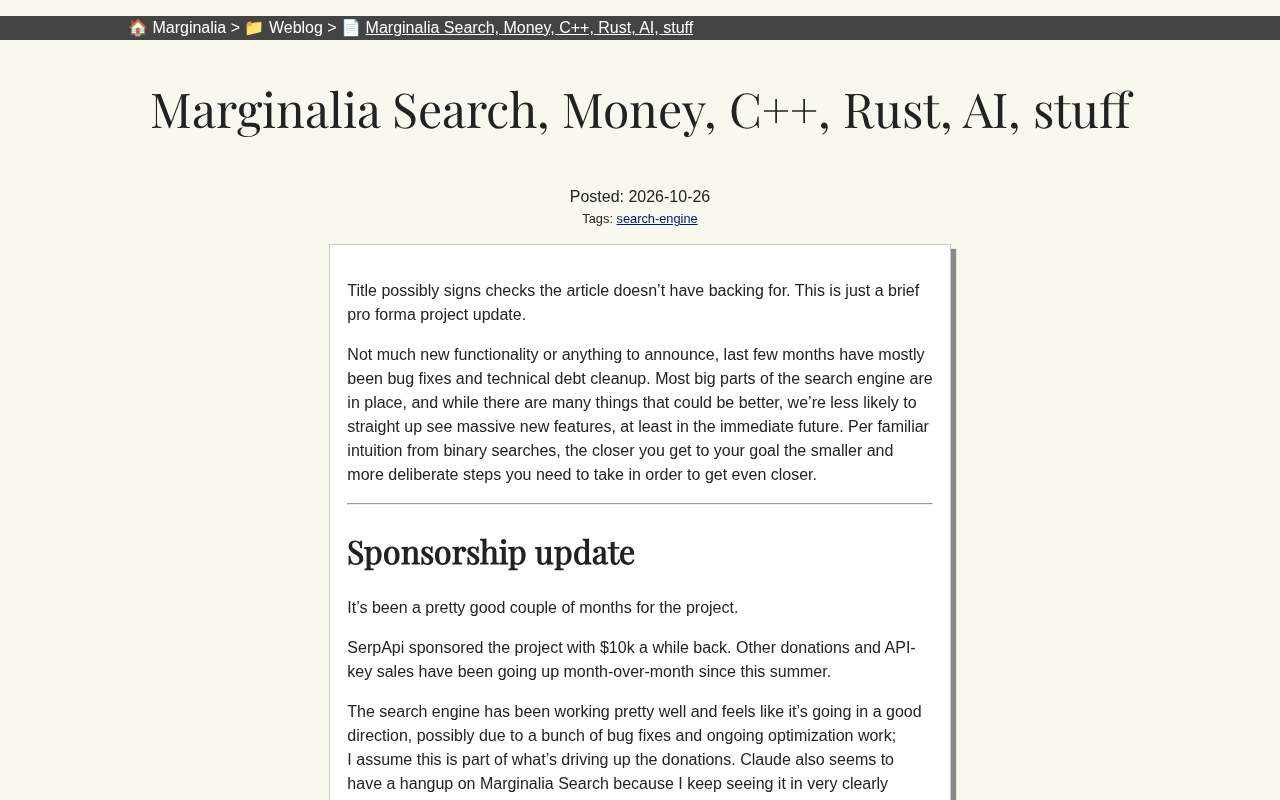
A real survival sample of independent search engine Marginalia under tech choices, funding pressure, and AI impact.
The article focuses on Marginalia Search, outlining its differentiated route of focusing on non-commercial small websites rather than indexing the entire web, and analyzes the real situation of independent search projects from three dimensions: the C++ vs Rust trade-off reflecting the dilemma among performance, memory safety, and maintenance costs; the heavy-asset nature of search engines and limited monetization constituting the core survival pressure; and large models both lowering the threshold for semantic search and squeezing small projects through answer-based search and content pollution. It concludes that search engines are a comprehensive problem of engineering, operations, and business models, and technical clarity and cost restraint matter more than chasing new concepts.
An Alternative Path for an Independent Search Engine
In a search market dominated by Google and Bing, Marginalia Search has taken a completely different route: instead of indexing the entire web, it focuses on "non-commercial" small websites and edge content. The project's developer recently posted on Hacker News, offering a rare look at the technology stack choices behind the search engine, the financial pressure, and the impact of AI on independent search.
Although the original discussion revealed only the title and a few brief words, the keywords "Money, C++, Rust, AI" already sketch out the real technical and survival questions an independent developer faces: what language to write a search engine in, how to sustain a search engine financially, and whether small projects can still survive in the era of large models.
Technology Stack Trade-offs: The Dilemma Between C++ and Rust
Judging from the order in the title, the developer placed C++ and Rust side by side, which itself suggests the struggle over language choice in a search system. Search indexing and query processing are extremely performance-sensitive; C++ is the traditional default answer for search engines, but issues with memory safety and development efficiency have long persisted. In recent years, Rust has rapidly penetrated the infrastructure software space, offering performance close to C++ with stronger safety guarantees, but ecosystem maturity, learning curve, and refactoring costs pose practical obstacles.
For a project of Marginalia's size, language choice is not just a matter of technical preference—it is directly tied to maintenance costs. A one-person project cannot afford the risk of a large-scale rewrite. This kind of discussion is valuable for independent developers: in high-performance scenarios, whether Rust is mature enough to replace C++ often depends on the project's trade-off between stability and iteration speed.
The core workload of a search system is typically divided into two main parts: index construction (indexing) and query serving (serving). Index construction requires parsing massive numbers of web pages, tokenization, merging and compressing inverted lists—a classic batch-processing-intensive task. Query serving requires completing inverted-list intersections, scoring, and ranking within milliseconds. Both are highly sensitive to memory layout, cache locality, and concurrency models, which is precisely why C++ has long dominated—it allows developers to manually control memory allocation and data layout. Rust, while maintaining zero-cost abstractions, eliminates data races and dangling pointers at compile time through ownership and borrow checking, at the cost of needing to redesign large amounts of traditional search engine code that relies on raw pointers and shared mutable state. For a single-maintainer project, a rewrite means months or even years of investment, during which feature iteration essentially stalls. Therefore, language migration is often a decision about "whether to pay a one-time high cost for long-term safety and maintainability," rather than a pure comparison of technical merits.
Money: The Hardest Part of an Independent Search Engine
It is telling that "Money" comes first in the title. Search engines are typical "heavy-asset" projects: crawlers need bandwidth, indexes need storage, queries need compute power—and Marginalia deliberately avoids monetizing through ads and commercial partnerships. The operating costs of independent search are not on the same scale as commercial search engines, but for an individual or small team they remain constant pressure.
Funding for independent search projects typically comes from a few sources: donations, sponsorships, and possibly search APIs or data services. But no matter which approach, it is hard to cover the long-term overhead of infrastructure. The developer put "Money" in the title, indicating that this has become a core issue the project cannot avoid, rather than a detail that can be deferred.
The cost structure of a search engine can be understood in "three layers": the crawling layer continuously consumes outbound bandwidth and proxy/IP resources; the storage layer must retain raw pages, inverted indexes, and various auxiliary data, with requirements on disk capacity and IOPS; the serving layer must maintain low-latency query responses, with memory and CPU overhead growing linearly with index size. Even a "small and beautiful" project that indexes only a few million small websites may have an index volume in the tens of GB. Unlike commercial search engines, independent projects usually cannot recover costs through ad bidding, because their user scale and commercial intent are insufficient to support advertisers. Realistic paths include community donations (such as Patreon, GitHub Sponsors), one-time crowdfunding, and providing limited search APIs to researchers or developers. These revenues are highly volatile and difficult to support the rigid expenses of bandwidth and hardware, so "money" often determines how large a scope the project can index and how frequently it can update.
What AI Means for Independent Search
The "AI" in the title is also worth pondering. On one hand, large models make semantic search and result re-ranking easier to implement, allowing small teams to deliver experiences that previously required big companies using open-source models. On the other hand, AI-driven search is changing user habits; answer-based search is putting pressure on the traditional result-list model, and the traffic entry points for independent search engines may further narrow.
For projects like Marginalia that emphasize "discovering interesting websites," AI is both a tool and a threat. Using AI for content classification and spam filtering can improve index quality, but AI-generated spam content is also polluting the web, in turn increasing the filtering burden on search engines. This two-way effect is a new variable that all search projects currently face.
Answer engines differ fundamentally from the traditional "ten blue links" in interaction paradigm: the former uses large models to directly synthesize multiple sources into a single answer, so users no longer need to click through to websites. This is especially impactful for small independent websites that rely on "being discovered"—their traffic already comes from long-tail queries, and once users become accustomed to staying at the answer layer, original site visits will decline further. At the same time, low-quality AI-generated content is flooding the web at scale; such pages are often well-structured and keyword-dense but lack real information, diluting index quality and increasing spam identification costs. For independent search engines, countermeasures typically include trust propagation based on link graphs, manual or semi-automated site whitelists, and content quality scoring using lightweight classification models. These methods all require additional compute and engineering investment, which brings us right back to the constraints of funding and manpower.
Practical Lessons from an Independent Project
What this discussion reveals is the real situation of an independent search project caught between technology, funding, and changing times. Cautious language selection, frank discussion of funding, and a wait-and-see attitude toward AI together form a survival sample of a small-scale search project.
For readers interested in search technology and independent development, the Marginalia case reminds us: a search engine is not just an algorithm problem, but a comprehensive problem of engineering, operations, and business model. In an era when AI is reshaping search entry points, maintaining technical clarity and cost restraint may be more important than chasing new concepts.
One-line Summary
A real survival sample of independent search engine Marginalia under technology choices, funding pressure, and AI impact.
Paragraph Summary
The article focuses on the independent search engine Marginalia Search, outlining its differentiated route of not indexing the entire web but focusing on non-commercial small websites, and analyzes the real situation of independent search projects from three dimensions. On the technical level, the trade-off between C++ and Rust reflects the dilemma of high-performance search systems among performance, memory safety, and maintenance costs; on the funding level, the heavy-asset nature of search engines and limited monetization methods constitute the most core survival pressure; on the AI level, large models both lower the threshold for semantic search and squeeze small projects through answer-based search and content pollution. The article ultimately points out that search engines are a comprehensive problem of engineering, operations, and business models, and maintaining technical clarity and cost restraint is more important than chasing new concepts.
Related articles

The Gemini 4 Trio and 3.8 Flash: A Full Comparison of Positioning, Pricing, and Benchmarks
A comparison of Gemini 4 Neon, Carbon, Argon, and Gemini 3.8 Flash: positioning, context, API pricing, Artificial Analysis and Arena benchmark scores, and available entry points.

AI Coding Model Leaderboard: Opus 5.5 Crowned, Gemini Neon Stages a Comeback
Tech blogger Matthew Berman releases an AI coding model tier list: Claude Opus 5.5 holds S-tier, Gemini Neon surprises with A-tier, OpenAI Astra lands B-tier. How do open-source models like DeepSeek fare? We break down the scoring logic and practical takeaways.

New Jersey Joe Sandwich: Meat and Coleslaw on Triple-Decker Rye
New Jersey Sloppy Joe isn't a ground beef burger—it's triple-decker rye bread with meat, Swiss cheese, and coleslaw, plus Russian dressing. Learn the authentic Essex County method and family recipe.