The Truth About AI Agents in Traditional Industries: Messy Data Is the Real Barrier

A real case study shows messy data—not model choice—is the true bottleneck for AI Agent deployments.
An AI Agent integrator shared a cautionary Reddit post: a client's estimated 3-day voice-and-chat Agent project took nearly 5 weeks. The first three weeks were consumed by cleaning chaotic CRM data, surfacing undocumented tribal knowledge, and hardening data-layer permissions — actual Agent configuration took less than two weeks. The core lesson: AI Agents are execution amplifiers, and messy underlying data will only be amplified faster. For traditional industries, tacit business rules must be made explicit before any Agent can make correct decisions. Practitioners should conduct data audits before quoting, treat data governance as a standalone deliverable, and use the "amplifier" analogy to set realistic expectations with non-technical stakeholders.
A Real Case Study: How "3 Days" Became 5 Weeks
On Reddit, an AI Agent integrator shared a cautionary tale from the field. A client wanted to build a voice-plus-chat Agent system to automatically handle inbound calls and sync updates to their CRM. Based on vendor marketing materials, the client's founder was convinced the project would be "done in 3 days."
Reality looked very different. The project ultimately took nearly 5 weeks. What's even more telling is that the actual Agent configuration and testing took less than 2 weeks — the first 3 weeks were spent entirely on things the outside world never sees: untangling messy data, fixing a broken CRM structure, and layering security and access controls onto the data tier.
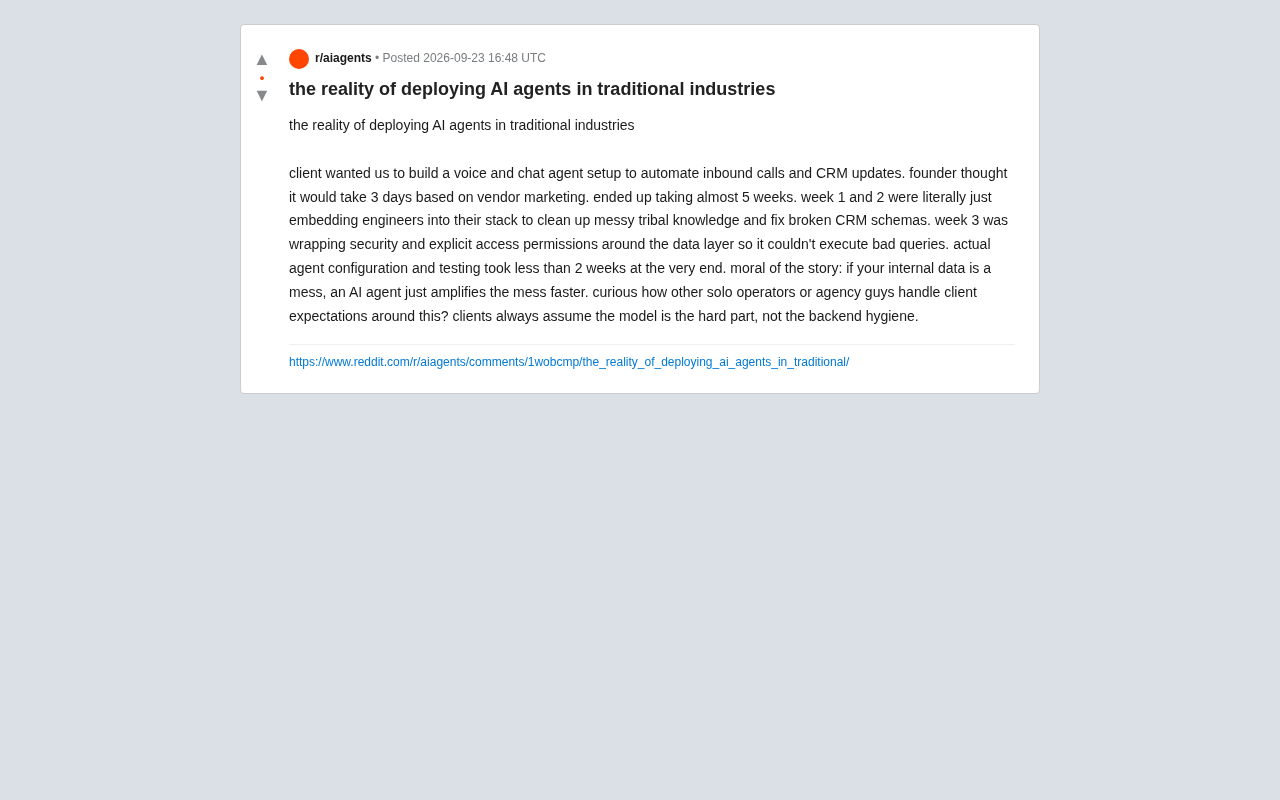
The post resonated widely because it punctured a pervasive myth: clients tend to assume the model itself is the hard part, while overlooking the fact that backend data hygiene is what actually determines whether a project succeeds or fails.
Where Did the Time Go? Breaking Down 5 Weeks of Real Work
Based on the original post, the time distribution of this project is highly representative of what real deployments look like:
Weeks 1–2: Cleaning up "tribal knowledge" and repairing the CRM schema. Engineers had to deeply embed themselves in the client's tech stack, dealing with knowledge scattered across the organization that existed only in long-tenured employees' heads — what's often called "tribal knowledge" — while simultaneously repairing the broken CRM data schema. This work is tedious but non-negotiable. If the underlying data fields are poorly defined and relationships are broken, no automation can function correctly.
Week 3: Wrapping the data layer with security controls and explicit access permissions. The core goal here was to prevent the Agent from executing incorrect or dangerous queries. When you connect a self-directed AI to a production database without guardrails, it can potentially delete, overwrite, or expose critical data. Permission boundaries around the data layer are essential.
The final ~2 weeks: Actual Agent configuration and testing. This is what clients imagine is "all the work" — but it represented just over a third of the entire project timeline.
The Core Insight: AI Will Amplify Chaos, Just Faster
The post's author landed on one brilliantly concise observation: "If your internal data is a mess, an AI Agent will just make that mess faster."
Every organization considering AI automation should sit with that line for a moment. Conventional wisdom treats AI as a silver bullet for solving problems, but AI Agents are fundamentally execution amplifiers — they faithfully operate according to the data and processes already in place. When the underlying data contains errors, an Agent doesn't correct them; it propagates them across the entire system at a speed no human operator could match.
In other words, automating a chaotic process just gives you a faster, larger-scale version of that chaos. This is precisely why, when deploying AI in traditional industries, upfront "data governance" work is almost always more important than "model selection."
Why Traditional Industries Are Especially Vulnerable
The biggest difference between traditional industries and digitally native companies is the maturity of their data assets. Many traditional enterprises have run CRM and ERP systems for years, accumulating a long tail of legacy issues: inconsistent field naming, duplicate records, broken relationships, and countless undocumented business rules.
In the era of purely manual operations, these problems were hidden by the buffer of human judgment — experienced employees could instinctively tell which data record was correct or which process had exceptions. But when an AI Agent takes over, that tacit knowledge must be made explicit and structured. Without that foundation, the Agent simply cannot make correct decisions.
This is exactly why the engineers in this case spent two full weeks doing what you might call "data archaeology." The work is invisible and unglamorous, yet it directly determines whether the Agent downstream will run reliably.
"Data Governance" refers to the systems, policies, and processes governing data definition, quality, security, and lifecycle management — typically including data dictionary maintenance, Master Data Management (MDM), and data quality scoring. Digitally native companies often bake these considerations into their architecture from the start. Traditional enterprises, by contrast, tend to have IT systems assembled piecemeal across different eras by different vendors, leaving natural gaps in data governance. "Model selection" refers to the technical choice between large language models like GPT-4, Claude, Gemini, and others. This is where most market marketing energy is concentrated, which is precisely why clients systematically misjudge where the real difficulty lies — assuming that upgrading to a better model will solve their problems, when in reality the difference in model capability has far less impact on outcomes than the quality of the underlying data.
What This Means for Practitioners: Managing Client Expectations
The post's author closes with an open question: as an independent developer or agency, how do you manage client expectations on projects like this? Clients will always assume the model is the hard part, not the backend cleanup.
Based on this case, a few practical suggestions are worth considering:
Do a data audit before quoting. Don't estimate timelines based on vendor marketing ideals. Assess the actual state of the client's data first. The messier the data, the larger the upfront investment.
List "data governance" as an explicit, standalone deliverable. Help clients understand that cleaning data and hardening permissions is valuable work — not a freebie bundled into the project. This sets realistic expectations and protects your margins.
Use the "amplifier" analogy to educate clients. Tell them directly: AI won't automatically fix your data problems — it will expose them at a faster rate. This framing tends to land far better with non-technical decision-makers than any amount of technical jargon.
Conclusion
This front-line case study offers a much-needed reality check for any organization harboring illusions about AI automation. AI Agents are genuinely powerful — but their value is highly dependent on the quality of the underlying data and processes. The real barrier has never been the model; it's always been the unglamorous, invisible backend hygiene work that determines whether everything else succeeds. For teams planning to deploy AI in traditional industries, building a solid foundation first is far more important than rushing to construct an impressive-looking automation layer on top of it.
Background Notes
"Tribal Knowledge" is a concept from organizational behavior referring to business rules, operational conventions, and exception-handling logic that exist only in specific employees' heads and have never been formally documented. This knowledge accumulates heavily in long-running organizations: why a particular field only accepts a specific format, why certain customer records have duplicate entries, why a process has exceptions at quarter-end — all things only experienced employees know from memory. A CRM's "schema" refers to the overall structure of field definitions, data types, relationships, and constraint rules in a database. When a schema is broken or poorly designed, fields may contain data of the wrong type, or relationships between tables may be severed, causing any automation that depends on that data to receive incorrect inputs.
In software architecture, data-layer access control is typically implemented through several mechanisms: database-level role-based access control (RBAC), API gateway access policies, and row-level security (RLS) for specific operations. For AI Agents, this step is especially critical, because modern Agent frameworks (such as LangChain, AutoGen, etc.) routinely grant Agents the autonomous ability to invoke tools and execute database queries. Without explicit permission boundaries, a vaguely worded natural-language instruction could be translated into a DELETE or UPDATE statement that causes irreversible damage to production data. The Principle of Least Privilege — meaning an Agent holds only the minimum permissions required to complete its current task — is therefore a foundational security requirement for any AI system connected to production infrastructure.
Related articles

Workbuddy for Absolute Beginners: How a Desktop AI Agent Fits Into Real Workflows
A beginner's guide to the Workbuddy desktop AI agent: installation, claiming credits, file management, and building automated workflows—compared with CodeX for fit and cost, helping professionals shift from AI question-askers to AI managers.

OpenAI's New Agent Stack: Computer Use, Decisions API, and Ultra-Fast Workflows
OpenAI Dev Day unveiled a new agent stack: Computer Use outperforms humans, Decisions API delivers ultra-low-latency classification via Luna, Agents API opens the same Computer Use capabilities, and GPT-6.1 Sol costs only one-seventh of Astra. Core updates, benchmark data, and developer insights.

Liang Wenfeng Open-Sources DeepInfo Inference Framework, Takes On U.S. Ban
DeepSeek open-sources its DeepInfo inference framework after its models, featuring GPU/CPU cross-pipelining, small-model prediction with large-model verification, and full Huawei Ascend and NVIDIA chip support—facing the U.S. federal ban head-on. This article analyzes its significance for AI deployment and open-source strategy.