The Truth About Free Cloud LLMs: The Business Logic Behind the Free Tier

Unpacking the business logic and hidden restrictions behind free cloud LLM offerings.
AI aggregation platforms offer free cloud models like MiniMax M3 and Nemotron-3-Ultra, but these come at real computational costs. This article explores the three key business drivers — customer acquisition funnels, vendor promotional subsidies, and data value exchange — and reveals hidden restrictions including rate limits, reduced context windows, and lower service priority that free-tier users should be aware of.
A Reddit User's Unexpected Discovery
Recently, a Reddit user stumbled upon an interesting finding while using an AI development platform: the platform was actually offering a batch of cloud models labeled as "free." This user had been carefully managing their Pro subscription budget, worried about overspending, when they unexpectedly noticed that these free options included some computationally intensive models, such as MiniMax M3 and Nemotron-3-Ultra.
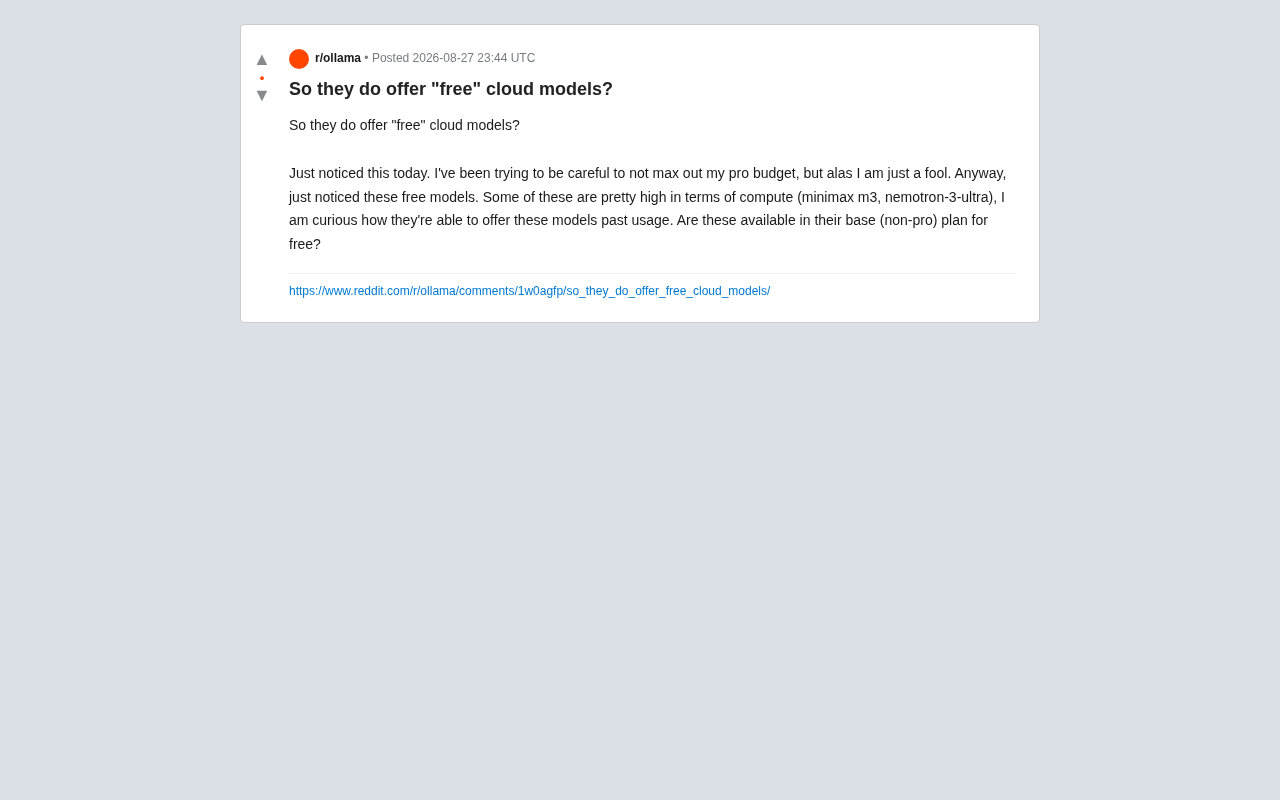
It's worth providing some background on these two models. MiniMax is a China-based AI startup that has risen rapidly in the large language model and multimodal model space in recent years. Its M3 series is known for high performance and multilingual capabilities, particularly excelling in long-text processing and complex reasoning tasks. Nemotron-3-Ultra is part of NVIDIA's large language model lineup, developed using NVIDIA's proprietary NeMo training framework and deeply optimized by leveraging the company's extensive expertise in GPU hardware and the CUDA ecosystem. A notable feature of the Nemotron series is its ability to achieve extremely high inference efficiency on NVIDIA's own hardware, making it a key vehicle for NVIDIA to promote its AI software and hardware ecosystem. The reason these two models being labeled "free" is so noteworthy is that the computational resources required to run them are anything but cheap — take Nemotron-3-Ultra as an example, whose parameter scale and inference complexity mean that each API call consumes substantial GPU compute.
The user immediately raised a question that every cost-conscious user would care about: How are these models able to offer their services for free? And are they also available to basic (non-Pro) users? This seemingly simple question actually touches on the core of current AI service business models.
It's worth noting that the AI development platform in question belongs to an emerging category known as "model aggregation platforms." These platforms don't train their own models. Instead, they package models from various providers (such as OpenAI, Anthropic, Google, Meta, NVIDIA, etc.) and offer them to developers through standardized API interfaces. Representative platforms include OpenRouter, Together AI, and Fireworks AI. Their core value lies in reducing developers' integration costs and switching costs — developers don't need to register and manage accounts with multiple model providers separately; they can call dozens of models on demand through a single platform. These platforms typically profit by adding a markup on top of the model provider's inference costs, while securing volume discounts through bulk purchasing. Offering free models is a critical strategy for these platforms to acquire initial users and build developer ecosystems.
"Free" Isn't Really Free
For ordinary users, the first reaction to seeing a "free" label is usually excitement. But from an industry perspective, running a model as massive as Nemotron-3-Ultra comes with substantial per-inference compute costs. GPU clusters, electricity, bandwidth — these are all very real expenses.
Specifically, running LLM inference services requires high-performance GPU clusters. The current industry standard uses NVIDIA A100 or H100 GPUs. Taking the H100 as an example, a single card costs roughly $25,000 to $40,000, and a cluster capable of supporting large-scale concurrent inference requests typically requires hundreds or even thousands of these GPUs. Beyond hardware procurement costs, power consumption is another massive expense — a medium-sized AI inference data center can consume tens of megawatts annually, with electricity bills running into tens of millions of dollars. There are also indirect costs like network bandwidth, cooling systems, and operations staff. Industry estimates suggest that a single conversational inference call on a GPT-4-class model costs anywhere from a few cents to several tens of cents, depending on the input/output token count and context length. This means that even for "free" models, the platform is paying real money for every user request it serves.
So why are platforms willing to subsidize these services at a loss?
Customer Acquisition and Conversion Funnels
Free models are essentially "experience bait." Platforms let users try high-performance models for free to build usage habits and dependency, ultimately guiding them to upgrade to paid Pro or enterprise tiers. Free quotas typically come with hidden limitations — lower rate limits, longer queue times, or degraded service during peak hours.
Promotional Subsidies from Model Providers
Model developers like MiniMax and NVIDIA (the company behind the Nemotron series) sometimes partner with aggregation platforms, subsidizing the cost to make their models freely available for a period. This helps them gather real-world usage data and build word-of-mouth. For model providers, this is a low-cost market education strategy.
Hidden Returns Through Data Value
In the terms of service of some platforms, conversation data from free-tier users may be used for further model training or quality evaluation. Users trade their "data" for free compute — a less visible but very real exchange.
Free Models Often Come with Hidden Restrictions
Returning to the user's core question — are these free models available to basic-tier users? The answer is typically "yes, but with conditions."
Types of Restrictions to Watch For
-
Rate and Quota Limits: Free models often have strict caps on requests per minute or per day. Once exceeded, you'll need to wait or pay. Rate limits are the most common traffic control mechanism in API services, typically measured in RPM (Requests Per Minute) or TPM (Tokens Per Minute). For example, OpenAI's free-tier API limits GPT-3.5-turbo to 3 requests per minute, while paid users can reach hundreds or even thousands per minute. This tiered throttling design serves both as a technical safeguard against service overload and a commercial strategy to encourage paid upgrades. When users hit the rate limit, the API typically returns an HTTP 429 status code (Too Many Requests), and users need to wait for a cooldown period or implement an exponential backoff retry strategy in their code. For developers who need to call models frequently, rate limits directly determine application responsiveness and user experience.
-
Reduced Context Length: Some platforms reduce the maximum context window for models available to free users. The context window refers to the maximum number of tokens a large language model can process in a single inference, determining how much text the model can "see" at once. For example, GPT-4 Turbo has a context window of 128K tokens, roughly equivalent to a 300-page book; Claude 3's context window reaches 200K tokens. A larger context window yields better performance on tasks like long document analysis, multi-turn conversation memory retention, and codebase comprehension, but the corresponding computational resource consumption grows superlinearly — because the computational complexity of the self-attention mechanism in Transformer architectures scales quadratically with context length (though various optimization techniques like Flash Attention have partially mitigated this issue). Therefore, reducing the context window for free users is an efficient cost control measure for platforms, providing a basic experience while significantly lowering the compute consumption per request.
-
Lower Service Priority: Paid users' requests are processed first. Free users may experience noticeable latency when servers are busy.
-
May Go Offline at Any Time: "Free" is often time-limited or experimental in nature, and platforms reserve the right to adjust the available model list at any time.
For users who rely on these models for serious development work, treating free models as a stable dependency in production environments is risky. They're better suited for exploration, testing, and learning.
How Users Should Approach Free AI Models Rationally
The Reddit user self-deprecatingly called themselves "just a fool," but their cautious attitude is actually commendable. In an era of increasingly commercialized AI services, understanding the cost structure behind "free" helps us make smarter decisions.
A Few Practical Tips
- Read the Terms of Service Carefully: Pay special attention to data usage policies and the specific limitations of free quotas.
- Distinguish Between Exploration and Production: Free models are suitable for prototype validation. For critical business operations, paid services with SLA guarantees are still recommended. An SLA (Service Level Agreement) is a formal commitment between a service provider and customer regarding service quality, typically covering availability (e.g., 99.9% uptime guarantee), maximum response latency, failure recovery time, and breach compensation terms. In the AI API services space, SLAs are particularly important because many enterprises have deeply integrated large language models into critical business processes such as customer service systems, content moderation workflows, and search recommendation engines. If an AI service goes down or latency spikes, it can directly lead to business disruption and revenue loss. Paid-tier AI services typically commit to explicit SLA metrics and provide service credit compensation when targets are missed; free tiers, on the other hand, offer virtually no SLA guarantees, and platforms can degrade, throttle, or completely interrupt service without notice.
- Be Aware of Model Retirement Risks: Don't over-commit your architecture to a free option that could disappear at any time.
- Make the Most of Free Windows: Vendor-subsidized periods are excellent opportunities to experience top-tier models (like Nemotron-3-Ultra) at low cost — seize them while they last.
Conclusion
The old saying "there's no such thing as a free lunch" still holds true in the AI era. Free cloud models offered by platforms are essentially the product of customer acquisition costs, vendor subsidies, and data value all intertwined. For users, understanding this logic lets you take advantage of the free offerings while avoiding being tripped up by restrictive terms at critical moments. This Reddit user's discovery may seem small, but it reminds us: while enjoying the dividends of AI, maintaining a clear understanding of the underlying business models is always worthwhile.
Related articles

Amphibious Transforming Drone: Beyond 100x Power Savings, What Are the Real Needs?
Is the amphibious transforming drone just a gimmick? Starting from the 100x power difference of the M4 Morphobot, explore real application scenarios and thesis topic ideas, analyzing boundary conditions where pure drones and pure ground robots both fail.

Warhound Raises $200 Million: Genetically Engineered "War Dogs" Paired with Anduril Gear
Warhound raises $200M, backed by Ben Lamm and Palmer Luckey, to genetically engineer dogs for military and law enforcement use and equip them with Anduril gear. This article analyzes its technology direction, funding logic, and ethical controversy.

Claude API Comes to Google Cloud: IAM Integration and SDK Access Guide
Anthropic hosts the full Claude API on Google Cloud with IAM-controlled permissions and unified billing. This guide covers the Vertex AI and Anthropic-hosted entry points, IAM role configuration, and SDK access.