The Truth About Free LLM APIs: No Account Needed, But Limits Are Tighter Than You Think

Free LLM APIs shrank sharply in 2026, and agentic use burns limited quotas fast—verify and switch dynamically.
Based on October 2026 testing and official docs, the article surveys the free LLM API landscape: GitHub Models, Cerebras's free tier, Gemini CLI, and QN Code free logins have all shut down, following a recognizable pattern of quota cuts, deprecation notices, and silent doc changes. Remaining options include no-account OpenCode Xen (10-14 rotating models), OpenRouter (17 free models but only 50 requests/day), Google AI Studio, Grok, and Cloudflare Workers. The article stresses that agentic workflows consume about 6 requests and 40K input tokens per small fix, making "50/day" enough for only 6-8 small fixes; each OpenRouter free model has a single host, so a busy host returns 429 with no failover. The author advises against hardcoding model IDs, verifying limits where they're enforced, and switching models on errors rather than retrying.
The State of Free LLM APIs: The 2026 Shakeup
If you're still relying on those online lists promising "1,000 free requests per day," it's time to update your assumptions. According to a guide published by the YouTube channel Big Iron on October 19, 2026, several services that once promised generous free quotas have shut down or significantly scaled back—and most online lists haven't caught up.
This year saw a notable contraction in free tiers: GitHub Models retired in July, Cerebras ended its free tier in August, and the free logins behind Gemini CLI and QN Code were shut down in June and April respectively. The author explicitly notes in the video that these shutdowns were not without warning signs—first quotas are cut, then deprecation notices are issued, and finally the documentation quietly changes. It's a recognizable pattern.

The remaining options are still useful, but they work differently now. The author emphasizes that all data comes from each provider's official pages during that week, and since the author didn't create accounts, the limits are "as documented" rather than "empirically measured."
The Free Options That Actually Work Today
OpenCode Xen: The Zero-Barrier Entry Point
The easiest option is the Xen provider built into OpenCode, which requires no account at all. The author confirmed in a fresh install environment that it rotates through 10 to 14 free models, including Big Pickle, GLM 5.3 Flash, and DeepSeq V4.1 Flash. All models are marked "free for a limited time," with no explicit limits published.
In testing, all 10 listed models passed a small coding task, with only one timing out. For anyone who wants to try a coding agent at zero cost, this is the lowest-barrier path.
OpenRouter: The Largest Catalog, But Limits Require Careful Planning
OpenRouter offers the largest catalog of free models. On October 19, the author recorded 17 free models out of 471, plus a free auto-router. The limits are 20 requests per minute and 50 per day.
One mechanism worth noting: after a one-time purchase of $10 in credits, the daily cap rises to $1,000 in credits—even after you've spent those credits. However, as analyzed below, this "generous" number isn't roomy for agentic use.
Auto Router is a routing mechanism offered by OpenRouter: instead of manually specifying a model, users let the platform automatically select a backend model based on factors like request content, model availability, and cost. For the free tier, the auto-router typically prioritizes the free model pool, but its behavior is opaque—users can't predict which model a given request will land on, or whether that model is currently rate-limited. This means that while the auto-router saves you the trouble of choosing a model, it offloads the 429 risk to the platform's scheduling logic: if its chosen single host is busy, the request will fail just the same. Therefore, in agentic workflows, explicitly specifying models and preparing fallbacks is often more controllable than relying on auto-routing.
Google AI Studio: The Free Gateway to Gemini
Google AI Studio covers Gemini Flash, Flashlight, 2.5 Pro, and Gemma 4. But Google no longer publishes per-model free limits, and the author recommends checking your own dashboard rather than old data. The trade-off to weigh: free-tier content is used to improve Google products.
Grok: Fast, But Token Caps Are Very Tight
Grok's docs list limits of 30 requests per minute, 1,000 per day, and 200,000 tokens per model per day. But the key constraint is only 8,000 tokens per minute, and limits are calculated per organization—creating multiple keys doesn't help.
Other Smaller Options
Cloudflare Workers offers 10,000 free neurons per day (resetting at UTC midnight), but there's no simple conversion between neurons and tokens. Users report roughly 40 requests per minute, and requests are logged. Mistral's experimental plan reportedly allows about one request per second, and requests may be used for training. Hugging Face offers 10 cents in credits per month.
The Free-Tier Graveyard: These Recommendations Are Outdated
The author lists four defunct options and warns: if any guide or video recommends them, no matter how recently published, it's already outdated.
- GitHub Models: The entire service has been retired
- Cerebras free tier: Ran until August 17, replaced by a one-time $5 credit that requires a payment method and expires after 30 days
- Gemini CLI free personal login: Stopped on June 18
- QN Code free hosted models: Shut down on April 15
These tools themselves still exist and are open source; what ended was the free models behind them. Both now require keys—Gemini can pair with a free AI Studio key (Flash models only, with lower limits than the old login), or point to other providers.
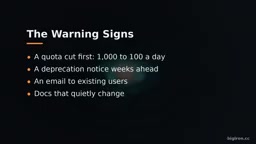
The shutdown pattern the author summarizes is worth remembering: first quotas are cut (QN Code went from 1,000 to 100 per day, then shut down), deprecation notices are issued weeks in advance, emails are sent to existing users, and documentation quietly changes. If a free tier you depend on cuts quotas or requires a card on file, start migrating before the shutdown notice arrives.
The "Weekly" Volatility of Free Model Catalogs
Free lists don't just disappear—they're constantly changing. The author recorded OpenCode's no-account free list on a disposable VM: at 2:04 UTC it listed 12 free models; at 2:09 it was 10—three disappeared, one was added. Five snapshots over the following 50 minutes were identical, while the Zen documentation page read the previous night listed 14.
OpenRouter changes more slowly but in the same direction: the oldest of its 17 free models was added in March, and two were added during the week of testing. An author who compiled a free list in June reported in October that none of them were still free.
The practical takeaway is straightforward: never hardcode free model IDs, don't build habits around a specific model's quirks, and re-check data terms when a model reappears. The author provides two endpoints that read current lists without a key: OpenRouter's public models endpoint (use JQ to filter IDs ending in ":free") and OpenCode's model list (filter for its own provider).
Agentic Use: Why "50 Per Day" Isn't Nearly Enough
Free tiers advertise two kinds of limits: per-minute rates and daily quotas. People worry about the rate, but the quota is what actually bites. A chat window makes one request per message—an agent doesn't.
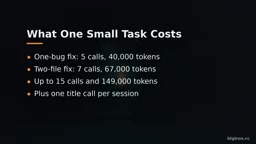
The author counted OpenCode's calls across 10 free models: fixing one bug took a median of 5 calls and 40,000 input tokens; two bugs in two files took 7 calls and 67,000 tokens, peaking at 15 calls and 149,000 tokens. On top of that, OpenCode makes one small call per session to generate a title. So a small fix is roughly 6 requests.
Even asking the model to reply "pong" consumed about 7,700 input tokens—the baseline of agent system prompts and tool definitions sent with every call. In other words, every agent request carries thousands of tokens before the question even starts.
Plug these numbers into the documented limits: OpenRouter's 50 requests per day works out to about 6 to 8 small fixes; after buying the $10 tier, 1,000 per day works out to about 120 to 160—unless the host refuses first. Grok runs out of tokens first, allowing 3 to 5 fixes per day, and its 8,000 tokens per minute is smaller than a single Claude Code request.
And these are single-file small tasks. Real sessions consume several times that, and heavier runtimes cost more: on the test VM, Claude Code's first request was 64.8KB versus OpenCode's 31.1KB. Prompt caching doesn't save quota, because one request still counts as one request.
The 429 Error: The Real Pain Point of Free Models
The most common complaint about OpenRouter's free models isn't the daily cap—it's getting a 429 (Too Many Requests) after barely using anything. One tester in September found that 4 of 19 free models refused requests from the test VM with a 429.
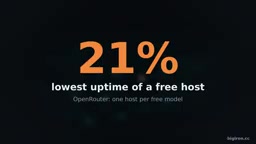
The reason: every free model on OpenRouter has exactly one host. The author checked all 17. When that host is busy, there's no room for failover. Published uptime from the previous day ranged from 100% to 21%. So treat a 429 as "this model is unavailable" and just switch models.
HTTP 429 (Too Many Requests) is the standard rate-limiting status code, indicating that the client sent more requests within a given time window than the server allows. Responses usually include a Retry-After header indicating the recommended wait time before retrying. In the context of OpenRouter free models, 429s come from two sources: first, the user themselves triggering the 20-per-minute rate limit; second, the upstream single host rejecting the request due to excessive global load. The former can be resolved with backoff and retry; the latter means the model is currently unavailable, and retries are usually futile. Distinguishing the two is critical for agentic workflows: wait in the former case, switch models in the latter. Many SDKs default to exponential backoff on 429, which in a single-host scenario can simply waste your daily quota.
Practical Strategies: How to Combine Free Tiers
Most providers support the OpenAI Chat Completions API, so one request can work anywhere: change the base URL, change the key, change the model. The author tests endpoints with deliberately wrong keys—a 401 means the URL is right, a 404 means it's wrong. OpenCode Zen requires no key at all.
Keys and environment variables should be stored safely and never written into committed scripts. Limits live where they're actually enforced, so check them there: OpenRouter's rate-limit response headers, Grok's console page caps, AI Studio projects, Cloudflare dashboards. The author recommends logging response headers and status codes for a week before trusting any free tier.
Choose tools by task: to try a coding agent with zero signup, use OpenCode's free models; to experiment across multiple models, use OpenRouter (expect 429s and churn); if you need Gemini and accept the data terms, use AI Studio; for speed, use Grok; for privacy-sensitive or daily-driver tasks, use local models—no caps, no churn, no data terms.
Free is still viable, provided you read current lists, verify where limits are enforced, and switch models when problems arise instead of retrying repeatedly. The author also reminds us that these lists change week to week—sometimes within minutes.
OpenAI Chat Completions API compatibility has become the de facto industry standard: many third-party providers (OpenRouter, Groq, Mistral, local Ollama/vLLM, etc.) expose endpoints with the same /v1/chat/completions structure, with largely compatible request bodies and response formats. This lets you switch backends by "changing the base URL, changing the key, changing the model name" without rewriting client code. But compatibility doesn't mean identical behavior: error code semantics, rate-limit response header naming (e.g., whether x-ratelimit-remaining-requests exists), streaming response details, and tool-calling formats may differ. This is why the article recommends probing endpoints with a wrong key (401 means the URL is correct, 404 means the path is wrong) and logging response headers for a week—essentially verifying the compatibility layer's actual behavior rather than assuming it fully matches the conversational API.
Background Notes
Prompt Caching is an optimization offered by several LLM providers: when multiple requests share the same prefix (such as system prompts, tool definitions, or long documents), the server caches that computation, and subsequent requests only process the new content, reducing latency and billed token counts. Note, however, that caching optimizes token billing and latency; it does not change how request counts are measured. For free tiers whose limits are expressed as requests per minute or per day, caching doesn't turn one agent call into half a call—each round of tool calls and each file read by the agent still counts as a separate request. This is exactly why the article emphasizes that "prompt caching doesn't save quota": the bottleneck of free tiers is request count, not tokens, and caching can't help with that.
Related articles

AI Can Read Neural Network Weights Directly: Do Models Already Exceed Expectations?
A Reddit developer experiment shows language models can directly read neural network weights and infer their function. Astra, Opus 5.5, and Muse Spark 1.3 all passed the test, sparking discussion on model generalization and training sources.

India's Microdrama Market Explodes: EloElo Secures $80M Investment from NBCUniversal
EloElo secures $80M from NBCUniversal to boost StoryTV, its microdrama platform with over 33M monthly active users, as India's microdrama market draws global capital.

Acoustic Detection of Multi-Rotor UAVs: Fusing Handcrafted Features with Pre-Trained Embeddings
Study reveals data leakage from random splits in UAV acoustic detection, proposes source-disjoint protocol with stacked ensemble of handcrafted features and YAMNet embeddings, achieving 95.29% accuracy for low-cost drone detection.