The Truth Behind Claude's Challenge Loop: How Wayfinder Skills Let AI Build Real Apps in One Shot

Challenge Loop + Wayfinder spec files let AI agents build original real-world apps reliably in a single pass.
The Challenge Loop is a multi-agent orchestration architecture where a main agent breaks tasks into parallel subagents, each paired with a memory-free Critic that loops until output meets a quality benchmark. While it can build complete apps from three lines of prompts, it has two fatal flaws: the main agent self-manages verification logic, and quality benchmarks require existing products as references — causing Critics to hallucinate standards for original projects. Wayfinder fixes this by explicitly resolving all design decisions through a "fog-clearing" planning process and generating a verifiable spec document to serve as the Critic's anchor. A real-world HR system built with this combined approach took ~1.5 hours and cost ~$116 in API usage, delivering functionality that matched the spec.
Challenge Loop: Building Complete Apps from a Single Prompt
The "Challenge Loop" has been generating serious buzz on X and YouTube lately, enabling developers to build large-scale applications and high-quality games from minimal prompts in a single pass. It went viral after Matt Schumer posted a demo where Claude built a first-person shooter game from a single prompt — no existing assets used. The result blew past what most people expected from a model, and the post exploded.
To understand the Challenge Loop, you first need to understand what a "loop" is. Before loops existed, building something with Claude meant you played the role of "checker": send a prompt, review the output, point out errors, iterate until it's right. Loops break that back-and-forth — you give the agent a goal and criteria, it keeps checking its own work until it meets the bar, and you only see the result at the end.
The Challenge Loop is a new kind of loop. Its key innovation: instead of letting the agent judge whether something is "good enough" on its own terms, you give it a real-world product as a quality benchmark. Schumer set the bar for his game agent at "AAA quality on par with the latest Call of Duty," giving the agent a concrete reference point. Andrej Karpathy, one of OpenAI's founding members, noted that results like this matter — because work of this caliber was previously "not worth doing," and models are breaking through that ceiling.
How Three Lines of Prompts Power the Whole Thing
Surprisingly, the prompt Schumer published was just three lines — yet it built an entire game. Each line handles a different part of the build, and it's simple enough to adapt for any project.
Line one defines what to build: Schumer wrote that he wanted a first-person shooter, with the second half defining quality standards — AAA-level quality, with everything from textures to physics being flawless.
Line two defines how to build it: The main agent is told to break the goal into smaller pieces and hand each piece off to independent subagents. Subagents are separate agent instances spun up by the main agent, each handling a small task within its own memory context, with no visibility into what other agents are doing. Critically, the prompt requires each subagent to be paired with a reviewing subagent called a "Critic." The Critic's only job is to evaluate — if something isn't good enough, it sends the work back to the build agent for revision until it passes. The Critic never builds anything itself, has no prior memory, and delivers nothing but brutally honest assessments.
Line three defines the final quality threshold: It tells the Critic when it can stop. The instruction is for the Critic to do a "blind comparison" — it doesn't know which output is Claude's and which is the reference product; it simply picks the better one.
There's one more key term at the end of the prompt: "Ultrathink" (referred to as "Ultra Code" in the video), which is a Claude Code feature that runs large numbers of subagents simultaneously. When many subagents are running in parallel loops, they form a "graph" — the Challenge Loop draws a diamond-shaped graph: one task at the top splits into parallel subagents, which then converge back into a single agent that synthesizes the final answer.
Subagents and multi-agent orchestration are the key underlying concepts here. In a traditional single-turn conversation, one model instance processes all tasks sequentially. In a multi-agent architecture, an "Orchestrator" dynamically instantiates multiple "Subagents," each with its own independent context window containing only the information relevant to its specific task. This delivers two advantages: parallel execution dramatically reduces total time, and context isolation prevents information from different tasks from contaminating each other — reducing the quality degradation caused by "attention dilution." The Critic agent is deliberately designed with no memory history to prevent it from developing tolerance for low-quality work through accumulated bias — every evaluation starts from zero, ensuring consistent standards. Ultrathink/Ultra Code is a scheduling directive in Claude Code that triggers large-scale parallel subagent deployment — essentially telling the runtime to allocate more concurrent compute resources to the task.
Two Fatal Flaws That Nobody's Talking About
Even though many people are using the Challenge Loop to complete entire projects in one shot, it has two critical problems — and these are precisely what make it great for games but hard to use for real-world projects.
Problem one: the main agent is completely self-managing. The main agent decides how to instantiate the Critic and write its instructions — you have no control over how it passes judgment criteria to the Critic. Verification should have more specific external configuration, rather than letting the agent validate everything itself. At small scale it works, but long-term you can't identify the real root cause of problems.
Problem two: quality benchmarks depend on existing products. The quality benchmark in the prompt is a ready-made product (like Call of Duty), and the Critic has something real to compare against. Building games, landing pages, or 3D worlds is fine, because there's always something to reference. But when you're building something entirely new — like billing rules specific to your own business — there's no existing app to hand the Critic, so the Critic invents standards and approves work based on those invented standards. By the time you realize it's been building in the wrong direction, you've wasted enormous amounts of time and tokens.
In other words, the Challenge Loop works when there's "something close enough to copy" — and falls apart the moment there's no reference to work from.
These two problems correspond to two classic challenges in AI systems design. The self-managing main agent problem is an instance of the "Self-referential Validation" dilemma: using the same logic to both generate and verify content makes it impossible to detect systematic bias — it's like letting a student write their own exam and grade it themselves. The reliance on existing products for quality benchmarks corresponds to "Out-of-Distribution Generalization" failure — models perform robustly in domains well-covered by training data (mainstream games, common applications), but face genuinely novel business logic (like a specific company's billing rules), they can't reliably extrapolate from known patterns and resort to hallucination to fill the gaps. This explains why the Challenge Loop works reliably in "general domains with abundant references" but fails systematically against "highly customized, original requirements."
Wayfinder: Clearing the Planning Fog with a Spec Document
The fix comes in two parts: first, verify that you've planned what to check rather than letting the agent invent criteria; second, give the loop concrete requirements so it doesn't drift off course. This is exactly where Wayfinder comes in — a skill built by software developer Matt Pocock.
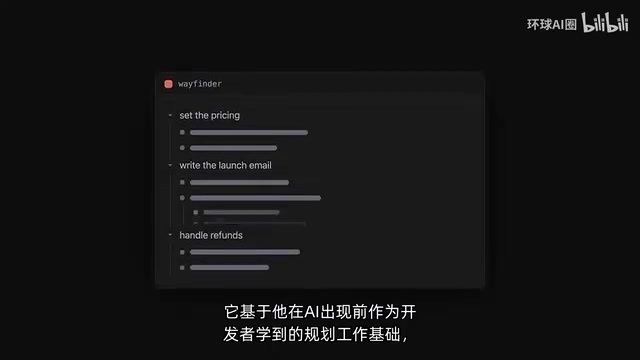
Wayfinder is a "dense planning skill" from a suite of skills Pocock published, based on planning methods he developed as a developer before AI existed, requiring no coding whatsoever. The core pain point it addresses: agents never tell you they're "in the fog" — they fill gaps with their own assumptions and keep planning, giving you something that looks complete but has fabricated sections in the middle.
Wayfinder works by constructing a "map" that places every decision that needs to be made as a question on the map. These questions fall into two groups: ones that can be resolved now (dependencies are confirmed), and ones still in the fog (blocked by something uninvestigated). When it hits fog, Wayfinder doesn't guess — it sends the agent to clear the fog through research, building rough prototypes to test, or doing real-world work (like signing up for a service to evaluate it). Each question is handled individually; once resolved, the answer goes back to the map and unlocks the next step, until there's no more fog.
Finally, Wayfinder converts all decisions into a "Spec" — a document describing what to build and why. This spec is exactly what the Challenge Loop has been missing: just as Call of Duty serves as the benchmark for the game, the spec becomes a solid foundation for validating completion criteria. Every decision in it has been actually resolved rather than assumed, giving the Critic a reliable reference to evaluate against.
The concept of "Planning Fog" draws on the uncertainty problem in software engineering requirements, analogous to the military term "Fog of War." In traditional software development, ambiguous requirements are the leading cause of project rework — developers push forward on assumptions when information is lacking, and contradictions only surface during integration testing. AI agents face the same problem, but more insidiously: the model doesn't throw an error and stop — it fills the blanks with plausible-sounding content, producing a plan that looks complete on the surface but is fictional at its core. Spec documents have a long tradition in software engineering, from RFCs (Request for Comments documents) to user stories in agile development — all fundamentally aimed at aligning stakeholder expectations in natural language or structured documents before coding begins. Wayfinder adapts this established engineering practice into an AI-executable workflow, making the spec document both a planning output and a verification anchor for subsequent Critic agents.
Real-World Demo: Building an HR System with a Modified Wayfinder
The video walks through a complete example using an HR system (supporting leave requests, complaint submissions, etc.). The original Wayfinder can be installed from GitHub, but it has one issue: it plans in exhaustive detail, taking you all the way to a complete spec. For this use case, only the planning portion — the part that achieves "clarity" — is needed.
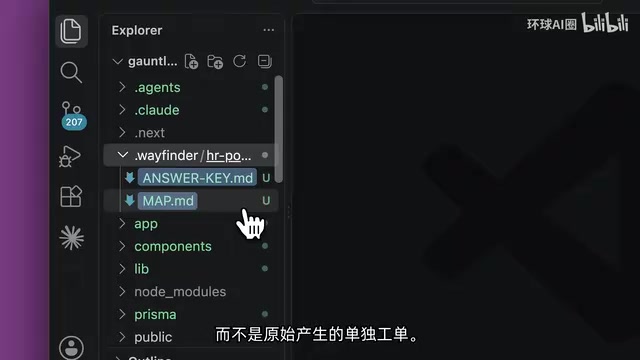
So they had Claude modify the skill: instead of writing multiple separate files, it converts decisions into a single answer file for the agent to self-check against. The modified version only writes two files — the map and the answer file — and streamlines dependencies on Pocock's other skills, ultimately requiring just three skills (with the Grimm skill used for the questioning phase).
When run, the agent raised 34 questions about the HR system: who the application is for, what must be included, what should be excluded, what it should look like when finished, and what problems users might encounter. After a lengthy back-and-forth, it wrote two files into a .wayfinder folder — the map (recording each decision and its rationale) and the answer file (returning pass/fail checks for each item).
Then the original Challenge Loop prompt Matt published was copied and handed to Claude, asking it to rewrite it for the HR system. The only change was the benchmark: instead of a game, the .wayfinder folder serves as the "source of truth" — everything gets checked against its contents, exactly as Call of Duty functioned in the original version. It was explicitly told there are no shortcuts and no "close enough" substitutes.
Claude first planned what to build, what tools to install, and the foundational work, then simultaneously launched multiple agents to handle different parts of the system. The entire build took 1 hour and 33 minutes and consumed roughly 40% of the usage limit. Running the same build via the API would cost approximately $116. Not cheap — but the output was an application built to spec, with every feature working correctly. Minor issues existed, but overall it came close to the stated requirements.
Takeaway: The Key to Getting AI to Build Real Projects
The Challenge Loop's viral success reveals the enormous potential of parallel AI agent collaboration — but the "self-evaluation" and "reliance on existing benchmarks" flaws make it difficult to apply directly to original projects. Wayfinder's value lies in using a rigorous planning process to produce a verifiable spec document, transforming "the Critic inventing standards from thin air" into "the Critic checking against a solid spec."
The core insight from this combination has broad implications for developers: the reliability of an AI agent doesn't depend on how clever your prompt is — it depends on whether you've given it clear, verifiable criteria for success. When there's no existing product to benchmark against, clear the planning fog first, then let the loop run.
Related articles
Getting Started with Ollama: The Essential Tool for Local Open-Source LLM Deployment
Learn what Ollama is and why it matters: a free, open-source tool for deploying LLMs like DeepSeek locally, with GPU/CPU support, cross-platform compatibility, and API access for private AI apps.

Letting AI Build AI Tools: A 7-Day, 31-Commit Bootstrapping Post-Mortem
An engineer ran a fully autonomous AI-builds-AI pipeline for 7 days, 31 commits, with a 1-in-6 success rate. This post-mortem covers 5 failure types, 11 structural rules, and how every mistake became a permanent immunity gate.
Building an AI-Powered E-Commerce Business from Scratch: A Real-World Account of Multi-Agent Architecture for Print-on-Demand
A blogger builds a print-on-demand e-commerce company from scratch using AI agents — documenting specialized Agent profiles, GPT-5.6 vs Claude Fable multi-model orchestration, and reusable skill accumulation.