The Two-Lane Gradient Turntable Property of Truncated BPTT: A Theoretical Breakthrough

Theoretical study proves truncated BPTT gradient error decays exponentially with distance from context boundaries, forming a two-lane gradient turntable property.
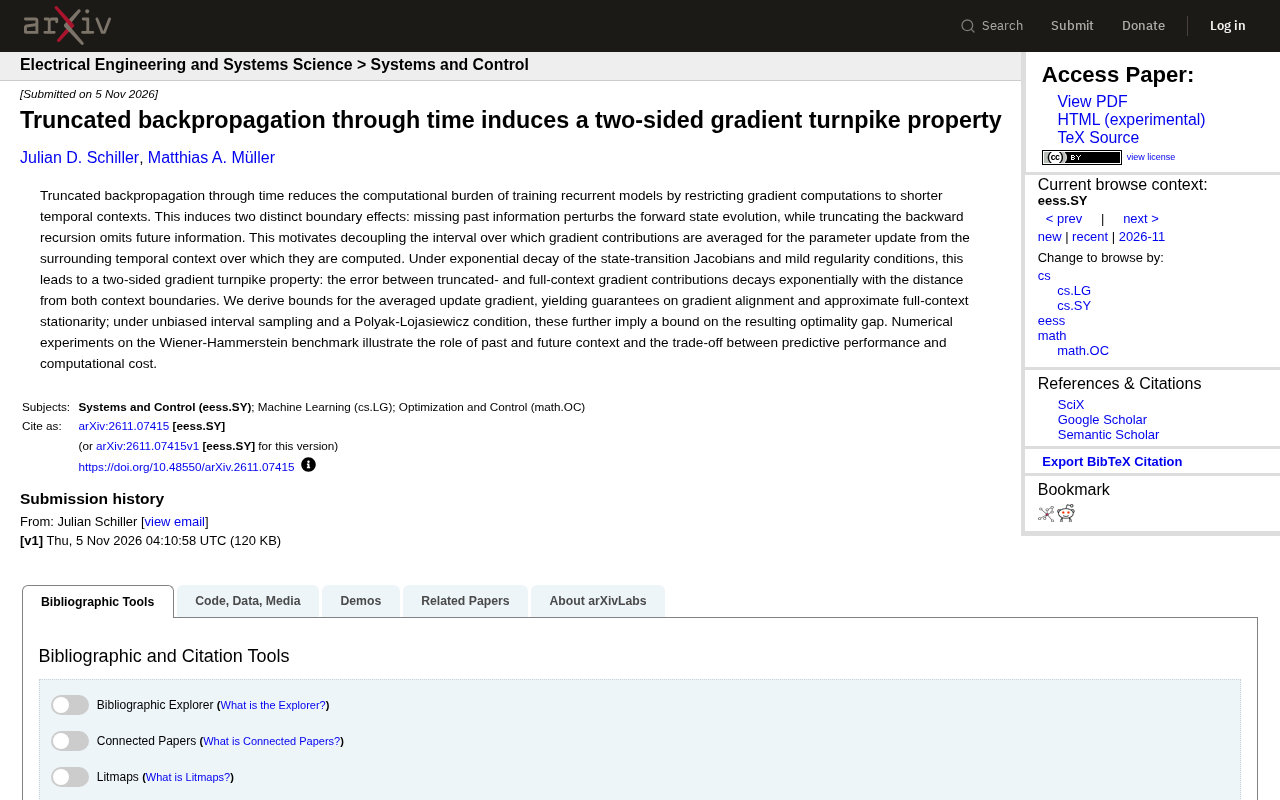
This article presents a theoretical study on Truncated BPTT. Although it reduces the computational and memory overhead of RNN training, it introduces gradient bias. The study decouples the parameter update interval from the gradient computation interval, analyzes past and future boundary effects, and proves that under exponentially decaying state-transition Jacobians, the error between truncated and full-context gradients decays exponentially with distance from the context boundaries—the "two-lane gradient turntable property." It derives error bounds for gradient alignment and stationarity, and an optimality gap bound under the Polyak-Lojasiewicz condition. Wiener-Hammerstein experiments validate the theory and the performance-cost trade-off, informing truncation window selection and adaptive training design.
When training recurrent neural networks, Truncated Backpropagation Through Time (Truncated BPTT) is a common technique for reducing computational burden, but the gradient bias it introduces has long lacked a rigorous theoretical characterization. A recent theoretical study shows that, under the assumption of exponentially decaying state-transition Jacobians, the error between truncated gradients and full-context gradients decays exponentially as the distance to the context boundaries increases, forming a "two-lane gradient turntable" property. This finding offers a new theoretical perspective for understanding the trade-off between truncation length and model performance.
Two Boundary Effects of Truncated BPTT
Truncated BPTT reduces memory and computation by limiting the time range over which gradients are computed, but this operation introduces information loss from two directions. Looking forward, missing past information perturbs the forward state evolution; looking backward, the truncated backward recursion discards future information. Together, these two types of boundary effects cause the truncated gradient to deviate from the full-context gradient.
The study decouples the averaging interval of parameter updates from the context interval covered by gradient computation, allowing a clearer analysis of the individual effects of the two boundary phenomena. This decoupled perspective is key to understanding the subsequent theoretical results.
Truncated Backpropagation Through Time (Truncated BPTT) is a gradient computation strategy used when training recurrent neural networks (RNNs). Standard BPTT requires backpropagating gradients along the entire sequence, and the computational graph and memory overhead grow linearly with sequence length, making long-sequence training impractical. Truncated BPTT works by splitting a long sequence into several fixed-length segments (i.e., truncation windows) and backpropagating gradients only within each window; historical states outside the window are treated as constants and do not receive gradients. This limits memory usage to the window length and substantially reduces computation. The cost is that gradients cover only a finite temporal context, deviating from the full-context gradient that uses all historical information. Truncation length therefore becomes a key hyperparameter: too short and the bias is large, making it hard for the model to capture long-range dependencies; too long and the computational savings are lost.
The Two-Lane Gradient Turntable Property
Under the assumptions that the state-transition Jacobian decays exponentially and mild regularity conditions hold, the study derives a core conclusion: the error between the truncated gradient and the full-context gradient decays exponentially as the distance to both context boundaries increases. This means that, as long as the gradient computation window is sufficiently long, the gradient contributions in the central region of the window are nearly identical to those of the full context.
The authors call this phenomenon the "two-lane gradient turntable property," analogous to the turnpike phenomenon in optimal control—where the system state is "attracted" to a neighborhood of an optimal path. Here, the gradient contribution is likewise "attracted" to the neighborhood of the full-context gradient, converging simultaneously from both the past and future directions.
The state-transition Jacobian matrix characterizes the sensitivity of an RNN's hidden state to the previous hidden state, i.e., the matrix of partial derivatives of the state-transition function with respect to the state. In an RNN, backpropagating gradients through time requires repeatedly multiplying the Jacobian matrices at each time step, and the norm behavior of this product determines whether gradients can be effectively propagated to distant steps. If the spectral norm or singular values of the Jacobian decay exponentially with the number of steps, the system has a "forgetting" property, and the influence of early states on later states diminishes rapidly. Conversely, if the product norm grows, gradient explosion may occur. The vanishing and exploding gradient problems stem precisely from the long-term behavior of this product. The core assumption of the paper—exponential decay of the Jacobian—is essentially a quantitative characterization of RNN stability and memory length, and it is the precondition for the conclusion that the error decays exponentially with distance to the context boundaries.
Theoretical Guarantees and Practical Significance
Building on the above property, the study further provides error bounds for the average update gradient, thereby guaranteeing gradient alignment and approximate full-context stationarity. Under unbiased interval sampling and the Polyak-Lojasiewicz condition, these results also yield bounds on the optimality gap. This provides theoretical support for the practice of truncated BPTT: truncation is not merely a simple approximation but a controllable one under certain conditions.
Numerical experiments on the Wiener-Hammerstein benchmark validate the theoretical analysis, demonstrating the respective roles of past and future context as well as the trade-off between predictive performance and computational cost. The experiments show that a reasonable choice of truncation window can significantly reduce computational overhead while maintaining performance.
The Polyak-Lojasiewicz (PL) condition is a class of conditions in optimization theory weaker than strong convexity; it does not require the objective function to be convex, only that the squared gradient norm can control the gap between the function value and the optimum. Under the PL condition, gradient descent achieves a linear convergence rate, i.e., the error shrinks geometrically. Using the PL condition, the paper converts the error bound for gradient alignment into a bound on the optimality gap, showing that even with truncated gradients, as long as the truncation window is sufficiently long and the gradient error sufficiently small, the gap between the final optimized solution and the solution obtained with full-context gradients is bounded. This elevates the theoretical conclusions beyond "gradient approximation" to a direct guarantee on the model's final performance.
The Wiener-Hammerstein benchmark is a model structure commonly used for system identification and sequence modeling tests, consisting of a linear dynamical system followed by a static nonlinearity and then another linear time-invariant system: the input first passes through a linear time-invariant system, then through a memoryless nonlinear function, and finally through another linear time-invariant system. This structure contains both linear dynamic memory and nonlinear transformation, and thus can better simulate the "dynamic + nonlinear" combination found in real systems; it is therefore often used as a standard testbed for checking whether recurrent models can capture long-range dependencies and nonlinear relationships. Comparing predictive performance and computational cost under different truncation windows on this benchmark intuitively demonstrates the trade-off predicted by the theory.
Implications for Recurrent Model Training
This theoretical result has guiding significance for practical training. It shows that the choice of truncation window should not be based on experience alone but should be designed in accordance with the decay rate of the state-transition Jacobian. When the Jacobian decays quickly, a shorter truncation window suffices to approach the full-context gradient; otherwise, a longer window is needed.
Moreover, the idea of decoupling the parameter update interval from the gradient computation interval opens a new direction for designing more efficient training algorithms. In the future, it may be possible to adaptively adjust the truncation length based on this property, achieving a better balance between computational efficiency and gradient accuracy.
One-line Summary
A theoretical study proves that the gradient error of truncated BPTT decays exponentially with distance from the context boundaries, forming a two-lane gradient turntable property.
Paragraph Summary
This article introduces a theoretical study on Truncated Backpropagation Through Time (Truncated BPTT). Although truncated BPTT reduces the computational and memory overhead of training recurrent neural networks, it introduces gradient bias that has long lacked rigorous characterization. The study decouples the parameter update interval from the gradient computation interval, separately analyzes the past and future boundary effects, and proves—under the assumption of exponentially decaying state-transition Jacobians—that the error between truncated and full-context gradients decays exponentially with distance from the context boundaries, i.e., the "two-lane gradient turntable property." On this basis, it provides error bounds for gradient alignment and approximate stationarity, and derives an optimality gap bound under the Polyak-Lojasiewicz condition. Experiments on the Wiener-Hammerstein benchmark validate the theory and demonstrate the trade-off between predictive performance and computational cost, providing a basis for choosing truncation windows and designing adaptive training algorithms.
Related articles
 Tech Frontiers
Stylome Bot Slammed as Useless Junk: Why Do AI Detection Tools Keep Failing?
Reddit users test the Stylome AI detection bot: Gemini-rewritten text judged human-written, consistently low confidence. An analysis of AI text detection's technical dilemmas, privacy concerns, and credibility crisis in community governance.
 Tech Frontiers
When AI Becomes a Productivity Divide: Clarity or "AI Psychosis"?
A civil engineer's deep use of agentic AI boosted efficiency but bred contempt for peers who refuse to learn. Is this clarity or AI psychosis? An analysis of the cognitive and psychological challenges behind the AI productivity divide.
 Tech Frontiers
Opus 5.5 Benchmark Scores Climb, Community Says Its "Weights Are Blessed"
Reddit community discusses Opus 5.5's rising scores on the Benchmaxxing Bench, with users describing its performance as "weights are blessed." This article interprets the community reaction and cautions against conflating benchmark scores with real capability.