The U.S. Military's Race for Synthetic Blood: Ending Battlefield Reliance on Donated Blood?

The U.S. military develops synthetic blood to end battlefield transfusion dependence, while battery tech shifts toward safety-cost trade-offs.
The U.S. military is advancing synthetic blood research, driven by the high risk of battlefield blood transport—a 2007 blood transport helicopter shootdown was a catalyst. Routes include stem-cell-cultured red blood cells, synthetic oxygen carriers, and freeze-dried plasma, all limited by cost, side effects, or function; the goal is a bridging solution. The same issue of The Download also covers battery tech shifting from energy density to safety, charging speed, and cost, with solid-state and sodium-ion batteries as key directions. Both threads share a logic of ensuring critical resources under extreme conditions.
The U.S. military is pushing forward with a controversial line of research—creating synthetic blood to end battlefield transfusions' reliance on human donors. This is not just a medical challenge; it also involves a complex interplay of military logistics and ethics.
It Starts with a Downed Helicopter
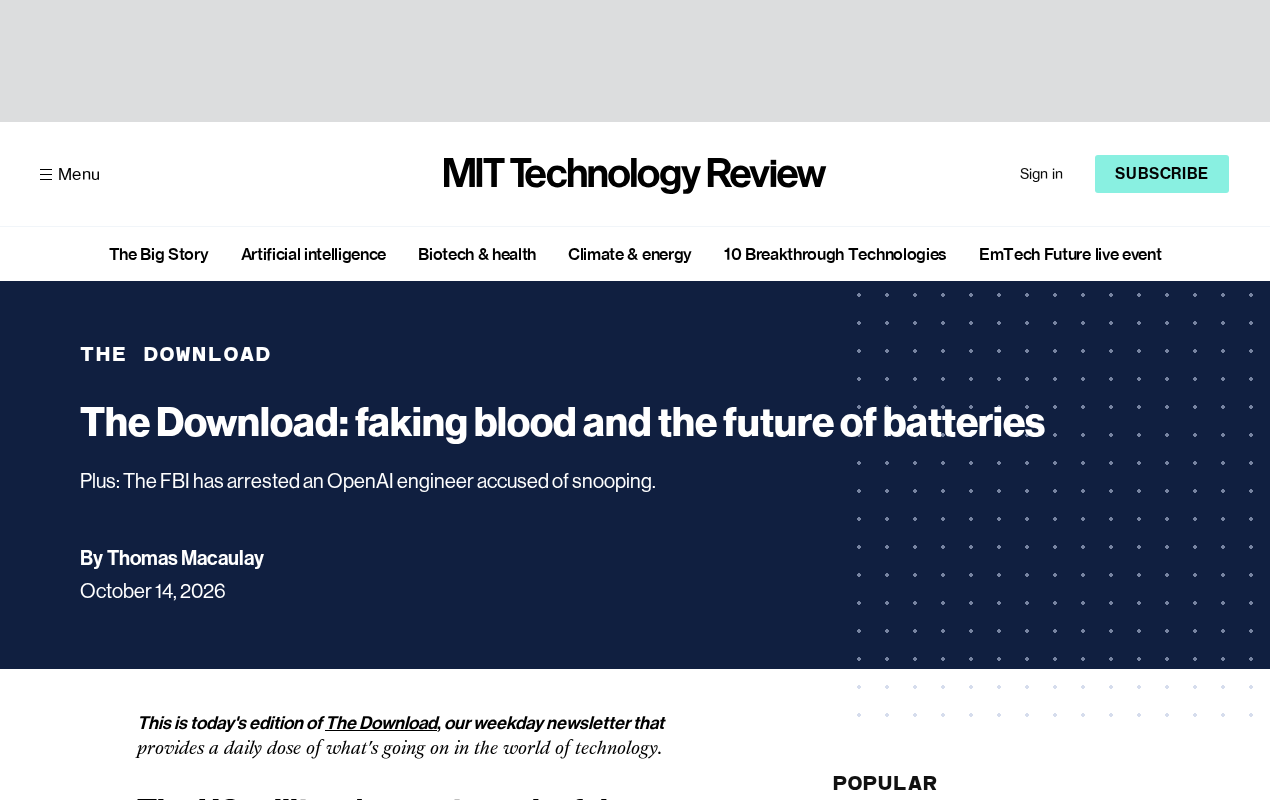
According to The Download, the news briefing from MIT Technology Review, in February 2007 a U.S. military helicopter carrying blood to a field hospital was shot down in Iraq, killing all seven crew members on board. This incident became one of the catalysts for the U.S. military to accelerate research into synthetic blood.
Blood is extremely vulnerable in transport on the battlefield: it requires temperature control, has a short shelf life, and once a transport route is exposed, it can become a target. If blood could be manufactured on site, frontline medical care would no longer be constrained by a fragile supply chain.
This need has driven long-term U.S. military investment in blood substitutes. The research involves not only how to mimic red blood cells' oxygen-carrying capacity, but also a series of physiological challenges such as coagulation and immune rejection.
Technical Routes and Bottlenecks for Synthetic Blood
Current synthetic blood research focuses mainly on several directions: one is using stem cells to culture red blood cells; another is synthesizing oxygen-carrying carriers, such as hemoglobin-based blood substitutes; and a third is developing freeze-dried plasma so it can be stored long-term at room temperature.
Each route has its own limitations. Stem cell culture is costly and slow; synthetic carriers may cause cardiovascular side effects; and freeze-dried plasma cannot fully replace the functions of whole blood. The U.S. military's goal is not to completely replace human blood, but to provide a "bridging" solution in emergencies, buying time for wounded personnel to be evacuated.
You may not have noticed that synthetic blood research is not unique to the U.S. military. Several biotechnology companies and academic institutions are also exploring similar directions, but the urgency of military demand has made the U.S. military a central driver in this field.
Hemoglobin-based oxygen carriers (HBOCs) are one of the most closely watched and most controversial routes in synthetic blood. The idea is to extract hemoglobin directly from bovine or human blood, chemically modify it, and turn it into an injectable oxygen-carrying solution. Early HBOC products exposed obvious problems in clinical trials: free hemoglobin scavenges nitric oxide, leading to vasoconstriction, elevated blood pressure, and an increased risk of myocardial infarction and stroke. In addition, because hemoglobin in plasma is not enclosed by a red blood cell membrane, it is quickly cleared by the kidneys and has a short half-life. In recent years, researchers have tried to reduce toxicity through cross-linking, polymerization, or encapsulation, but as of now, no HBOC has received full FDA approval for clinical use in the United States.
Freeze-dried plasma is another path that is closer to practical use. Unlike whole blood and red blood cells, plasma can be stored for years at room temperature after freeze-drying, and when needed it only has to be reconstituted with sterile water before infusion. This makes it especially suitable for battlefields and remote areas. But plasma mainly provides clotting factors and volume expansion, and does not have the oxygen-carrying function of red blood cells, so it can only serve as a "bridging" measure and cannot replace whole blood. That is exactly the U.S. military's goal: to sustain vital signs before evacuating the wounded, rather than completely replacing human blood donation.
The Future Direction of Battery Technology
The same issue of The Download also looked at the future of battery technology. As demand surges for electric vehicles, energy storage systems, and consumer electronics, battery R&D is shifting from a pure energy density race to a comprehensive trade-off among safety, charging speed, and cost.
Solid-state batteries are seen as a key direction for the next generation of technology, promising to improve energy density while reducing fire risk. But mass production of solid-state batteries still faces engineering challenges such as interfacial impedance and material stability. That said, sodium-ion batteries, thanks to abundant raw materials and low cost, are becoming a strong complement to lithium-ion batteries.
The evolution of battery technology will profoundly affect the pace of the energy transition. Whether for grid-scale energy storage or portable devices, requirements for battery performance are constantly rising, and technological breakthroughs often come from cross-disciplinary innovation in materials science and manufacturing processes.
The core change in solid-state batteries is replacing the liquid electrolyte in traditional lithium-ion batteries with a solid electrolyte. Liquid electrolytes are flammable and are the main source of thermal runaway and fires in lithium batteries. Solid electrolytes are nonflammable and resistant to high temperatures, and in theory can improve both safety and energy density. However, the commercialization of solid-state batteries faces two major engineering bottlenecks: one is interfacial impedance, where insufficient contact between the solid electrode and solid electrolyte reduces ion transport efficiency; the other is material stability, as some solid electrolytes undergo side reactions with electrodes during repeated charge and discharge cycles, or decompose at high voltage. At present, many companies have launched semi-solid-state batteries as a transitional solution, but large-scale mass production of all-solid-state batteries still takes time.
Sodium-ion batteries take a different route: rather than pursuing extreme energy density, they win on abundant raw materials and low cost. Sodium is far more abundant in the Earth's crust than lithium, and sodium-ion batteries can use aluminum foil as a current collector, further reducing cost. Their drawback is lower energy density, making them more suitable for grid-scale energy storage and low-speed electric vehicles where weight is less sensitive. Against the backdrop of volatile lithium prices and supply chain risks, sodium-ion batteries are seen as an important complement to lithium-ion batteries, not a replacement.
Two Seemingly Unrelated Threads of Technology
Synthetic blood and battery technology may at first glance belong to two different fields, medicine and energy, but they share an underlying logic: ensuring the availability of critical resources under extreme conditions. Blood supply on the battlefield and electricity supply in remote areas both face the dilemmas of high transport costs and poor environmental adaptability.
The U.S. military's investment in synthetic blood reflects the spillover effects of military technology on civilian technology. Similarly, advances in battery technology will first benefit scenarios with extremely high reliability requirements, such as national defense and aerospace, before gradually trickling down to consumer markets.
Judging from the content of this issue of The Download, the value of technology news lies not only in reporting a single breakthrough, but also in revealing hidden connections between different fields. Synthetic blood and battery technology are typical examples of exactly that kind of connection.
One-line Summary
The U.S. military is developing synthetic blood to end battlefield transfusion dependence, while battery technology is moving toward a comprehensive trade-off between safety and cost.
Paragraph Summary
The U.S. military is advancing research into synthetic blood, driven directly by the high risks of battlefield blood transport—the downing of a blood transport helicopter in 2007 served as a catalyst. Synthetic blood routes include stem-cell-cultured red blood cells, synthetic oxygen carriers, and freeze-dried plasma, but all face limitations in cost, side effects, or function; the goal is to provide a "bridging" solution for the wounded. The same issue of The Download also looks at battery technology, noting that R&D is shifting from an energy density race toward a comprehensive trade-off among safety, charging speed, and cost, with solid-state and sodium-ion batteries as important directions. The two threads share an underlying logic: ensuring the availability of critical resources under extreme conditions, and reflecting the spillover effects of military technology on civilian technology.
Related articles

WorkBuddy Step-by-Step Tutorial: Get an Automated Workflow Running in Half an Hour
A step-by-step breakdown of the WorkBuddy automated workflow: why most people only use it as a chat app, how the 27-anchor course and 12 templates help beginners get up and running in half an hour, plus notes on usage boundaries.

The Truth About Free Claude Code: Three Legitimate Paths and One Scam
Is free Claude Code possible? We break down the real cost of Pro and Max (with exchange rates and taxes), how community free methods work and their privacy trade-offs, plus fake installers and phishing traps—and three legitimate free paths.
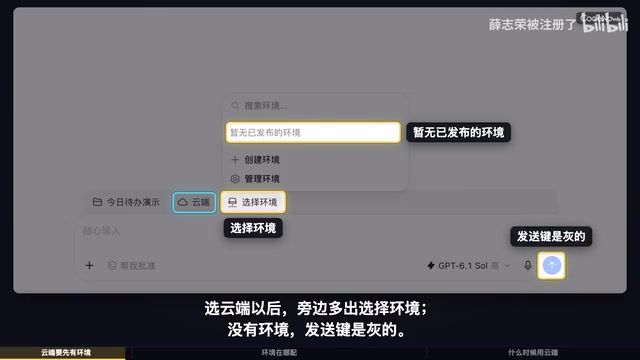
Codex Cloud Mode Explained: Environment Setup and Use Cases
This article explains how Codex cloud mode works, environment setup steps, and use cases, including how to create environments, connect GitHub repositories, set scheduled tasks, and compare cloud vs. local mode.