The Viral Hotel Lobby AI Rap Meme: Wan 3.0 Workflow and Consistency Breakdown

Breaking down the Hotel Lobby AI rap meme's generation pipeline and how vertical micro-tools beat general video models via scenario constraints.
Using the viral Hotel Lobby AI rap meme on TikTok as a starting point, the article analyzes three major failure modes general text-to-video models face when recreating the COLORS orange studio: background drift, portrait-to-video identity drift, and 4-second duration truncation. These problems stem from general models lacking prior constraints for specific scenes. Local ComfyUI solutions work but the 24GB VRAM barrier and fragile node dependencies have driven dedicated web micro-apps that package a Wan 3.0 backend into a browser workflow. The production pipeline has three stages: portrait preprocessing, parameter locking, and audio sync with subtitle compositing. The core conclusion: vertical micro-tools are beating general prompt portals by constraining latent spaces around specific cultural aesthetics.
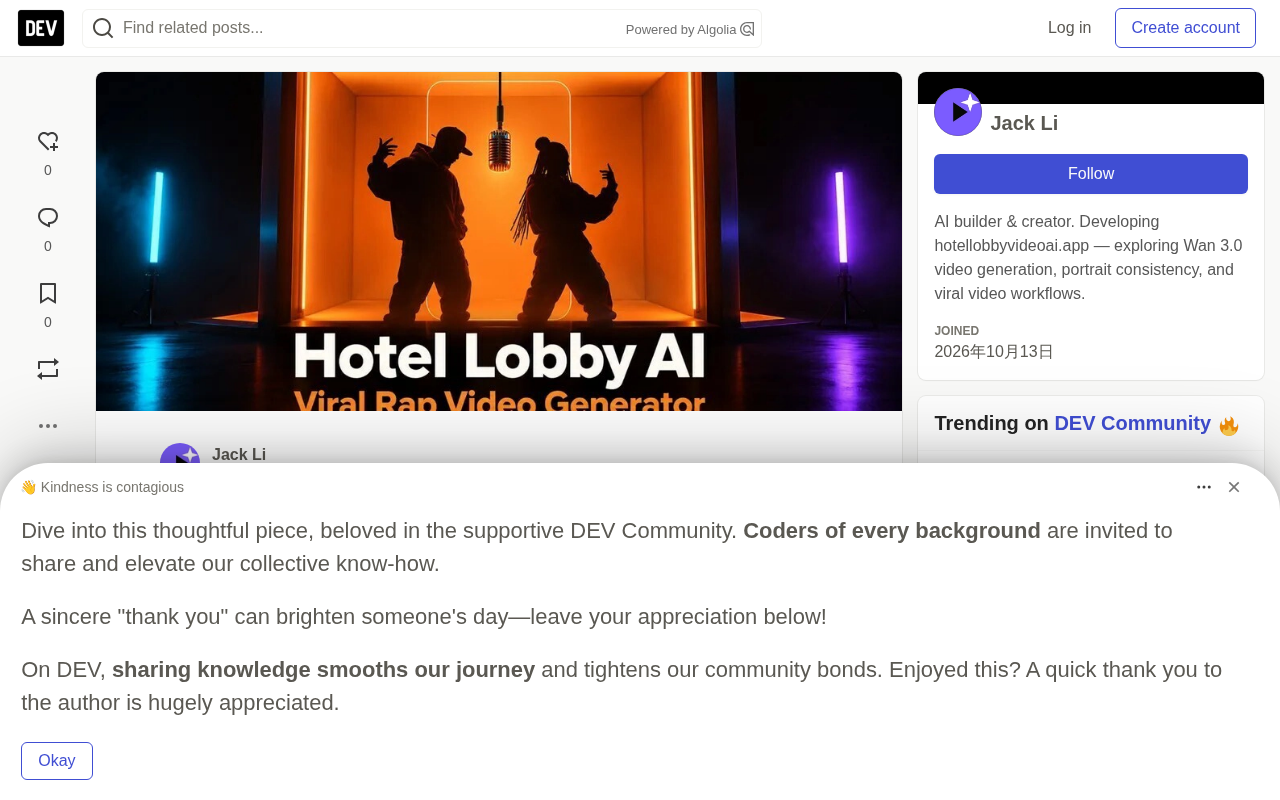
If you've scrolled through TikTok, Instagram Reels, or YouTube Shorts in the past few weeks, chances are you've seen the same visual template: a minimalist monochrome studio washed in orange, a suspended condenser microphone, and two animated avatars — from pixel-game characters to deadpan house pets — taking turns spitting rhymes while their bodies groove along.
The meme pays homage to Quavo and Takeoff's iconic performance of "HOTEL LOBBY" on A COLORS SHOW. Audiences tune in for the comedic punch, but from an AI engineering perspective, batch-generating this kind of high-retention video exposes a whole set of core challenges in multimodal video synthesis.
The Technical Hurdles: Temporal Consistency in Multi-Character Motion
Recreating the COLORS orange studio sounds simple, but general-purpose text-to-video engines fall apart at several points:
- Spatial depth and background drift: General diffusion models tend to distort minimalist backgrounds, warp the lighting rig, or hallucinate instruments that don't exist mid-clip.
- Portrait-to-video consistency: Injecting non-rigid motion — rap-style head bobs, shoulder grooves, mic handoffs — while preserving facial identity sends generic face-swap pipelines straight into the uncanny valley.
- Temporal coherence: The standard 4-second output cap on off-the-shelf models truncates rap verses, and creators need 6 to 15 seconds of coherent generation with stable lip-sync and body motion.
These three failure modes aren't isolated problems — they all point to one fact: general models lack prior constraints for a specific scene. Background drift stems from the model having no concept of a "fixed studio," identity drift comes from temporal attention modeling non-rigid motion unstably, and the duration limit directly caps the content's rhythm.
Temporal Consistency is the core difficulty that sets video generation apart from image generation. Image generation only needs to ensure a reasonable pixel distribution within a single frame, whereas video generation demands highly stable continuity across adjacent frames in spatial structure, identity features, lighting conditions, and other dimensions. Within the diffusion model framework, this is typically achieved through temporal attention layers: during denoising, the model doesn't just attend to spatial relationships within a single frame — it builds key-value associations across frames so the same character maintains consistent identity and form across different timesteps. However, as motion amplitude increases — rapid head bobs during rapping, shoulder grooves, mic handoffs — the modeling pressure on temporal attention spikes dramatically, making inter-frame jitter, gradual identity drift, and even localized structural collapse more likely. This is the fundamental reason why general video models perform far worse on non-rigid motion scenes than on static or slow-motion ones.
Saying Goodbye to the Heavy Local ComfyUI Stack
Not long ago, the only path to acceptable results was orchestrating custom ComfyUI node graphs alongside frontier video generation models like Wan 2.1 or Wan 3.0.
But the hardware barrier for local execution is steep:
- You need 24GB+ of VRAM (NVIDIA RTX 3090/4090 or a cloud A100 instance).
- Dependency management across motion modules, depth guidance, and face-lock nodes is fragile and brittle.
- High render latency doesn't match the pace of content creators chasing fast output.
To solve this friction, purpose-built micro-apps started appearing. Rather than making creators wrestle with bloated ComfyUI nodes, some web architectures package a dedicated Wan 3.0 backend into a streamlined browser workflow.
By hardcoding studio lighting, spatial camera angles, and head-bob latent vectors on the server side, these Hotel Lobby AI generators let users input a simple photo and render near-production-grade assets in minutes. The trade-off is clear: sacrifice generality for speed and consistency. For meme content, that trade-off is almost always worth it.
Wan 3.0 is a video generation model series from Alibaba's Tongyi Wanxiang team, built on a diffusion architecture that supports both text-to-video and image-to-video tasks. Compared to its predecessor Wan 2.1, Wan 3.0 delivers significant improvements in motion amplitude, temporal consistency, and resolution support — particularly strengthening its ability to model non-rigid human motion. The model natively supports multiple aspect ratios and incorporates a more refined temporal alignment strategy during training, allowing it to maintain solid inter-frame stability across 4-second to longer clips. In the ComfyUI ecosystem, Wan 3.0 typically serves as the core sampling node, working alongside auxiliary nodes for motion modules, depth guidance, and face locking to form a complete video synthesis pipeline. It's precisely this open-source, deployable nature that has made Wan 3.0 one of the most mainstream base models in current AI meme video production.
Architecture Breakdown: Three Steps to Publishable Output
Whether you're building an internal meme production line or deploying a "Hotel Lobby AI cat video generator," modern production pipelines follow three stages.
1. Source Portrait Preprocessing
Input cleanliness determines motion fidelity:
- Composition: An upper-body portrait gives the motion transfer engine enough bounding-box space to synthesize lively shoulder grooves and gestures.
- Lighting alignment: High-contrast frontal lighting ensures seamless blending with the matte orange studio atmosphere.
- Pet adaptation: When processing animal faces, high-precision eye and mouth keypoints prevent temporal blurring during vocalization.
2. Parameter Locking
- Aspect ratio: Hardcoded to native 9:16 vertical to avoid black bars from mobile platform secondary cropping.
- Frame rate and resolution: Target 1080p MP4 output to preserve facial edge sharpness even under aggressive social media compression.
- Duration: 6 seconds suits short, punchy looping memes; 15 seconds suits multi-segment back-and-forth duets.
3. Audio Sync and Compositing
Once video rendering is complete:
- Import into a downstream editing tool (CapCut, Premiere, or work directly inside TikTok).
- Align the main audio track's drop with the subject's first rap motion.
- Add high-contrast dynamic subtitles to drive retention and completion rates.
Key Takeaways for Generative AI Developers
The explosion of a single meme generator confirms a key trend in generative media: vertical micro-tools consistently outperform general-purpose prompt portals.
By constraining the latent space around a specific cultural aesthetic (like the COLORS studio), developers can optimize inference speed, lock in temporal consistency, and capture massive user demand before the algorithm shifts.
The lesson here extends beyond memes. It shows that as video generation capabilities become commoditized, competitive differentiation is shifting from "how powerful is the model" to "how precisely is the scenario packaged." While general models still set barriers with 24GB VRAM requirements and fragile node dependencies, products that hardcode specific aesthetics, ratios, and durations into the server side can reach real creators sooner.
For teams looking to replicate this model, Wan 3.0 is just the base layer — the real engineering value lies in three layers of constraint: input constraints (portrait preprocessing specs), parameter constraints (ratio/duration/resolution locking), and post-processing constraints (audio alignment and subtitle pacing). Whoever makes these three layers both stable and invisible will be first to catch the traffic when the next meme drops.
Latent Space Constraint is the core engineering technique behind vertical video generation tools. Diffusion models operate on high-dimensional latent vectors during denoising rather than generating pixels directly. By imposing specific constraints on the latent space during inference — for example, hardcoding the latent vectors in background regions to a fixed studio lighting pattern, or anchoring the initial noise of character poses to a preset head-bob motion distribution — developers can dramatically reduce output variance without retraining the model. The essence of this approach is replacing the general model's open exploration with prior knowledge, sacrificing generation diversity for speed and stability in a specific scenario. For meme content — where aesthetic boundaries are clear, fault tolerance is low, but creative direction is focused — latent space constraints offer far better value than repeatedly tuning a general model.
One-line Summary
A breakdown of the Hotel Lobby AI rap meme's generation pipeline, revealing how vertical micro-tools outperform general video models through scenario constraints.
Paragraph Summary
Using the viral Hotel Lobby AI rap meme on TikTok as a starting point, the article analyzes three major failure modes general text-to-video models face when recreating the COLORS orange studio: background drift, portrait-to-video identity drift, and 4-second duration truncation. The root cause is that general models lack prior constraints for specific scenes. Local ComfyUI solutions can produce acceptable results, but the 24GB VRAM barrier and fragile node dependency management have driven the rise of dedicated web micro-apps — packaging a Wan 3.0 backend into a browser workflow, trading generality for speed and consistency via hardcoded studio lighting, camera angles, and motion latent vectors. The production pipeline has three stages: source portrait preprocessing, parameter locking, and audio sync with subtitle compositing. The core conclusion: vertical micro-tools are beating general-purpose prompt portals by constraining latent spaces around specific cultural aesthetics.
Related articles

Gaussian Process Bandit Optimization: Exploration Strategies and Inference Regret Guarantees
Cumulative regret guarantees in Bayesian optimization fail to reflect final recommendation quality. This article examines a new study that provides inference regret guarantees for Gaussian process bandit optimization through exploration query strategies and fill distance analysis, validated on hyperparameter optimization and control tasks.

The Most Detailed Codex Guide on Bilibili: From Installation to Real-World Practice
The most detailed Codex guide on Bilibili: from app store installation to daily work mode configuration, with a real coffee shop project demonstrating file organization, data extraction, dashboard creation, and other practical tasks. Learn to use Plan Mode and desktop pets to leverage Codex efficiently.

Appearance Compensation in Volume Rendering: Why RGB Accuracy Cannot Guarantee Density Correctness
Volume rendering research reveals that volumetric data perfectly reproducing external RGB views may still contain density errors: appearance compensation can double central density and keep external rays unchanged even when L2 error exceeds 14.52%. Density recovery depends on appearance capacity, spatial resolution, and measurement design.