Theoretical Breakthrough in Subgroup Discovery: Decoding Optimal KL-Divergence Subgroup Structure

First structural theorem for maximum KL-divergence subgroups, proving optimal solutions consist of complete atoms and at most one fractional atom.
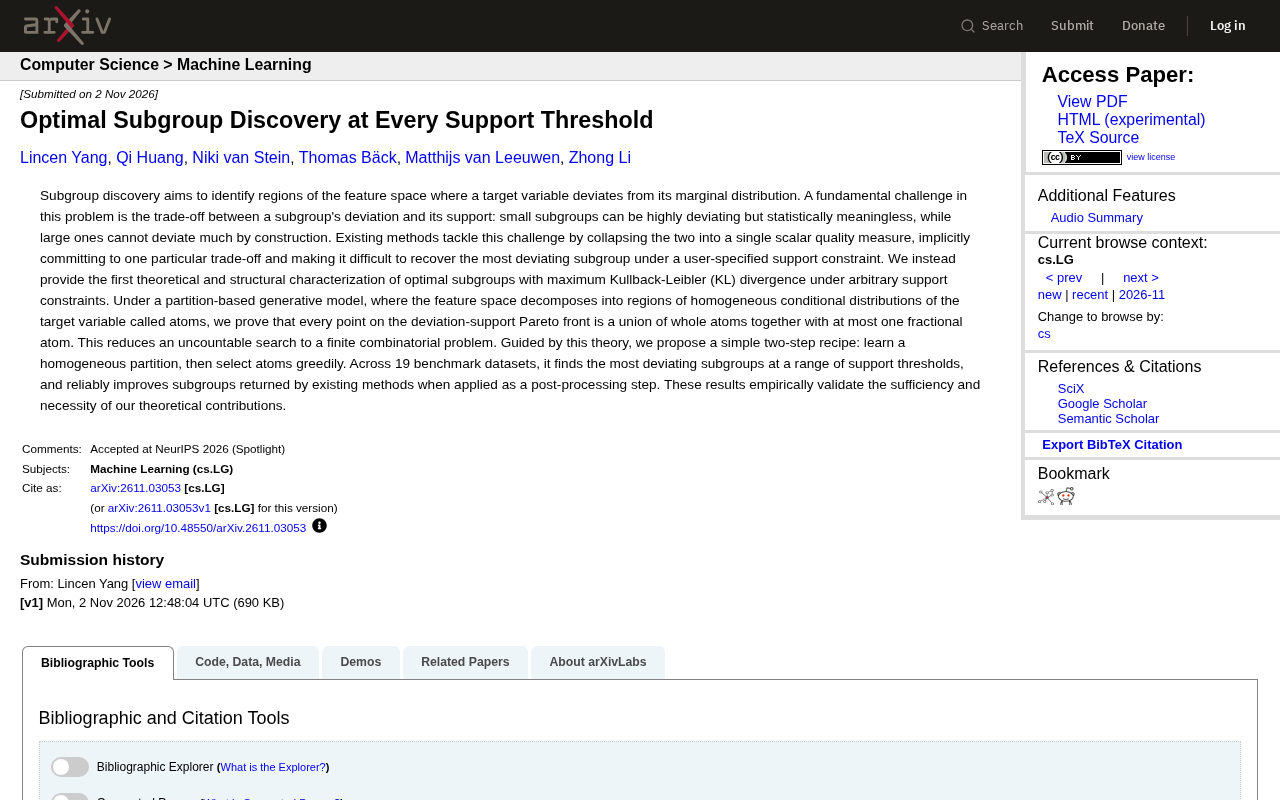
This paper tackles the long-standing deviation-support trade-off in subgroup discovery, providing the first theoretical and structural characterization of maximum KL-divergence subgroups under arbitrary support constraints. Under a partition-based generative model, the authors prove that every point on the deviation-support Pareto front is the union of complete atoms and at most one fractional atom, compressing the uncountable search space into a finite combinatorial problem. They propose a two-step method—learning a homogeneous partition and greedily selecting atoms—validated on 19 benchmark datasets, stably finding the most deviating subgroups across support thresholds and reliably improving existing methods as a post-processing step.
Theoretical Breakthrough in Subgroup Discovery: Decoding Optimal KL-Divergence Subgroup Structure
Subgroup Discovery is a classic problem in data mining, aimed at finding regions in feature space where the target variable deviates from its marginal distribution. But for a long time, researchers have faced a fundamental challenge: the trade-off between deviation and support. Small subgroups can deviate highly but lack statistical significance; large subgroups are constrained by construction and struggle to deviate substantially. Existing methods typically compress the two into a single scalar quality measure, implicitly locking in a particular trade-off, making it difficult to recover optimal subgroups under user-specified support constraints.
A recent paper presents the first theoretical and structural characterization of maximum KL-divergence subgroups under arbitrary support constraints, offering a new approach to this problem.
Core Theory: Atom Merging and the Structural Theorem of Fractional Atoms
The paper analyzes under a partition-based generative model: the feature space is decomposed into regions with homogeneous conditional distributions, called "atoms." Under this model, the researchers prove that every point on the deviation-support Pareto front is the union of several complete atoms and at most one fractional atom.
The significance of this structural theorem lies in compressing the originally uncountable search space into a finite combinatorial problem. In other words, rather than blindly searching over continuous support thresholds, one only needs to identify the atom structure to precisely characterize optimal subgroups. The theory also provides arguments for both sufficiency and necessity, laying a solid foundation for subsequent algorithm design.
KL divergence (Kullback-Leibler Divergence) is an asymmetric measure of the difference between two probability distributions, defined as (D_{KL}(P | Q) = \sum_x P(x) \log \frac{P(x)}{Q(x)}). In subgroup discovery, it is used to quantify the degree to which the target variable distribution within a subgroup deviates from the global marginal distribution: the larger the KL divergence, the more "anomalous" or "interesting" the subgroup. Compared with measures such as information gain and chi-squared statistics, KL divergence has a clear information-theoretic interpretation and is sensitive to differences in distribution tails, making it suitable for capturing small but highly deviating subgroups. However, KL divergence itself does not include a penalty for subgroup size, and direct maximization leads to overfitted small subgroups—this is precisely the fundamental reason for introducing support constraints.
Pareto Front in multi-objective optimization refers to a set of mutually non-dominated solutions: one cannot further improve one objective without sacrificing another. In the deviation-support trade-off, each point on the Pareto front represents an "optimal trade-off"—maximum deviation for a given support, or minimum support for a given deviation. Traditional methods compress the two objectives into a single number via a scalar quality measure (e.g., a weighted combination with an exponent), which essentially selects a fixed cut point on the Pareto front and thus cannot adapt to different user support preferences. The structural theorem in this paper directly characterizes the composition of the entire Pareto front, enabling users to obtain the corresponding optimal subgroup at any support threshold without re-tuning parameters.
Two-Step Recipe: Learn Homogeneous Partition, Greedily Select Atoms
Based on the above theory, the authors propose a concise two-step method:
- Learn a homogeneous partition: infer the atom structure from data, i.e., regions with consistent conditional distributions.
- Greedily select atoms: under a given support constraint, greedily select atoms to maximize KL divergence.
This "partition first, select later" strategy directly corresponds to the theoretical guarantees, avoiding the information loss caused by a single scalar measure in traditional methods. As a detail, the method does not rely on complex optimization techniques, yet it stably finds the most deviating subgroups across multiple support thresholds.
Homogeneous Partition refers to partitioning the feature space into several regions such that the conditional distribution of the target variable is the same within each region. This concept originates from sufficient dimension reduction and partition modeling: if two data points differ in all features but have consistent conditional distributions, they belong to the same "atom." Learning a homogeneous partition typically requires decision trees, clustering, or density-based segmentation methods to infer from data the boundaries where conditional distributions change. The quality of the partition directly determines the accuracy of subsequent atom selection—if the partition is too coarse, heterogeneity remains within atoms; if too fine, the number of atoms explodes and estimation variance increases. Experiments in the paper show that even with imperfect partitions, greedy selection still yields improvements, providing tolerance for practical applications.
Experimental Validation: Performance on 19 Benchmark Datasets
The paper conducts a systematic evaluation on 19 benchmark datasets. Results show that the method can identify the most deviating subgroups across various support thresholds. More critically, when applied as a post-processing step to existing methods, it reliably improves the quality of the subgroups they return.
This empirical result validates the sufficiency and necessity of the theoretical contribution: the structural theorem is not only mathematically elegant but also yields practical gains on real data. For application scenarios requiring fine control of support (e.g., anomaly detection, risk stratification), a method that can provide optimal solutions at any threshold has clear value.
Implications for the Subgroup Discovery Field
For a long time, the design of quality measures in subgroup discovery has often relied on empirical trade-offs, lacking theoretical understanding of the Pareto front structure. This work is the first to reveal the combinatorial nature of optimal subgroups at the atom level, opening new directions for future research.
A natural extension is: how do the theoretical guarantees degrade when the atom structure cannot be perfectly learned? The paper's experiments show that even with imperfect partitions, the greedy strategy still yields improvements, suggesting robustness to model error. In addition, how to efficiently learn atom partitions and how to handle high-dimensional feature spaces remain engineering questions worth exploring.
Overall, this research pushes subgroup discovery from "heuristic measure tuning" toward "structured optimal search," providing a new theoretical foundation for interpretable pattern mining under support constraints.
One-line Summary
First structural theorem for maximum KL-divergence subgroups, proving that optimal solutions consist of complete atoms and at most one fractional atom.
Paragraph Summary
This paper addresses the long-standing deviation-support trade-off in subgroup discovery and provides the first theoretical and structural characterization of maximum KL-divergence subgroups under arbitrary support constraints. Under a partition-based generative model, the authors prove that every point on the deviation-support Pareto front is the union of several complete atoms and at most one fractional atom, thereby compressing the uncountable search space into a finite combinatorial problem. Based on this, the paper proposes a two-step method—"learn a homogeneous partition, greedily select atoms"—and validates on 19 benchmark datasets that it stably finds the most deviating subgroups across multiple support thresholds and reliably improves existing methods as a post-processing step. This work pushes subgroup discovery from heuristic measure tuning toward structured optimal search.
Related articles

AI SDK Workflow 2.0.95 Update: Stream Transform API Removed
AI SDK Workflow 2.0.95 removes the experimental_transform option from WorkflowAgent.stream() and the StreamTextTransform type export, as stream transforms cannot reliably cross workflow step boundaries. This article covers the reasons, migration points, and upgrade advice.

AI SDK Vue 4.0.163 Patch Released: Full Dependency Chain Update
AI SDK Vue releases patch 4.0.163, synchronously upgrading dependencies including ai@7.0.163 and @ai-sdk/provider-utils@5.0.75. This article analyzes the practical impact of this dependency chain update.

AI SDK Voyage 2.0.75 Patch Release: What the Dependency Chain Update Means
AI SDK's Voyage Provider releases patch version 2.0.75, syncing only @ai-sdk/provider and provider-utils deps. We analyze the impact and upgrade guidance.