ThinkMorph-SSL: Scaling Interleaved Multimodal Reasoning with Pretext Tasks
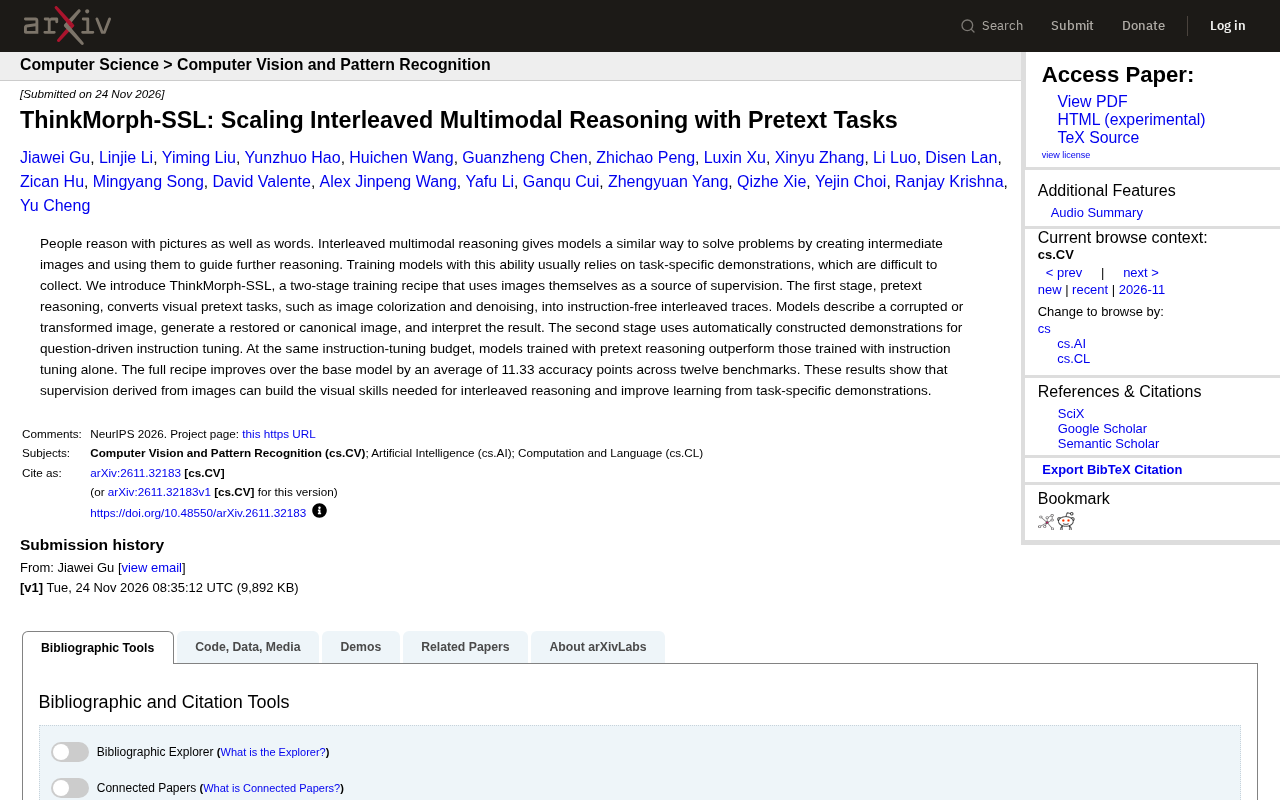
ThinkMorph-SSL replaces manual demonstrations with image self-supervision signals, boosting interleaved multimodal reasoning through two-stage training.
ThinkMorph-SSL proposes a two-stage training scheme to address the high cost of collecting task-specific demonstration data for interleaved multimodal reasoning. Stage 1 uses visual pretext tasks like colorization and denoising to build instruction-free interleaved reasoning trajectories, teaching the model to carry reasoning information through intermediate images in a describe-generate-interpret loop; Stage 2 automatically constructs demonstration data for instruction fine-tuning, transferring visual skills to problem-driven tasks. Experiments show that under the same instruction fine-tuning budget, models with pretext reasoning outperform those trained with instruction fine-tuning alone; the full scheme surpasses the base model by an average of 11.33 accuracy points across twelve benchmarks. This work demonstrates that images themselves can serve as supervision signals, improving the model's learning efficiency from demonstrations.
Interleaved multimodal reasoning lets models think with both images and text like humans do—generating intermediate images during the reasoning process to help solve problems. But training this capability typically relies on task-specific demonstration data, which is extremely costly to collect. ThinkMorph-SSL proposes a two-stage training scheme that uses images themselves as supervision signals, bypassing the dependence on manually annotated demonstrations.
The Supervision Dilemma of Interleaved Multimodal Reasoning
Humans don't solve problems with language alone. Sketching a rough diagram, marking an arrow, scribbling over a schematic—these visual actions are themselves part of reasoning. Interleaved multimodal reasoning attempts to give models a similar capability: inserting intermediate images during text generation, then using those images to guide subsequent reasoning steps.
The problem lies in acquiring training data. To teach a model "when to draw, what to draw, and how to use what it draws," the conventional approach is to provide task-specific demonstration trajectories—human annotators show how to generate and use intermediate images at each reasoning step. Such data is not only expensive to annotate but also covers a limited range of task types, making it hard to scale.
The core insight of ThinkMorph-SSL is that images themselves carry rich supervisory information, and effective training signals can be constructed without human demonstrations.
Two-Stage Training: From Pretext Tasks to Instruction Fine-Tuning
Stage 1: Pretext Reasoning
The research team reframes visual pretext tasks into instruction-free interleaved reasoning trajectories. Pretext tasks refer to classic tasks in self-supervised learning such as image colorization and denoising—the model must perform some transformation based on an input image. ThinkMorph-SSL embeds these tasks into an interleaved reasoning framework, forming three-step trajectories:
- The model describes a corrupted or transformed image
- It generates a restored or normalized image
- It interprets the result
No instruction annotations are needed throughout the process—the supervision signal comes entirely from the images themselves. Through the "describe-generate-interpret" loop, the model learns how to use intermediate images to carry reasoning information.
Pretext Task is a core concept in self-supervised learning, referring to proxy tasks artificially constructed to learn representations from unlabeled data. Classic examples include: image colorization (restoring grayscale images to color), denoising (recovering clean images from noisy ones), jigsaw puzzles (rearranging image patches), rotation prediction (determining image rotation angle), and more. The defining feature of these tasks is that labels are automatically generated by data transformations, requiring no manual annotation. In completing pretext tasks, the model is forced to learn the underlying structure, semantics, and transformation patterns of images, and these representations can subsequently be transferred to downstream tasks. ThinkMorph-SSL's innovation lies in extending pretext tasks from mere representation learning to the construction of interleaved reasoning trajectories—the model must not only complete the transformation but also describe, generate, and interpret intermediate images, thereby learning to "think with images."
Stage 2: Instruction Fine-Tuning with Automatically Constructed Demonstrations
The visual skills established in Stage 1 are transferred to problem-driven instruction fine-tuning in Stage 2. The research team automatically constructs demonstration data, enabling the model to invoke the interleaved reasoning abilities acquired in Stage 1 when answering specific questions.
The connection between the two stages is logically clear: first, pretext tasks give the model the fundamentals of "thinking with images"; then, instruction fine-tuning teaches it "what to think about and how, under what circumstances."
Instruction Tuning is a training paradigm that aligns pre-trained models with downstream task formats: given a task instruction (e.g., "Please answer the following question") and an input, the model learns to generate the expected output. In multimodal reasoning, instruction tuning typically requires manually annotated demonstration trajectories that show what text and images should be generated at each reasoning step. ThinkMorph-SSL's automatic demonstration construction method leverages the visual skills acquired in Stage 1, generating intermediate images and reasoning steps through rules or the model itself, replacing manual annotation. This dramatically reduces data collection costs while maintaining demonstration diversity and scalability. The connection between the two stages is essentially curriculum learning: first master the fundamentals of visual manipulation through pretext tasks, then learn to flexibly invoke these skills under problem-driven conditions through instruction fine-tuning.
Key Finding: The Gain from Pretext Reasoning
The paper presents a noteworthy controlled experiment result: under the same instruction fine-tuning budget, models trained with pretext reasoning outperform those trained with instruction fine-tuning alone. This shows that Stage 1 is not an optional warm-up but brings substantive capability improvement.
The full training scheme surpasses the base model by an average of 11.33 accuracy points across twelve benchmarks. This figure covers multiple task types, indicating that the gain has some generality rather than being effective only on specific tasks.
The more important conclusion concerns the source of supervision signals. Experiments show that supervision signals derived from images can establish the visual skills required for interleaved reasoning and improve the model's learning efficiency from task-specific demonstrations. In other words, pretext reasoning is not only useful in itself but also makes subsequent instruction fine-tuning more efficient—the model learns better from the same demonstration data.
Implications for Multimodal Reasoning Training Approaches
The value of this work lies not only in the method itself but in the direction it points to: the training bottleneck of multimodal reasoning need not be overcome solely through more manual annotation. The structural information naturally present in visual data—image corruption and restoration, transformation and reconstruction—is itself a supervision signal.
This is consistent with the successful path of self-supervised learning in language and vision. When interleaved reasoning requires models to understand "how images carry information," pretext tasks happen to provide the lowest-cost entry point for such understanding.
Of course, the quality ceiling of automatically constructed demonstrations and the degree of distribution matching between pretext tasks and downstream tasks remain questions requiring further validation. But at least from current results, supervising images with images and leveraging pretext tasks to unlock interleaved reasoning is a technical direction worth pursuing.
Related articles
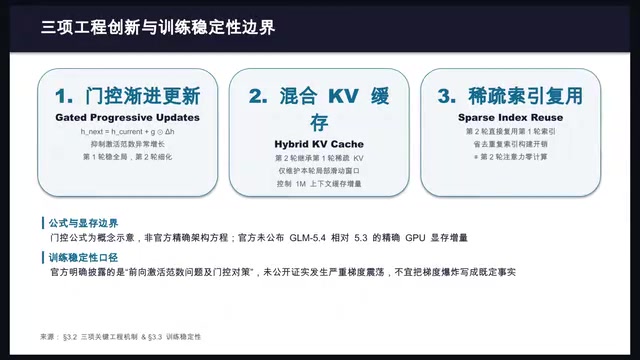
GLM-5.4 Loop Transformer Deep Dive: Architecture and Cost-Effectiveness
An in-depth analysis of GLM-5.4's Loop Transformer architecture: shared-weight looping, 30B ablation data, multi-model API cost simulations, strong-weak collaboration strategies, and the challenges of scaling computational depth.

Zhipu GLM-5.4 Debuts Loop Transformer, Upgrading Coding and Vision
Zhipu releases GLM-5.4, debuting the Loop Transformer architecture, adding vision capabilities and stronger coding, with existing users' quota raised to 1.5x. Also covers MiniMax H3's low-VRAM runtime, the information compression perspective, and subscription ecosystem developments.
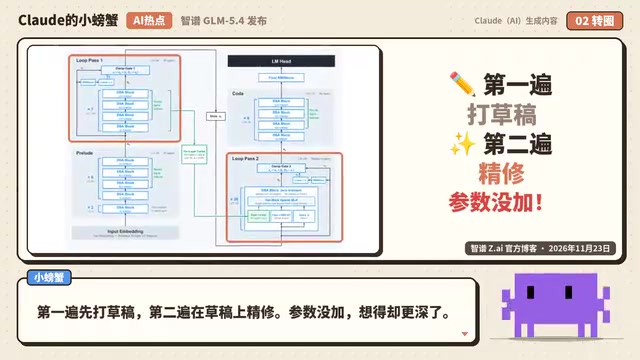
Zhipu GLM-5.4 Released: 750B Model Achieves 2-3 Trillion Parameter-Level Intelligence
Zhipu releases GLM-5.4, a 750B model achieving 2-3 trillion parameter-level intelligence via repeated layers, with a 30B experiment showing major math reasoning gains plus new vision capabilities and generalized programming applications.