ThreadLore: Using AI to Turn Fabric Photos into Editable Loom Drafts

ThreadLore uses AI to infer weave structures from fabric photos, letting users verify results and export loom cards or WIF files.
ThreadLore is an AI assistant for artisans that solves the problem of reproducing textiles when weaving records are lost. Users upload fabric photos, the system uses computer vision to suggest a preliminary weave structure, and users verify and correct it row by row against yarn crossings. Confirmed patterns can be exported as printable loom cards or WIF files for direct use on the loom. Positioned as an assistant rather than a fully automated solution, it emphasizes human-AI collaboration and suits artisans, textile restorers, and designers. WIF support lets it integrate into existing digital textile workflows. Still early-stage with limited community feedback, its real-world performance needs more user validation.
From Photo to Loom: ThreadLore Tackles the Lost Art of Weaving Instructions
When a textile's weaving instructions are lost, a photograph still holds clues. That's the question ThreadLore tries to answer. This product, which earned 64 upvotes and ranked 17th on Product Hunt, positions itself as an AI assistant for artisans: upload a fabric photo, the tool suggests a weave structure, lets you verify it against yarn crossings, and finally converts the confirmed pattern into a printable loom card or WIF file.
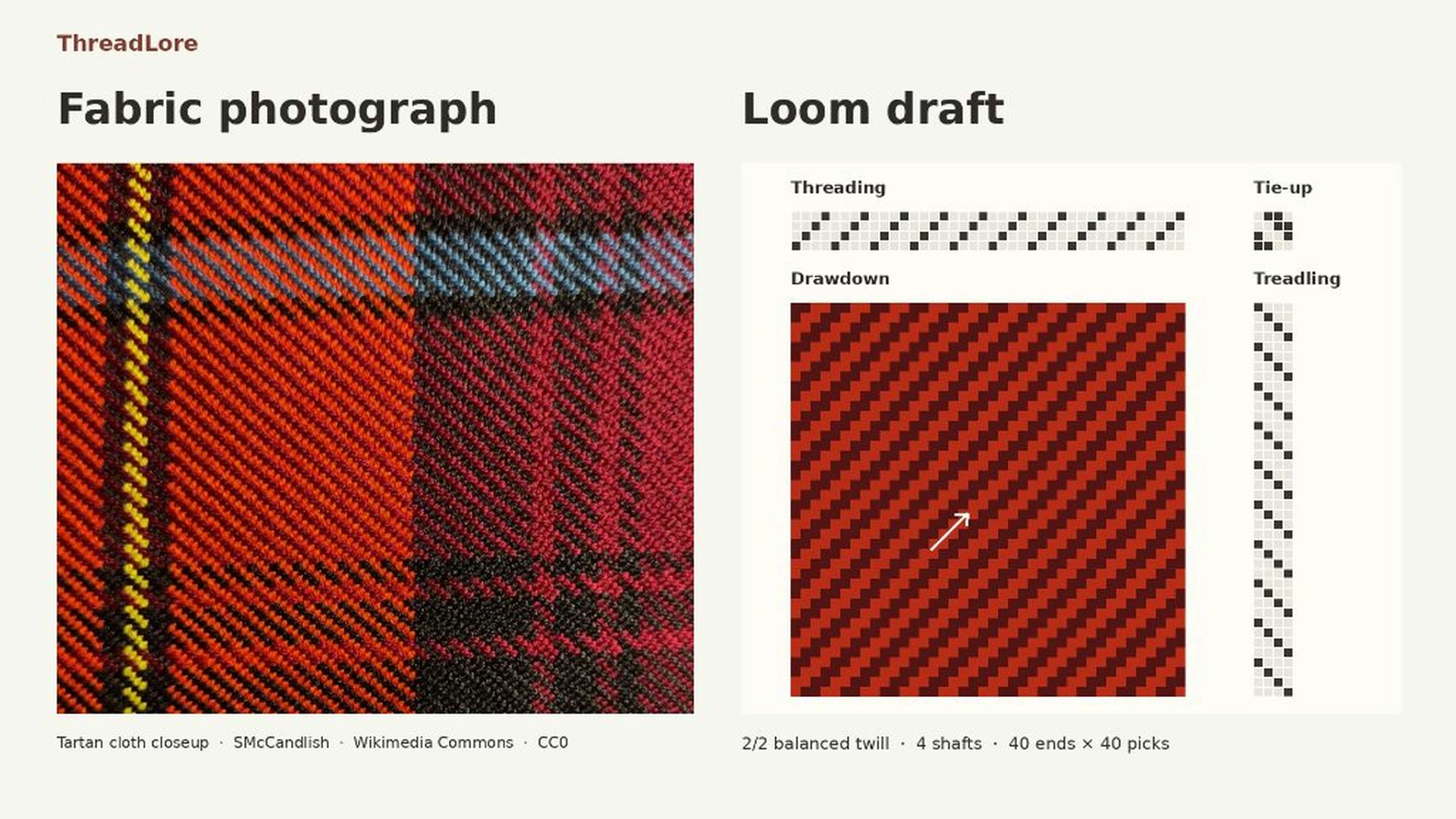
Its core value isn't "one-click generation" but a human-in-the-loop verification process—which means ThreadLore has a clear-eyed awareness of its own limitations.
Why Is Reverse-Engineering a Loom Draft from a Fabric Photo So Hard?
Weaving information for textiles is typically preserved as a loom draft, containing parameters such as threading, tie-up, and weft order. Once the paper records are lost, reverse-engineering from a finished photo is nearly equivalent to reverse engineering: lighting, wrinkles, and yarn colors all interfere with judging the crossings.
ThreadLore doesn't claim to fully automate this process. According to its Product Hunt page, it offers a "suggested weave," then lets artisans "check against the yarn crossings." This design acknowledges a fact: AI's visual inference needs human expertise as a backstop.
Loom draft is the standard diagram in textiles for describing fabric structure, typically consisting of four parts: the threading draft (which heddle frame each warp thread passes through), the tie-up draft (how treadles connect to heddle frames), the treadling draft (the order of weft passes), and the drawdown (the final interlacement effect of warp and weft). These four parts are interrelated and indispensable. Once paper records are lost, reverse-engineering from a finished photo means deriving all these parameters backwards from the final fabric appearance—an extremely difficult task. Because a photo can only provide visual information at the drawdown level, while threading, tie-up, and other setup parameters can have multiple possible combinations that require textile expertise to reconstruct.
Feature Breakdown: A Closed Loop of AI Suggestions and Human Verification
ThreadLore's workflow can be summarized in three stages:
- Photo input and structure inference: The user uploads a fabric photo, and the system uses computer vision and AI models to analyze the texture pattern and provide a preliminary weave structure suggestion.
- Crossing verification: This is the tool's key differentiator. Users can check the AI's suggestions row by row against the actual yarn crossings in the interface, confirming or correcting them. This step transforms black-box output into reviewable intermediate results.
- Export to loom-ready formats: The confirmed pattern can be generated as a printable loom card or WIF file (Weaving Information File, a common exchange format in textiles), ready for direct use on the loom.
Judging from the product's category tags—"Photography," "Artificial Intelligence," "Google Cloud Run"—ThreadLore's tech stack involves image processing and cloud inference, but the product interface deliberately stays craft-oriented rather than showing off technical prowess.
WIF (Weaving Information File) is a text-based open format for exchanging loom draft data between weaving software. It was championed by Sweden's weaving software community in the 1990s and has become the common exchange standard for mainstream loom design software such as Fiberworks, WeavePoint, and Pixeloom. A WIF file typically contains fabric structure parameters, yarn colors, threading and tie-up information, and annotation metadata. Supporting WIF export means ThreadLore's generated patterns can be directly imported into these professional software tools for further editing or to directly drive electronic looms, thereby embedding into existing digital textile workflows rather than becoming a closed island.
Target Users and Scenarios: Who Needs ThreadLore?
Artisans, textile restorers, and textile designers are ThreadLore's most direct users. A typical scenario: a museum or private collection has an old textile whose weaving records are no longer traceable, but a researcher wants to reproduce its structure. The traditional approach requires an experienced weaver to analyze the physical object stitch by stitch—time-consuming and dependent on individual expertise.
ThreadLore partially digitizes this process: first let AI propose candidate structures, then have experts verify. This "AI proposes, human decides" model is not uncommon in professional tools, but in textiles—a vertical industry highly dependent on tacit knowledge—it still has practical value.
You may not have noticed that the product currently has only 2 reviews, a limited community feedback sample, which indicates it's still early-stage and means real user experience remains to be observed.
Tacit knowledge refers to knowledge that is difficult to express and transfer explicitly through language, text, or symbols, usually tied to personal experience, intuition, and situational judgment. In textile crafts, experienced weavers can often quickly judge structure by touching yarn and observing fabric hand-feel, but this ability is hard to write into an operation manual. ThreadLore's design logic precisely attempts to convert part of this tacit knowledge into reviewable intermediate results—AI provides candidate structures, and experts apply their tacit knowledge to judge and correct during the crossing verification step. This "AI proposes, human decides" model essentially builds a bridge between tacit knowledge and explicit algorithms, preserving professional judgment while reducing repetitive analytical workload.
Limitations and Observations: How Far Can the Tool Go?
ThreadLore positions itself as an assistant, not a replacement. From public information, it focuses on the scenario of "having a photo but lacking a draft" and doesn't promise to handle complex weaves or multilayer fabrics. The very existence of the verification step also indicates that AI inference accuracy isn't yet sufficient to confidently go straight to the loom.
For a field like textiles with low tolerance for error, this conservative design actually makes it easier to earn professional users' trust. Its success depends on two things: the hit rate of suggested structures on common fabrics, and whether the verification interface is intuitive enough. Currently available materials don't disclose specific performance data, so actual use is needed to judge.
Another noteworthy direction is WIF export. WIF is a common format between weaving software, and supporting it means ThreadLore can embed into existing digital workflows rather than becoming an island. For a tool-type product, this is a smart ecosystem choice.
Conclusion
ThreadLore taps into a niche that mainstream AI tools have overlooked: digital assistance for textile crafts. Its methodology—AI suggestions plus human verification—has reference value in professional vertical domains. The product is still early-stage with limited community buzz, but the "from photo to loom card" closed-loop design offers artisans an actionable new path. Whether it's actually usable ultimately depends on suggestion quality and verification experience, which requires more real-user testing.
Related articles
ChatGPT Plus Top-Up in China: Third-Party Website Recharge That Supports WeChat Pay and Alipay, No Overseas Card Needed
A Bilibili creator tests ChatGPT Plus top-up methods in China: comparing third-party website recharge, direct credit card, and mobile in-app purchase, with a full walkthrough of password-free WeChat/Alipay recharge and an analysis of Session credential and payment risk-control risks.

6GB Delivers Opus-Level Performance: Bonsai 2.5 27B Hands-On Test
Prism ML releases Ternary Bonsai 2.5 27B: ternary quantization brings it to just 5.9GB, runnable on a single consumer GPU while retaining 262k context and vision. Hands-on agentic benchmarks approach full-precision Qwen 3.8 27B, exceeding 150 tokens/s on a 4090, with impressive frontend and dashboard results, though game development and long tasks remain weak spots.

System Exchange Spawns an Offbeat Journey to the West: Why This Comedy Series Works
A Bilibili comedy short series reimagines Journey to the West with a system-exchange premise, as the protagonist challenges Sun Wukong, Erlang Shen, and other classics.