Three AI Agents Tested on Real Estate Tasks: From Basic LLM to Master Router

Three AI Agents tested on real estate tasks reveal that tools+memory is the sweet spot for 90% of agencies.
A creator ran a real-world real estate scenario across three AI Agent configurations built in n8n: a basic LLM node (fast but no memory or external data access), an advanced Agent with tools and memory (reads property databases, matches buyer budgets — deemed the sweet spot for 90% of agencies), and a master router Agent (orchestrates secondary workflows for end-to-end automation, but with significantly higher build and maintenance costs). The key takeaway isn't "more complex is better" — it's that technology selection should precisely match task complexity, and over-engineering creates unnecessary burden.
In the real estate industry, AI Agents are gradually moving from concept to practical deployment. A YouTube creator used the same real-world real estate task to test three AI Agents of varying complexity, trying to answer one key question: which configuration can truly replace a human assistant? Built on n8n (the workflow automation platform featured throughout the video), the results clearly reveal a three-tier hierarchy of Agent capability.
Tier 1: Basic LLM Node — Fast but Limited
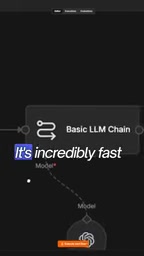
The first Agent is the simplest configuration — a basic large language model (LLM) node. Its biggest advantage is build speed: the entire setup takes under two minutes, and running costs are extremely low.
But speed and low cost come at the price of severely limited capability. This Agent can only output generic email templates — it has no memory and cannot read any external data. In other words, it functions more like an enhanced text generator than a true "assistant." For scenarios that only require rapid bulk generation of standardized responses, it might suffice, but it falls short the moment personalization enters the picture.
Tier 2: Tools + Memory — The Sweet Spot for 90% of Agencies
The second Agent is a clear step up, using an advanced AI Agent node equipped with tools and memory. Its real-world performance actually resembles an assistant: it can open a property database spreadsheet, cross-reference a buyer's budget, and filter out three matching listings.
The key breakthroughs here are tool calling and memory. Tools give the Agent access to external data (such as a property listings spreadsheet), while memory allows it to maintain context continuity across a conversation. The creator made a notably strong claim: for 90% of real estate agencies, this configuration is the "sweet spot" — capable enough to be genuinely useful, while keeping complexity and cost within a reasonable range.

This assessment is worth reflecting on. It hints at a commonly overlooked reality: the most complex solution isn't always the optimal one. For most businesses, over-engineering brings maintenance burdens and unnecessary overhead, while the middle ground of "tools + memory" strikes the right balance between practicality and manageability.

A quick note on the underlying concepts: Tool Use (also called Function Calling) refers to a large language model's ability to recognize when it needs to invoke an external function or API during response generation, pass structured parameters to those tools, and integrate the returned results into its answer. Pioneered systematically by OpenAI in GPT-4, this capability has become a standard feature across mainstream LLMs. In this real estate scenario, the "tool" is specifically a node that reads a Google Sheets property database — when the Agent recognizes a user's filtering request, it automatically calls that tool to retrieve data rather than generating answers from thin air. "Memory," meanwhile, typically divides into short-term memory (context within a conversation window) and long-term memory (persistent storage, such as a vector database). The memory node in n8n defaults to session-level short-term memory, allowing the Agent to remember a buyer's budget and preferences across multiple turns without requiring the user to re-explain the context each time. The combination of these two capabilities is what transforms an Agent from a "text generator" into a genuine "task executor."
Tier 3: Master Router Agent — True End-to-End Automation
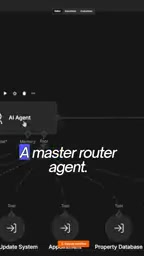
The third Agent is the "ultimate form" of the entire test — a master router agent. Its fundamental difference from the previous two is this: it no longer controls simple tools, but entire secondary n8n workflows.
This architecture enables it to complete a series of tasks that would otherwise require team coordination: qualifying leads, triggering background checks, updating the CRM, and automatically generating booking links. In essence, it orchestrates multiple independent automation flows into a single, complete business loop.
From a technical perspective, this is precisely the direction Agent architecture is evolving — from monolithic Agents toward multi-Agent collaboration, with a "router" or "orchestration" layer responsible for task distribution and scheduling. This design greatly enhances system scalability, but it also means higher build costs, more complex debugging, and more demanding maintenance requirements.
Going deeper: The multi-Agent collaborative architecture represented by the master router Agent is also known in academic and engineering circles as a Multi-Agent System (MAS) or Agentic Workflow. The core idea is that a single Agent tends to run into context overflow and unclear capability boundaries when handling complex, multi-step tasks. Decomposing those tasks across multiple specialized sub-Agents — each handling a specific domain — and coordinating them through an orchestrator layer significantly improves system reliability and scalability. In n8n's implementation, "secondary workflows" are essentially pre-packaged automation processes (such as a background check flow or a CRM write flow). The master Agent evaluates the task type and decides which workflow to trigger. This logic is closely aligned with LangChain's Agent Executor and AutoGen's conversational multi-Agent framework. It's worth noting that once an orchestration layer is introduced, debugging difficulty rises exponentially — when something goes wrong, the investigation trail may span multiple workflows and tool nodes, which is precisely why the creator places such emphasis on its maintenance cost.
What the Three-Tier Architecture Tells Us
The value of this comparative test isn't proving that the third-tier Agent is the most powerful — it's in drawing a clear boundary between capability and cost trade-offs.
A basic LLM is suitable for validating ideas or handling the simplest tasks. An Agent with tools and memory covers the vast majority of real-world business scenarios. The master router Agent is for large or high-growth organizations that need end-to-end automation.
The creator's judgment that "tools + memory" is the sweet spot for 90% of agencies is a point business decision-makers should take to heart: the core of technology selection isn't chasing the most cutting-edge architecture — it's matching the actual need. When deploying AI Agents, being clear about "which tier your task complexity actually falls into" is often far more important than blindly stacking capabilities.
Related articles

JobRunner MCP Server: AI Agents Can Now Fix Failed Java Jobs
JobRunner launches an open-source MCP server enabling AI agents to view cluster status, diagnose failures, and recover Java jobs—incident response from any cloud coding environment or existing agent.

MLAI Digital Launches 9 Security Agents: MCP Server Safeguards the Full Lifecycle of Agentic AI
MLAI Digital launches Security MCP Server with nine built-in specialized security agents covering vulnerability discovery, attack simulation, prompt injection detection, API and infrastructure assessment, and accelerated remediation—embedding security validation across the full Agentic AI lifecycle from development to production.

Running Isaac Lab on H100 GPUs: Exploring Better Approaches
Exploring optimization methods for running Isaac Lab on NVIDIA H100 GPUs, including MIG configuration, mixed precision, TensorRT acceleration, and community experience to improve robotics simulation and reinforcement learning efficiency.