Three Failure Recovery Scenarios for AI Agents: Timeouts, Zombie Processes, and Expired Authorization

AI agent failure recovery hinges on distinguishing confirmed, unresolved, and safe-to-execute states after errors occur.
This article examines a developer's proposed AI agent failure recovery checklist across three scenarios: external write timeouts (where you can't tell if an operation succeeded), zombie worker processes returning after their claim expired, and actions that exceed the original authorization scope. The core engineering challenge isn't task completion — it's the ambiguous gap after an error and before the next action, where agents must distinguish confirmed outcomes, unresolved unknowns, and permitted next steps. Design principles across all three scenarios include leveraging API idempotency, rejecting stale writes on controlled systems, and binding every authorization to a specific target and scope.
When an AI agent is interrupted mid-task, how does it determine what actually happened — and whether it's safe to proceed? This question is far harder than simply "getting an agent to run." A Reddit developer recently proposed a failure recovery checklist for agents, focusing on three typical failure scenarios. These edge cases may seem obscure, but they cut right to the most fragile part of any automated workflow: the ambiguous gap between when an error occurs and when the next action is taken.
Why Failure Recovery Is Harder Than Task Execution
Most discussions about AI agents focus on whether they can complete a task. But once you actually deploy an agent in production, the trickiest problems arise when a task doesn't complete cleanly. The original author is explicit about what he cares about: what facts can be established after a workflow goes wrong, before the next action is taken.
This implies a critical distinction: confirmed completed outcomes, unresolved unknown outcomes, and safe actions that are permitted to proceed. If an agent can't tell these three apart, it will either blindly retry and cause duplicate side effects, or push forward without enough information. The author is candid that this is a "proposed checklist" — not a solved problem. That restraint itself is worth noting.
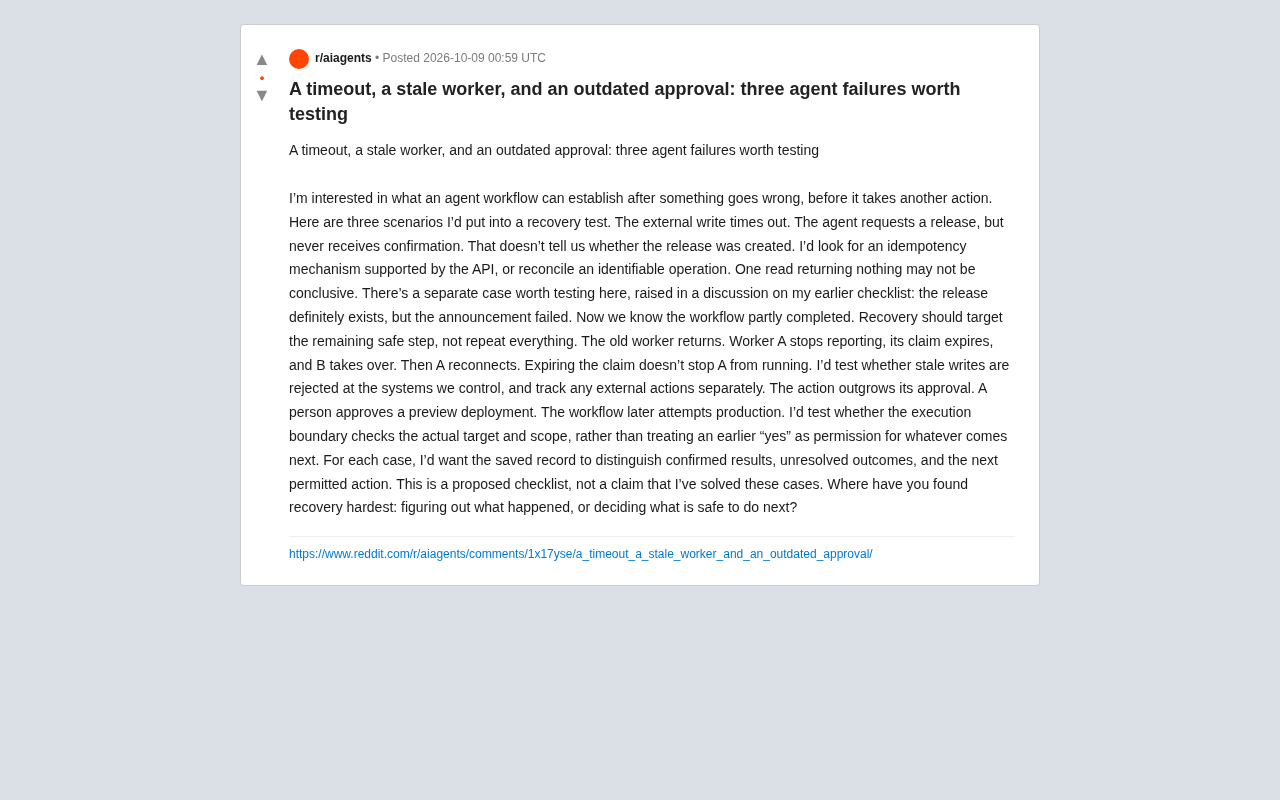
Scenario 1: External Write Timeout
The first failure type is an external write operation that times out. The agent requests a release to be created but never receives confirmation. The problem: a timeout tells you nothing about whether the operation succeeded. The request may have arrived and executed — the confirmation just got lost on the way back.
The author's approach is pragmatic: look for idempotency mechanisms built into the API, or use identifiable operation IDs to reconcile state. He specifically warns that a read returning empty is not sufficient to draw conclusions, since reads themselves can be delayed or inconsistent.
A variant that emerged from earlier checklist discussions makes this even more interesting: the release was successfully created, but the subsequent "announcement" step failed. The workflow is only partially complete. In this case, the right recovery strategy isn't to re-run the entire pipeline — it's to precisely identify the remaining step that is still safe to execute and complete just that. Re-running the whole chain could easily create duplicate release records.
Idempotency is a core design principle in distributed systems for handling duplicate requests: executing the same operation once or multiple times should produce exactly the same result. The common implementation involves the client generating a unique Idempotency Key that is sent with every request. The server records the result associated with that key and returns the cached result for duplicate requests instead of re-executing. Stripe, GitHub, and other major APIs have this mechanism built in. For AI agents, generating and persisting an idempotency key before any write operation with side effects is the lowest-cost way to prevent duplication. Reconciliation is a more proactive fallback strategy: by periodically reading the actual state of the target system and comparing it against the expected state, you can infer which operations have completed and which need to be retried. Kubernetes' controller pattern is built around a reconciliation loop — which is exactly why it has strong self-healing capabilities by design.
Scenario 2: A Zombie Worker Process Returns
The second scenario is a classic distributed systems problem — a stale worker process comes back online. Worker A stops reporting in, its task claim expires, and Worker B takes over. Then A reconnects.
The trap here: letting a claim expire doesn't actually stop A from continuing to run. A may still be executing writes it believes still belong to it. The author's testing focus is whether the systems we control will reject stale writes from the expired process; and for external actions that have already been dispatched, those must be tracked separately, since they may not be reversible.
This gets at the essence of concurrency control: there is always a time gap between the "logical expiration" of ownership and the "physical stop" of a process. Reliable recovery mechanisms must assume this gap always exists.
The task claim and lease expiration mechanism comes from the "Lease" model in distributed locking: a worker process acquires a time-limited hold on a task when it picks it up, and must continuously renew it (heartbeat) before expiration, or the system considers the process lost and reassigns the task. Redis, ZooKeeper, etcd, and other coordination services all provide similar primitives. However, lease expiration is only a logical judgment at the coordination layer — it cannot send a stop signal to a physical process. This creates what's known as a "Split-Brain" window: B has legitimately taken over the task while A still believes it holds the lock and continues writing. The classic defense against this is the Fencing Token — a monotonically increasing token issued with each lease. The storage system rejects any write requests carrying a token number lower than the highest it has seen, blocking stale writes from expired holders at the data layer, without depending on whether the process has actually stopped.
Scenario 3: Actions That Exceed Authorization Scope
The third failure type concerns permission boundaries — especially dangerous in human-in-the-loop agent systems. Someone approved a deployment to a preview environment, but the workflow then attempts to proceed to production.
The author argues the core thing to test is whether execution boundaries validate the actual target and scope of an action, rather than treating an earlier "approval" as blanket authorization for all subsequent operations. In other words, authorization should be bound to a specific target and scope — not interpreted by the agent as an open-ended permission slip.
As agents increasingly execute chains of actions on behalf of humans, "expired authorization" will become the top security risk by design. A loose approval should not be amplified into authorization for an entire downstream operation chain.
In the AI agent context, this scenario corresponds to the "Authorization Creep" problem, which is structurally similar to the classic "Confused Deputy Attack" in traditional software: an entity holding a certain level of permissions is induced — or decides on its own — to apply those permissions toward a target that goes beyond the original intent. In human-agent collaborative systems, human approvals given in natural language tend to be ambiguous ("go ahead and deploy it"), and agents have a tendency to interpret vague instructions as broader authorization. The standard security design response is to apply the Principle of Least Privilege combined with Intent Anchoring: every tool call or external action must be traceable back to a specific target and scope that the user explicitly approved, rather than inherited from a broad contextual approval. Some agent frameworks are beginning to introduce "restricted execution contexts" that require each subtask to run inside an independent permission sandbox.
The Core of Recovery: Records Must Distinguish Three States
Running through all three scenarios is a single design principle: the records you save must be able to distinguish confirmed outcomes, unresolved outcomes, and the next permitted safe action.
This is essentially transplanting the reliability thinking of traditional distributed systems into AI agent workflows. Idempotency, reconciliation, ownership leases, permission scope validation — these concepts are familiar to backend engineers. But when the decision-maker shifts from deterministic code to an agent with some degree of autonomy, their importance is multiplied. Agents will "fill in the gaps" on their own when information is incomplete. A well-designed recovery layer is precisely the guardrail that constrains that improvisation.
The author closes with an open question: is the hardest part of recovery figuring out what happened, or deciding what's safe to do next? There's no standard answer, but it pinpoints exactly where agent engineering crosses the line from toy project to production system.
Takeaways for Agent Developers
The value of this checklist isn't in providing ready-made solutions — it's in offering a testing lens. If you're building agents that execute real side effects (writing to databases, calling APIs, deploying code), these three scenarios are a solid starting point for recovery testing:
- For all external writes, rely on the API's idempotency support or reconcilable operation IDs whenever possible;
- When handling concurrent takeover, assume the old process may still be active by default, and reject stale writes on the controlled system side;
- Bind every authorization strictly to a specific target and scope — reject the pattern of "approve once, permit forever."
Designing failure recovery as a first-class concern rather than an afterthought may well be the necessary path to making AI agents truly trustworthy.
Related articles

Amphibious Transforming Drone: Beyond 100x Power Savings, What Are the Real Needs?
Is the amphibious transforming drone just a gimmick? Starting from the 100x power difference of the M4 Morphobot, explore real application scenarios and thesis topic ideas, analyzing boundary conditions where pure drones and pure ground robots both fail.

Warhound Raises $200 Million: Genetically Engineered "War Dogs" Paired with Anduril Gear
Warhound raises $200M, backed by Ben Lamm and Palmer Luckey, to genetically engineer dogs for military and law enforcement use and equip them with Anduril gear. This article analyzes its technology direction, funding logic, and ethical controversy.

Claude API Comes to Google Cloud: IAM Integration and SDK Access Guide
Anthropic hosts the full Claude API on Google Cloud with IAM-controlled permissions and unified billing. This guide covers the Vertex AI and Anthropic-hosted entry points, IAM role configuration, and SDK access.