Tiden: A New Tool for Intent Verification in Coding Agents

Tiden verifies coding agent changes with branchable intent records, separating testing from implementation.
The article introduces Tiden's solution to the verification dilemma of coding agents (Claude Code, Cursor, etc.). Traditional tests often share context with implementation, making "tests pass" true by construction. Tiden saves user intent as branchable, mergeable requirement records, comparing each code change against them. Verdicts come from tests running in the user's environment rather than models scoring the diff, avoiding unauditable criteria while retaining human merge decisions. Tiden works in parallel with existing tools and supports tracing production errors to specific releases. It ranked 6th on Product Hunt with 93 votes.
The Verification Dilemma of Coding Agents
As coding agents like Claude Code, Cursor, Codex, and Copilot become more deeply involved in real-world development, a repeatedly raised question has surfaced: How do we confirm that the code they write is actually what we want?
The common approach is to run tests. But the Tiden team pointed out a key loophole on Product Hunt—most checks run in the same session where the code was written, with tests and implementation sharing context, so "tests pass" is in many cases true by construction rather than truly independent verification. In other words, the agent writing the code conveniently also manufactures the evidence proving itself correct.
Tiden aims to solve exactly this problem.
Coding Agent refers to AI systems capable of autonomously reading codebases, planning modifications, editing files, and running commands. Typical examples include Claude Code, Cursor, Codex, and GitHub Copilot's agent mode. Unlike traditional code completion tools that only suggest the next line, coding agents typically have multi-turn tool-calling capabilities, enabling cross-file changes within a single task.
This autonomy brings new trust issues: agents don't just make suggestions—they directly land changes. When they're responsible for both writing implementation and writing tests, the independence of verification is weakened. When evaluating such tools, developers need to pay attention not only to generation quality but also to whether changes are auditable, rollback-able, and traceable.
Tiden's Core Approach: Treating Intent as Branchable Requirements
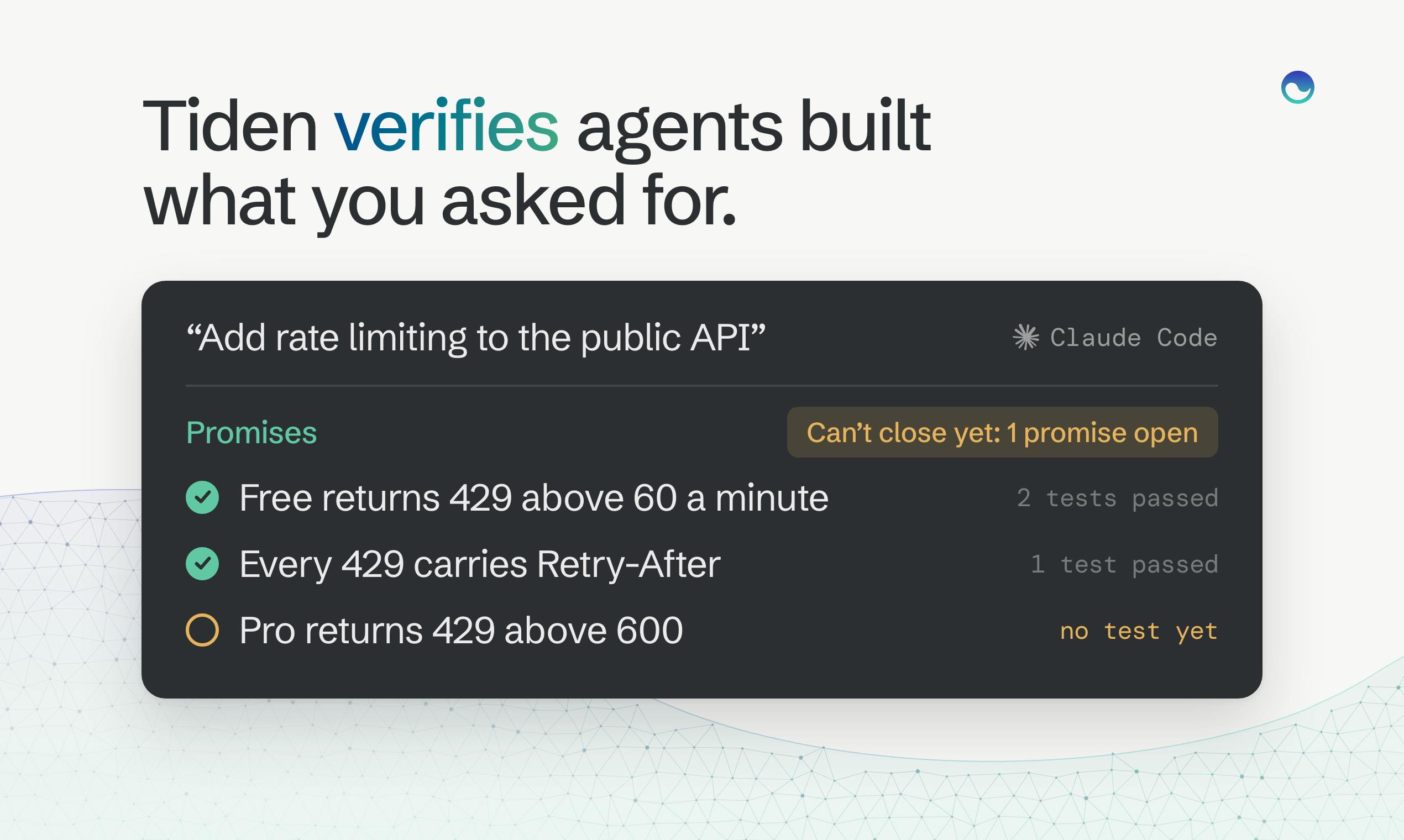
Tiden positions itself as "Intent verification." It doesn't treat requirements as a document that's fixed once written, but saves user intent as requirement records that can be branched and merged like code. Every code change is compared against this record.
This design has two direct consequences:
- The requirements themselves have version history and can fork and merge as the project evolves, rather than being a static document disconnected from reality;
- What's being verified isn't "does the code look right" but "does this change still conform to the originally recorded intent."
For teams that frequently experience agents "drifting off course while making changes," this intent-anchored approach is closer to the real pain point than simply piling up test cases.
Branchable and mergeable requirements borrows the branching metaphor from version control systems like Git. In Git, code can fork from the mainline into feature branches, evolve independently, and then merge back. Tiden applies the same model to requirement records: a requirement can fork for different scenarios, and after verification passes, merge back to the mainline.
The benefit is that requirements are no longer a static document that expires once written, but a living object synchronized with code evolution. When an agent makes changes on a branch, the system can compare those changes against the intent version corresponding to that branch, thereby judging whether it has deviated from the original goal.
Not Letting Models Score the Diff
Tiden made a noteworthy choice in its verification mechanism: the final verdict comes from tests running in your environment, not from having some model score the diff.
This contrasts with many current "LLM-reviewing-LLM" approaches. Having a model evaluate a model seems convenient, but introduces new opacity—the judge's criteria themselves are difficult to audit. Tiden hands the conclusion back to reproducible test execution while reserving human judgment for what can be merged.
It also provides error traceability: issues that appear in production can be traced back to specific release versions. For teams already using agents for continuous delivery, the value of this chain is significant.
LLM-reviewing-LLM is a common current verification approach: having a model read the diff and judge whether it's correct. The problem with this approach is that the evaluation criteria themselves are not auditable—the model's scoring basis is hidden in the weights and cannot be reviewed and reproduced like test cases.
Tiden chose to return decision-making authority to reproducible test execution. Tests run in the user's own environment, results are verifiable and repeatable, and humans retain the final merge decision. This division of labor confines "machine judgment" to an observable scope, avoiding a new black box in the verification chain. diff refers to the difference between two code versions, the basic unit of input for the review process.
How It Works with Existing Coding Tools
Tiden doesn't try to replace existing coding agents, but chooses to work in parallel—according to its official description, it can be used alongside Claude Code, Cursor, Codex, and Copilot.
This "sidecar" positioning lowers the adoption barrier: teams don't need to abandon their existing toolchain, just introduce a layer of intent validation at the merge stage. For technical leads evaluating the risks of deploying coding agents, this is a relatively lightweight entry point.
According to Product Hunt data, Tiden received 93 votes, 14 comments, and ranked 6th, falling at the intersection of software engineering, developer tools, and artificial intelligence. This level of attention indicates that "how to accept agent-written code" is indeed a topic developers care about today.
Will Intent Verification Become Infrastructure?
As coding agents take on more real work, the importance of the verification layer will only increase. Test coverage addresses "does the code run as expected," while intent verification tries to answer "should this code exist in the first place." The two don't replace each other.
Tiden turns requirement records into branchable, mergeable, and traceable objects. Whether this abstraction will be adopted by more teams remains to be seen. But it at least points out an easily overlooked reality: When the party writing code also controls the means of verification, independent external validation becomes a necessity.
One-line Summary
Tiden verifies coding agent changes with branchable intent records, separating testing from implementation.
Paragraph Summary
This article introduces Tiden's solution to the verification dilemma of coding agents (Claude Code, Cursor, etc.). Traditional tests often share context with implementation, making "tests pass" true by construction and unable to independently verify. Tiden saves user intent as branchable, mergeable requirement records, comparing each code change against them to judge whether it still conforms to the original intent. Verdicts come from tests running in the user's environment rather than models scoring the diff, avoiding unauditable evaluation criteria while retaining human merge decisions. Tiden doesn't replace existing tools but works in parallel, and supports tracing production errors to specific releases. It received 93 votes, 14 comments, and ranked 6th on Product Hunt, reflecting developer attention to the agent acceptance stage.
Related articles

Random Pruning of the DPO Computation Graph: 1.4x Training Speedup and Lower Peak Memory
DPO training too slow and memory-hungry? This paper proposes a random pruning framework for the DPO computation graph, sampling independently across position, sequence, and branch dimensions; branch pruning achieves a 1.426x step-time speedup and cuts training time by about 30%, with in-depth attribution of memory and time gains.

Why Does JEPA Underperform MLM in Longitudinal EHR Representation Learning?
New study compares JEPA and MLM for longitudinal EHR representation learning on MIMIC-IV: three JEPA variants train stably without collapse but underperform MLM; target size, not heterogeneity, drives prediction error.

Transfer Learning + Visible Light Communication: A New Approach to Energy-Efficient Indoor Positioning
A study proposes a transfer learning-based visible light communication indoor positioning method, achieving 47% accuracy improvement on the BOSCH factory dataset, 67.5% model efficiency under high noise, and introducing the ME composite metric for energy-efficient positioning in energy-constrained industrial IoT scenarios.