Tigriden: A 40MB Rust Minimalist IDE Designed Specifically for AI Coding Agents

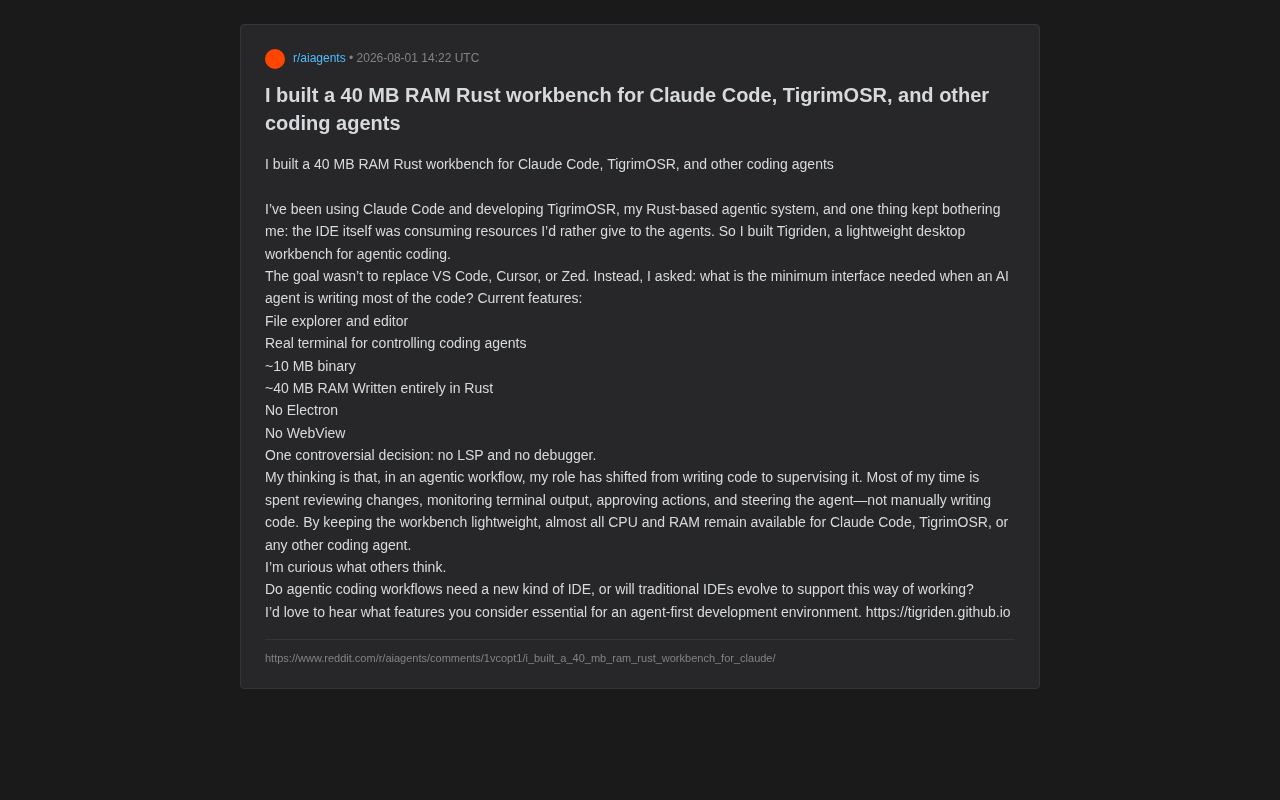
Tigriden is a 40MB Rust IDE built from scratch to leave system resources for AI coding agents.
Tigriden is a minimalist workbench written entirely in Rust that uses only ~40MB of memory at runtime, specifically designed for AI coding agent workflows like Claude Code. By eliminating Electron, WebView, LSP, and debuggers, it frees maximum system resources for AI Agents. The project challenges conventional IDE design by redefining the developer's role as a supervisor rather than a coder in the agentic era.
When IDEs Become a Resource Burden for AI Agents
With the rise of AI coding tools like Claude Code and Cursor, more and more developers are delegating coding work to intelligent agents. But an overlooked problem is gradually emerging: traditional IDEs themselves are consuming massive system resources that should be reserved for AI Agents.
A Reddit developer experienced this firsthand while using Claude Code and developing his own Rust agent system, TigrimOSR. He found that Electron-based editors like VS Code and Cursor routinely consume hundreds of MB or even over a GB of memory—resources that could let locally-running coding agents operate more smoothly. So he made a bold attempt: building a minimalist workbench from scratch, designed specifically for agent workflows: Tigriden.
To understand the severity of this problem, you need to understand the nature of the Electron architecture. Electron is a cross-platform desktop application framework developed by GitHub in 2013. Its core principle is bundling the Chromium browser engine and Node.js runtime together, allowing developers to build desktop applications using web technologies. VS Code, Cursor, Slack, Discord, and other well-known applications are all built on Electron. The cost of this architecture is that every Electron application is essentially running a complete Chrome browser instance—including the V8 JavaScript engine, Blink rendering engine, and multi-process architecture. A single Electron application typically requires 150-300MB of base memory at startup, and can easily exceed 1GB after loading extensions and projects. When AI Agents simultaneously need substantial computing resources, this baseline overhead becomes an undeniable competitor.
Tigriden: An Ultra-Lightweight Workbench Built with Rust
Surprisingly Low Resource Usage
Tigriden's most eye-catching feature is its resource consumption data:
- ~10 MB binary size
- ~40 MB runtime memory usage
- Written entirely in Rust
- No Electron dependency
- No WebView
By comparison, mainstream Electron-based editors need hundreds of MB of memory just to start. A 40MB footprint is practically negligible—developers can leave the vast majority of CPU and memory resources to the AI Agents doing the actual work.
Tigriden's choice of Rust as its development language has deep reasoning behind it. Rust is a systems programming language released by Mozilla in 2010 that eliminates memory safety issues at compile time through its Ownership System and Borrow Checker, with no garbage collector (GC) and therefore no latency jitter from GC pauses. In recent years, Rust adoption has accelerated in the developer tools space—the Zed editor, ripgrep search tool, SWC compiler, and Turbopack bundler all chose Rust. This means Tigriden is not only extremely small, but when AI Agents are running under heavy load, the workbench itself won't become a system performance bottleneck, and its memory usage is more predictable and stable.
The core of this design philosophy is: since agents like Claude Code or TigrimOSR themselves need considerable computing resources (especially locally-running models or frequent API calls), the development environment should be as "invisible" as possible, giving the spotlight to the main actor.
Regarding the actual resource demands of AI Agents, a more detailed analysis is worthwhile. Cloud API call patterns (like Claude Code calling the Anthropic API) mainly consume network bandwidth and a small amount of local memory for context management, but local inference modes require substantial resources. Even quantized small code models (like the Q4 quantized version of CodeLlama-7B) need 4-6GB of VRAM or memory; more powerful models like DeepSeekAd-Coder-33B require 16GB or more. Even without running local models, Agent frameworks themselves need to maintain conversation history, file indexes, tool call states, and other context information, plus frequent file I/O operations and subprocess management—the overall resource consumption is significant. In this context, every 100MB of memory the development environment saves means the Agent can maintain a longer context window or deliver faster response times.
A Minimalist Feature Set
Tigriden doesn't try to become the next full-featured IDE. The author explicitly states that its goal isn't to replace VS Code, Cursor, or Zed, but to answer a more fundamental question: When AI Agents are writing most of the code, what is the minimum interface humans actually need?
Currently it provides only three core features:
- File browser and editor: View and modify code
- Real terminal: For controlling and driving various coding agents
- Lightweight architecture: Ensuring system resources are reserved for Agents
This "less is more" philosophy directly addresses the essential needs of agentic development.
Dropping LSP and Debugger: A Controversial Design Decision
Trade-offs from a Role Shift
Tigriden's most controversial design choice is completely omitting LSP (Language Server Protocol) support and having no debugger.
For traditional developers, this is almost unimaginable. Code completion, go-to-definition, type checking, breakpoint debugging—these are all standard features of modern IDEs. But the author's reasoning is quite thought-provoking:
In agentic workflows, my role has shifted from "writing code" to "supervising code." I spend most of my time reviewing changes, monitoring terminal output, approving operations, and steering the Agent—not manually typing code.
To understand the impact of dropping LSP, you need to understand how it works and its resource consumption. The Language Server Protocol was designed by Microsoft in 2016 for VS Code and open-sourced, and has since become an industry standard. LSP abstracts programming language intelligence features into independent server processes that communicate with editors via JSON-RPC protocol. This means each language requires running an independent background process: TypeScript's tsserver, Rust's rust-analyzer, Python's Pylance/Pyright, etc. These language servers need to build complete project semantic models in memory—including ASTs (Abstract Syntax Trees), type inference graphs, symbol tables, and other data structures. For large projects, a single LSP process consuming 300-800MB of memory is not uncommon, and rust-analyzer in large Rust projects can even exceed 1GB. If developers work on multi-language projects simultaneously, the cumulative memory usage of multiple LSP processes can exceed that of the IDE itself.
This is a point worth deep consideration. LSP services themselves are memory-hungry, with a single language server process easily consuming hundreds of MB. If developers are no longer writing large amounts of code themselves but instead shifting to reviewing and overseeing Agent output, then the value of these heavy features optimized for human coding truly needs to be reassessed.
The Role Shift from Coder to Supervisor
This role transformation actually reflects a deeper trend in the AI programming era. When Agents handle most of the work from requirement understanding to code implementation, the core tasks for human developers become:
- Review: Check whether Agent-generated code meets expectations
- Monitor: Observe terminal and execution processes
- Approve: Authorize critical operations
- Steer: Correct the Agent promptly when it veers off course
In this workflow, a clean, responsive interface that doesn't compete for resources may have more practical value than a feature-complete but bloated IDE.
Agent-First Development Environments: New Paradigm or Transitional Solution?
Two Paths the Industry Is Exploring
The author posed a thought-provoking question in the post: Do agentic coding workflows need an entirely new kind of IDE, or will traditional IDEs evolve to support this workflow?
There's no standard answer to this question yet, and the industry is exploring two paths simultaneously:
On one hand, projects like Tigriden advocate "reinvention"—designing from scratch for Agent workflows, discarding the historical baggage optimized for human coding. On the other hand, products like Cursor and Windsurf choose to layer AI capabilities on top of mature IDEs, following a "gradual evolution" path.
Agentic coding workflows are one of the most prominent trends in software development during 2024-2025. Claude Code (Anthropic), Devin (Cognition), SWE-Agent (Princeton), OpenHands, and others represent different implementation paths. The common characteristic of these tools is that Agents don't just generate code snippets—they can autonomously execute complete development tasks: reading codebases, planning implementations, writing code, running tests, fixing bugs, forming complete feedback loops. Cursor and Windsurf represent the IDE integration route, embedding Agent capabilities within traditional editors. The third route that Tigriden represents—a minimal host environment plus external Agents—may be better suited for advanced developers who use multiple Agent tools simultaneously or prefer terminal-driven workflows. Which of these three paths ultimately becomes mainstream will likely depend on the evolution speed of AI Agent capabilities: the more powerful and autonomous Agents become, the fewer IDE features humans need.
Where Are the Boundaries of Minimalism?
Of course, Tigriden's radical design has also sparked discussion. Has completely abandoning LSP and debugger gone too far? In certain scenarios, developers still need to quickly locate issues and understand the structure of complex codebases—this is where language servers and debugging tools retain undeniable value.
A possible compromise would be: making LSP and debugging features optional, on-demand modules rather than always-resident default components. This would maintain lightweight operation while providing deep support when needed.
Deeper Thinking Behind Minimalist Tools
Although Tigriden is just a personal project, the questions it raises are extremely valuable. It forces us to reconsider: in an era where AI deeply participates in coding, who should our development tools serve, and what should they optimize for?
40MB of memory usage isn't just a technical number—it's a declaration of attitude: leave computing resources to the intelligent agents that truly create value, and let humans focus on supervision and decision-making. Whether or not Tigriden ultimately gains popularity, this "Agent-first" design philosophy deserves serious consideration from every developer interested in AI programming tools.
Project page: https://tigriden.github.io
Note: This article is based on a single Reddit developer's shared post. Tigriden's actual performance and user experience await verification from more users.
Related articles
Robinhood Executive to Speak at TechCrunch Disrupt 2026 on Winning the Modern Financial Consumer
Robinhood VP of Product Marketing Abhishek Fatehpuria will speak at TechCrunch Disrupt 2026 on winning the modern financial consumer. Early-bird saves up to $200 before Sept 25.

Using ChatGPT to Batch-Generate Editable Academic Slides: A Practical Efficiency Tool for Researchers
A complete workflow for batch-generating editable academic PPTs with ChatGPT: upload a PDF and template, use a structured prompt to render slides as images, then convert to editable format — all in under 30 minutes.

GPT-6 Full Power Guide: Unlocking Ultra Thinking Intensity via GPT-work
Step-by-step guide to using GPT-6 at full power: Apple ID registration, Plus/Pro subscription, and unlocking GPT-6 Ultra max thinking intensity via GPT-work client.