TikTok Launches Must Eat Restaurant Guide, Taking On Yelp and Google Head-On

TikTok launches Must Eat restaurant guide, extending from food content to a local dining decision gateway.
TikTok has launched a restaurant guide feature called Must Eat, attempting to turn the platform's rich food exploration content into a local dining decision tool so users can complete searches and choices without jumping to other apps. This move puts TikTok in more direct competition with Yelp and Google for the local-life gateway. TikTok's differentiated advantage lies in the sense of presence and social spread efficiency of short videos, but it still has shortcomings in merchant data completeness, review systems, and mapping capabilities. The article points out that content credibility governance, integration with the existing content ecosystem, and localized operations costs are key variables determining the feature's success, while the original information still lacks details such as feature form, coverage, and launch timeline.
TikTok is turning the flood of food content on its platform into a more direct business. According to RSS sources, TikTok has launched a restaurant guide feature called "Must Eat," a move that puts it in more direct competition with local-life platforms like Yelp and Google.
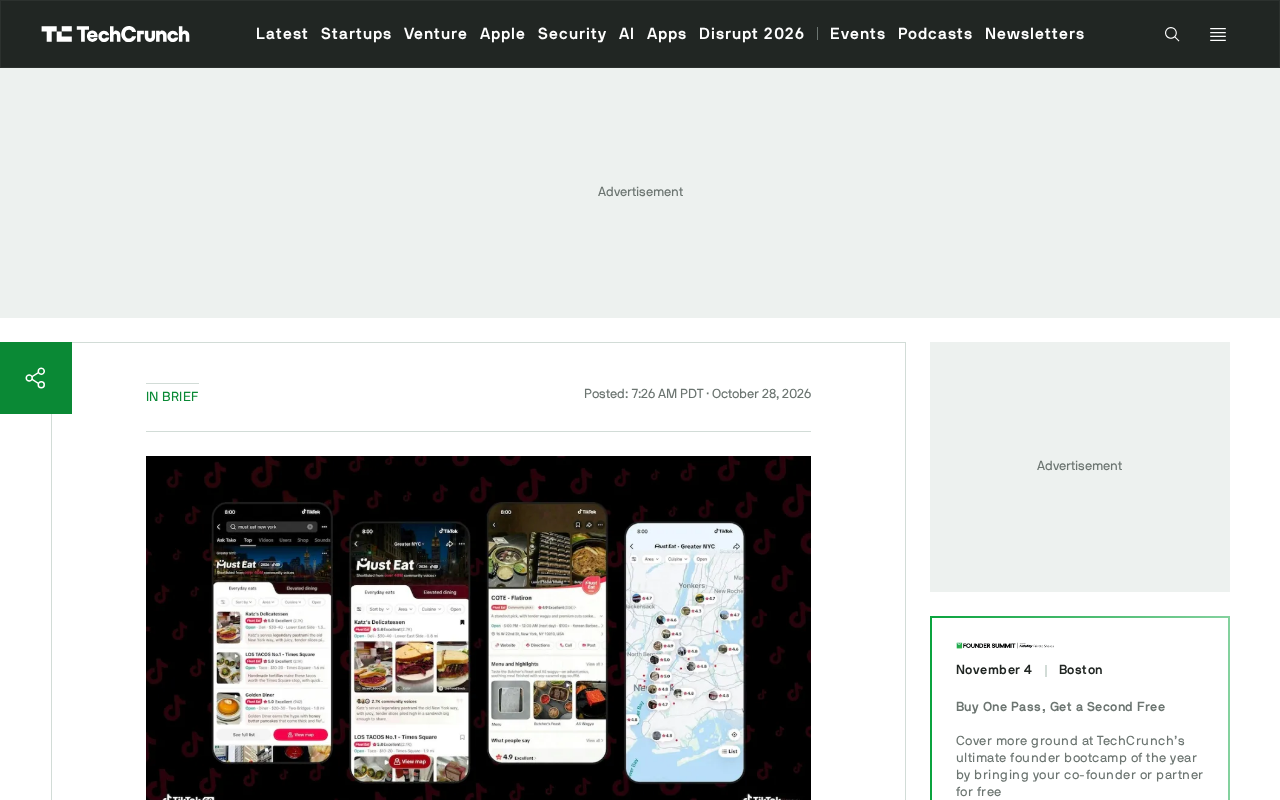
From Content Feed to Decision Gateway
Food exploration videos on TikTok have long been one of the platform's most vibrant content categories, but after watching a video, users often still need to jump to other apps to complete searches, locate places, and navigate. The significance of Must Eat is that TikTok is trying to bring the final link in this chain into its own product ecosystem.
The essence of a restaurant guide product is a decision tool: users don't need to scroll aimlessly through content but instead enter with a clear intent of "what to eat and where to eat." For the platform, such high-frequency, high-intent scenarios often mean a clearer monetization path, including merchant partnerships and local advertising.
Head-On Clash with Yelp and Google
According to the original report, this move makes TikTok's competition with platforms like Yelp and Google more direct. These two have long occupied the gateway position for local dining decisions: Yelp has accumulated a large volume of structured merchant reviews, while Google has turned "restaurants nearby" into a default action through Maps and Search.
TikTok's differentiated advantage lies not in data accumulation but in content format. The sense of presence and social传播 efficiency brought by short videos are difficult for traditional review platforms to replicate. Conversely, however, the review system, the completeness of merchant information, and mapping capabilities remain shortcomings that TikTok needs to address.
Local-Life Platforms: Local-life services refer to consumption scenarios such as dining, leisure and entertainment, and lifestyle services centered around users' daily life radius. Their core characteristics are strong geographic relevance, short consumption decision chains, and high transaction frequency. Yelp is an early representative in this field, building its moat with structured merchant information and user reviews; Google, relying on Search and Maps, has made "restaurants nearby" the default decision gateway for users. The value of such platforms lies in standardizing scattered offline merchant information so that users can quickly make choices based on reviews, ratings, distance, and other information. In recent years, local life has become an important direction for traffic platforms' monetization, because high-intent scenarios mean higher ad conversion rates and clearer willingness of merchants to pay.
Several Variables Worth Watching
How to govern content credibility: Once restaurant recommendations become an official feature, the boundary issue between fake探店 (fake restaurant visits) and commercial promotion will be amplified. The platform needs to provide credibility signals in its recommendation mechanism.
Integration with the existing content ecosystem: Whether Must Eat can smoothly leverage existing creator content on the platform determines whether it is "just another list" or "a natural extension after content accumulation."
Localized operations costs: Restaurant guides are a typically operations-heavy business, requiring continuous investment in merchant coverage and data updates across different cities.
Governance of fake探店 and commercial promotion: 探店 content itself carries a consumption-recommendation nature, but once the platform solidifies it into an official guide feature, the boundary between commercial promotion and genuine sharing becomes blurred. Common issues include merchants paying for positive reviews, creators not disclosing sponsorship relationships, and review manipulation. Mainstream platforms typically respond through disclosure mechanisms (labeling ads or partnerships), review authenticity audits, and introducing credibility signals into recommendation algorithms. For TikTok, how to establish a credibility signal system within its short-video content ecosystem is key to whether Must Eat can be trusted by users.
Localized operations: Restaurant guide products are a typically operations-heavy business, requiring city-by-city establishment of merchant databases, maintenance of business information, updates to menus and reviews, and handling of merchant partnerships and content moderation. Merchant density, consumption habits, and content ecosystems vary greatly across cities, and platforms need to invest substantial local teams or partners to achieve cold start and ongoing maintenance. Such operational costs do not dilute linearly with user scale, so local-life platforms often need a long time to achieve profitability at scale.
Editorial Judgment
Must Eat is a product extension of TikTok moving from "discovery" to "decision." The direction is reasonable, but the original information only discloses the feature's existence and competitive positioning, lacking details such as feature form, coverage, and launch timeline. What truly determines success is whether it can convert the content momentum of short videos into a reliable local decision experience—a step that Yelp and Google have been walking for many years.
Related articles

LLM Application Development: A High-Paying Career Guide for Ordinary People
LLM application development offers fresh graduates up to 35K/month, with SP offers reaching 600K. This article explains the core skills, how to break in, and how ordinary people can seize AI opportunities through learning by doing.

Say Goodbye to AI Influencer Faces: A Complete Guide to Creating Visual Assets for AI Comic Dramas from Scratch
Bilibili creator shares a full workflow for zero-basics AI comic drama visual assets: use Doubao Work skills with script-first, visual references, and real-person texture to escape AI influencer faces, then lock character and scene consistency with asset sheet layouts, weapon detail images, scene nine-grids, and cinematic color palettes.

The AI Production Pipeline Behind Great Videos: From Research to Agent Validation
AI video production isn't just a model race. This article breaks down a transferable four-step pipeline: researching professional workflows, organizing a skill checklist, configuring agents, and experimental validation—and explains how general-purpose LLMs like DeepSeek can replace paid tools to run the entire process.