TileLang: A DSL for Writing High-Performance GPU Kernels in Python

TileLang is a Python-based DSL using tile abstraction to write near-hardware-peak kernels for GPUs and accelerators.
TileLang is a domain-specific language (DSL) for GPUs, CPUs, and AI accelerators that lets developers write near-hardware-peak compute kernels in Python. Its core design philosophy uses "Tile" partitioning as its primary abstraction, mapping computation onto hierarchical storage resources like registers and shared memory, with the compiler handling low-level scheduling. This enables implementation of key large model components — FlashAttention, GEMM, quantization — without hand-writing CUDA. With 8,200+ GitHub stars and growing, it represents a maturing "Python-style kernel development" paradigm alongside OpenAI Triton.
Why We Need a New Kernel Development Language
High-performance computing has long faced an uncomfortable tradeoff: squeezing maximum performance out of a GPU typically requires dropping into CUDA or even hand-written assembly, at enormous engineering cost — yet prioritizing developer productivity usually means accepting a performance penalty. As the computational demands of large model training and inference have exploded, this tension has grown even more acute. Whether it's attention mechanisms, matrix multiplications, or quantization operators, every round of manual optimization comes with a lengthy debugging cycle.
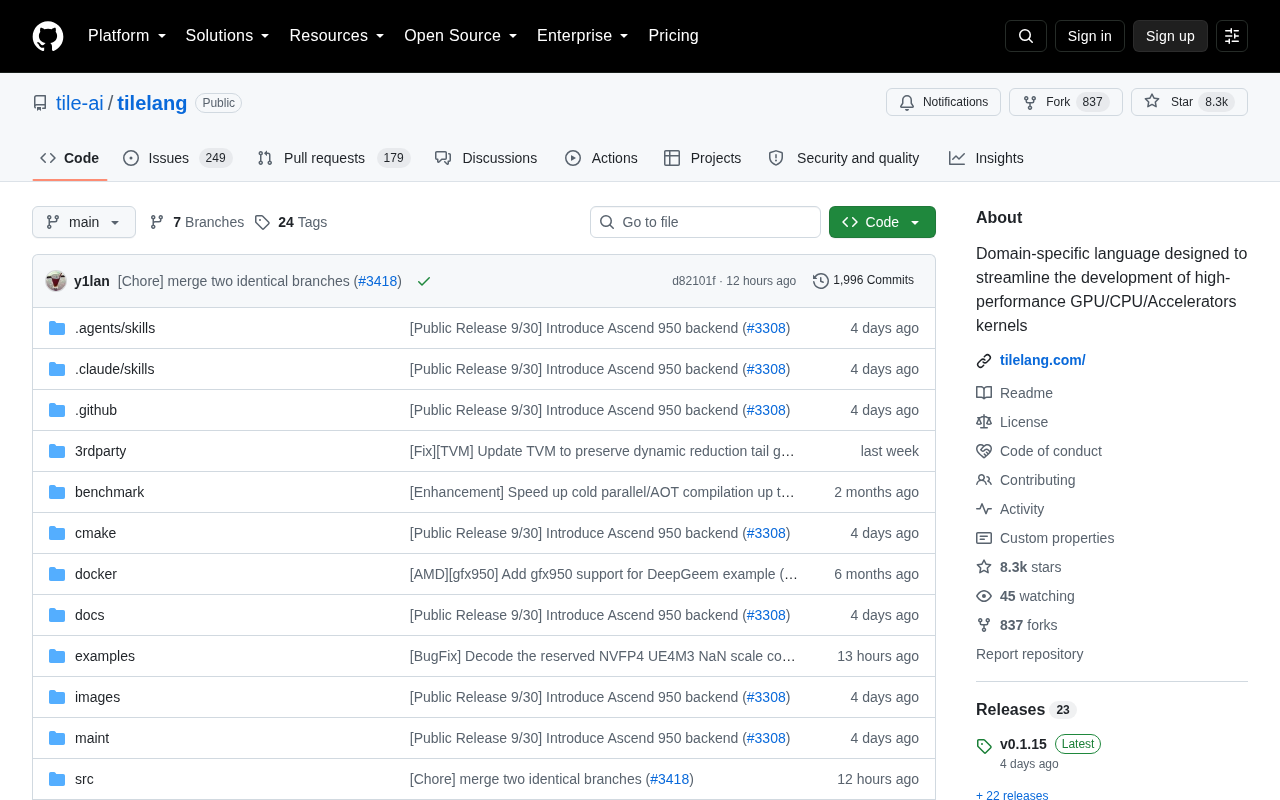
TileLang (tile-ai/tilelang) was built specifically to address this pain point. It's a domain-specific language (DSL) designed to simplify high-performance kernel development targeting GPUs, CPUs, and a wide range of accelerators. The project has already earned over 8,200 stars and 800+ forks on GitHub, with roughly 800 new stars added in a single week — a remarkably strong growth trajectory.
What TileLang Is All About
TileLang's most distinctive feature is Python as its development language. This means developers can write kernels in a familiar syntax environment without having to fully shift into a CUDA C++ mindset. For machine learning engineers who already live in Python, this dramatically lowers the barrier to entry for high-performance kernel development.
The name itself signals TileLang's design philosophy: everything revolves around the "Tile" (tiling) concept. Tiling is a foundational technique in high-performance computing for improving data locality and optimizing memory access patterns. By organizing computation into tiles, a compiler can better exploit hierarchical storage resources — registers, shared memory, and so on — to approach the theoretical performance ceiling of the hardware. This tile-centric abstraction lets developers describe algorithmic logic at a relatively high level while delegating tedious low-level scheduling to the compiler.
Ambitions Across Hardware Platforms
Notably, TileLang isn't limited to GPUs. The project explicitly targets GPUs, CPUs, and various accelerators. In today's diverse AI chip landscape, this kind of cross-platform abstraction capability is particularly valuable — it gives a single set of operator implementations a real chance to run across different hardware backends, eliminating the need to reinvent the wheel for each new chip.

The "Tile" abstraction is grounded in real hardware principles. Modern GPU memory hierarchies, from slowest to fastest, look like this: global memory (HBM) → shared memory (SRAM) → register file. Global memory latency can reach hundreds of clock cycles, shared memory takes only dozens, and registers are effectively zero-latency. The core idea behind tiling is to split a large computation into smaller chunks, each of which fits entirely in shared memory or registers, complete all computation at that level, then write results back to global memory — maximizing data reuse and hiding memory access latency. In matrix multiplication, for instance, a naive implementation requires repeatedly reading input rows and columns for each output element. With tiling, a thread block can share a single input tile, drastically reducing global memory reads. This is precisely how high-performance libraries like cuBLAS and FlashAttention achieve near-peak hardware performance, and it's the fundamental reason TileLang adopts tiling as its central abstraction.
What Problems It Solves
Given its design goals, TileLang's most immediate application territory is the core operators of deep learning. In the large model era, the performance of operators like FlashAttention, GEMM (General Matrix Multiplication), and quantization/dequantization directly determines training and inference efficiency and cost. These are also precisely the operators that are most time-consuming to tune by hand and most demanding in terms of specialized knowledge.
By providing a high-performance abstraction at the Python level, TileLang aims to let researchers quickly implement and iterate on custom operators without getting bogged down in low-level optimization every time they want to make a change. For research and engineering teams that need to experiment with new architectures frequently, the combination of "fast to write, fast to run" is genuinely appealing.
FlashAttention is a classic case study for understanding TileLang's value proposition. Standard Transformer self-attention computes an N×N attention matrix for sequences of length N. A naive implementation writes this enormous matrix to global GPU memory, creating a severe memory bandwidth bottleneck with O(N²) space complexity. FlashAttention's key innovation is tiling the Q, K, and V matrices, computing the softmax and weighted sum within SRAM tile-by-tile, and never materializing the full attention matrix in HBM — reducing memory complexity to O(N) and dramatically improving throughput. Implementing FlashAttention by hand requires precise control over CUDA thread blocks, shared memory allocation, and numerical stability tricks, resulting in a large, hard-to-port codebase. TileLang's goal is to let researchers express the same logic in dozens of lines of Python, delegating tile scheduling and memory management to the compiler so they can focus on algorithmic innovation rather than engineering details.
Its Place in the Open-Source Ecosystem
This kind of approach isn't without precedent. OpenAI's Triton similarly attempts to bring Python-style syntax to GPU kernel development and has already gained broad industry adoption. TileLang's emergence signals that a kernel development paradigm centered on Python as the carrier and compiler optimization as the engine is forming into a genuine trend. Together, these projects point toward the same direction: high-performance computing is shifting from a "specialist craft" toward programmable, reusable engineering practice.
For developers who want to explore or contribute to this space, TileLang — as a rapidly growing open-source project — offers both a practical entry point into high-performance kernel development and a useful lens through which to observe the evolution of AI compiler technology.
OpenAI Triton, released in 2021, is the most prominent pioneer in this space. Triton lets developers write GPU kernels in Python syntax while the compiler automatically handles shared memory allocation, thread scheduling, and vectorization. It has been adopted as one of the default backends for operator fusion in PyTorch (torch.compile). By comparison, TileLang's tile-centric design makes the tiling strategy more explicit, giving developers the option of fine-grained control beyond automatic optimization. The broader academic ecosystem also includes predecessors like Halide (an image processing DSL) and TVM's TE/TIR, all of which have validated the "separation of computation and scheduling" design philosophy. TileLang differentiates itself by targeting multiple hardware backends simultaneously and by making targeted optimizations for large model operators — such as FlashAttention variants and MoE routing — that are central to the current era. This focus is a key reason it has attracted rapid community attention even with Triton already relatively mature.
Summary
Built on Python syntax with tile-based partitioning as its core abstraction, TileLang targets high-performance kernel development across GPUs, CPUs, and accelerators — lowering the barrier to entry while pursuing performance close to hardware limits. As large model compute demands continue to climb and the AI chip ecosystem grows increasingly diverse, domain-specific languages like this will only become more valuable. Its rapid growth on GitHub is a clear signal that the community has a strong and unmet need for more effective kernel development tooling.
Related articles

Over 50 Claude Code Plugins Making AI Dumber? A Curated List of Practical Tools
Claude Code plugins aren't a case of more is better—over 50 tools make AI pick the wrong ones and perform worse. Here's a curated list of practical plugins and MCP tools including Pyright LSP, GitHub, Context7, Composio, and Figma, plus the difference between plugins and MCP servers and installation tips.

Reducing Code Attack Surface with Claude: A New Approach to AI-Assisted Security Auditing
A Hacker News discussion on using Claude to reduce code attack surface: treating LLMs as a security-audit triage layer, reviewing by input points, auth, and serialization—complementing static analysis tools. Includes practices and limitations.

Free Local n8n Deployment: Run AI Automation Workflows on Your Laptop
Deploy the open-source automation tool n8n locally for free with no subscription: install from source, launch with one PowerShell command, and run an email automation workflow on your laptop.