Timeless Code: Bringing Meeting Notes into the Claude Code Terminal

Timeless Code embeds AI meeting transcription directly inside Claude Code's terminal environment.
Timeless Code is an AI meeting recorder that runs natively inside Claude Code, with Claude handling installation automatically so developers never leave the terminal to capture or search meeting content. Its core insight: the terminal is already the hub for heavy engineering workflows, and merging meeting context with code context in the same AI session eliminates the copy-paste friction of standalone tools. The product earned 86 upvotes and a #9 ranking on Product Hunt, though it remains early-stage — limited to Claude Code users, opaque on data privacy, and unverified on transcription quality. More broadly, it signals a new distribution strategy: embedding inside high-frequency AI environments rather than competing for desktop or browser real estate.
A developer's day is often torn between code and meetings. Just as you hit your flow state, a standup or requirements review yanks your attention away — and afterward, you're left trying to reconstruct who said what and what got decided. Timeless Code aims to bridge that gap: it's a meeting recorder that runs directly inside Claude Code, letting developers capture meetings and search through what was said without ever leaving the terminal.
The product launched on Product Hunt with 86 upvotes and a #9 ranking, categorized under meeting tools, developer tools, and AI. Its positioning is clear: it's built for developers who live in the terminal.
A Note-Taker That Lives Inside Claude Code
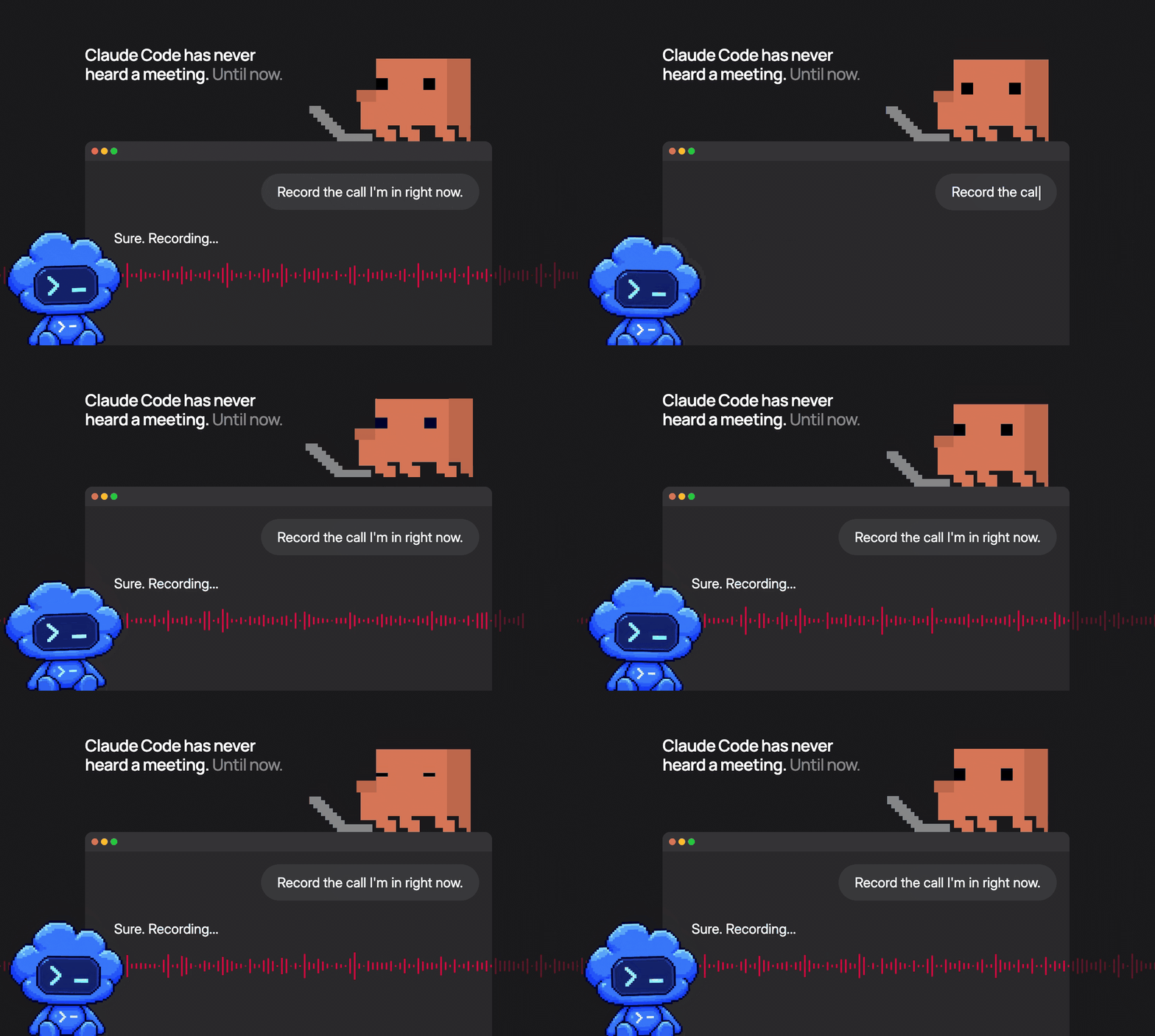
Timeless Code's core pitch is that it doesn't exist as a standalone app — it "lives inside Claude Code." According to the official description, Claude handles the installation and configuration for you. There's no separate client to download, no additional accounts to create. Claude Code simply wires it into your existing work environment.
Once set up, the usage is straightforward: record a meeting, then ask questions in the terminal like "what did everyone say about this topic just now?" It bundles speech transcription, content retrieval, and natural language Q&A together, with the command line as the interaction layer — the same interface you already know. The implicit design philosophy here is that the best tools for developers are the ones that don't interrupt the workflow.
Claude Code is Anthropic's command-line AI coding assistant, allowing developers to interact with Claude directly in the terminal to generate code, debug, manipulate files, and more. Its defining characteristic is deep integration into the developer's local environment — it can read project files, run commands, and maintain code context across conversations. Unlike IDE plugins such as GitHub Copilot, Claude Code operates primarily in the terminal, targeting engineers who are comfortable with command-line workflows. This "native command-line" nature is precisely what enables third-party tools to embed themselves via MCP (Model Context Protocol) or custom tool calls — Timeless Code's "living inside" approach leverages this extension mechanism, making meeting transcription available to Claude as a callable tool rather than a separate running process.
Why the Terminal as an Entry Point
Building meeting notes into Claude Code is fundamentally a bet on a broader trend: AI coding assistants are evolving from pure code-writing tools into general-purpose workbenches for developers.
For heavy Claude Code users, the terminal is already the hub where they read docs, run commands, and converse with AI. Layering meeting memory on top of that hub means context can flow seamlessly — in theory, you could ask Claude to reference decisions made in the meeting while simultaneously helping you refactor code. That combination of "meeting content + code context in one place" is something standalone meeting tools like Otter or transcription SaaS products simply can't offer.
This also reflects a new approach to product distribution: rather than competing for space on a user's desktop or browser tab, the strategy is to embed inside an AI environment that's already seeing high-frequency use. Whoever owns the interface where developers spend the most time has a shot at becoming the default entry point.
Typical general-purpose meeting transcription tools — Otter.ai, Fireflies, Notion AI — work like this: after the meeting ends, they generate a standalone summary document that users access in a browser or separate app. For a developer mid-coding session who wants to reference a decision from that meeting, this means switching windows and copy-pasting, with context completely severed. What Timeless Code is trying to solve is exactly that transfer loss between "meeting conclusions" and "code implementation." When meeting content and code context exist within the same Claude session, a prompt like "write this API endpoint based on today's meeting requirements" theoretically no longer requires the developer to manually relay background information — an architectural advantage that current standalone SaaS tools are hard-pressed to replicate.
Things Worth Approaching With Caution
The buzz is real, but Timeless Code is still an early-stage product, and a few things deserve scrutiny.
Narrow target audience. Its value is tightly coupled to Claude Code usage. If your team doesn't use Claude Code, or if meeting participants include non-engineering roles like product managers or designers, this "record meetings in the terminal" model may actually be less convenient than a general-purpose tool.
Privacy and data boundaries. Meeting content often contains sensitive information, and transcription plus Q&A means that data has to be processed somewhere. The available information doesn't disclose details about data storage or handling. Enterprise users will need to verify compliance before adopting it.
Transcription and retrieval quality remains unverified. The actual experience depends on speech recognition accuracy and the quality of answer retrieval — neither of which can be evaluated from current public information. The 86 upvotes reflect the appeal of the concept, not necessarily the quality of the execution.
A Direction Worth Watching
Setting aside the maturity of this particular product, the direction Timeless Code represents is genuinely thought-provoking: AI coding environments are emerging as a new platform layer, with specialized functionality increasingly aggregating inside them as plugins or native integrations. Meeting notes are just one example — task management, documentation, knowledge bases, and more could all get pulled in over time.
For developers, this suggests that workflows may continue to consolidate around AI assistants. For founders, it hints at a new route around the traditional distribution red ocean — building the feature that sits closest to what users are doing right now, inside someone else's AI ecosystem.
Related articles

From Photons to Production: An Open-Source Computer Vision Engineering Reading Path
Reddit user open-sources a computer vision engineering reading path with 16 chapters from image formation to production deployment, emphasizing primary sources, dependency order, and reproducible benchmarks to help engineers understand why models fail and build reliable vision systems.

Prompt Failures? The Truth About Why AI Agents Struggle in Production—and How to Fix It
A Reddit developer built Agents with Copilot and Gemini but faced unstable behavior. This article analyzes three gaps in prompt engineering for Agent scenarios and offers three practical paths to reliable Agent deployment, including structured prompts, workflow-first approaches, and building an evaluation loop.

Tesla Robotaxi to Open Private Vehicle Access Next Year: Promise or Pipe Dream?
At its Q3 earnings call, Tesla said owners can add their cars to the Robotaxi fleet next year. We analyze the technical basis, Musk's missed deadlines, business logic, and competition.