Tiny Funnel: A Cookie-Free Lightweight Funnel Analytics Tool That Makes Conversion Data Crystal Clear

A cookie-free, lightweight funnel analytics tool that makes conversion data instantly understandable.
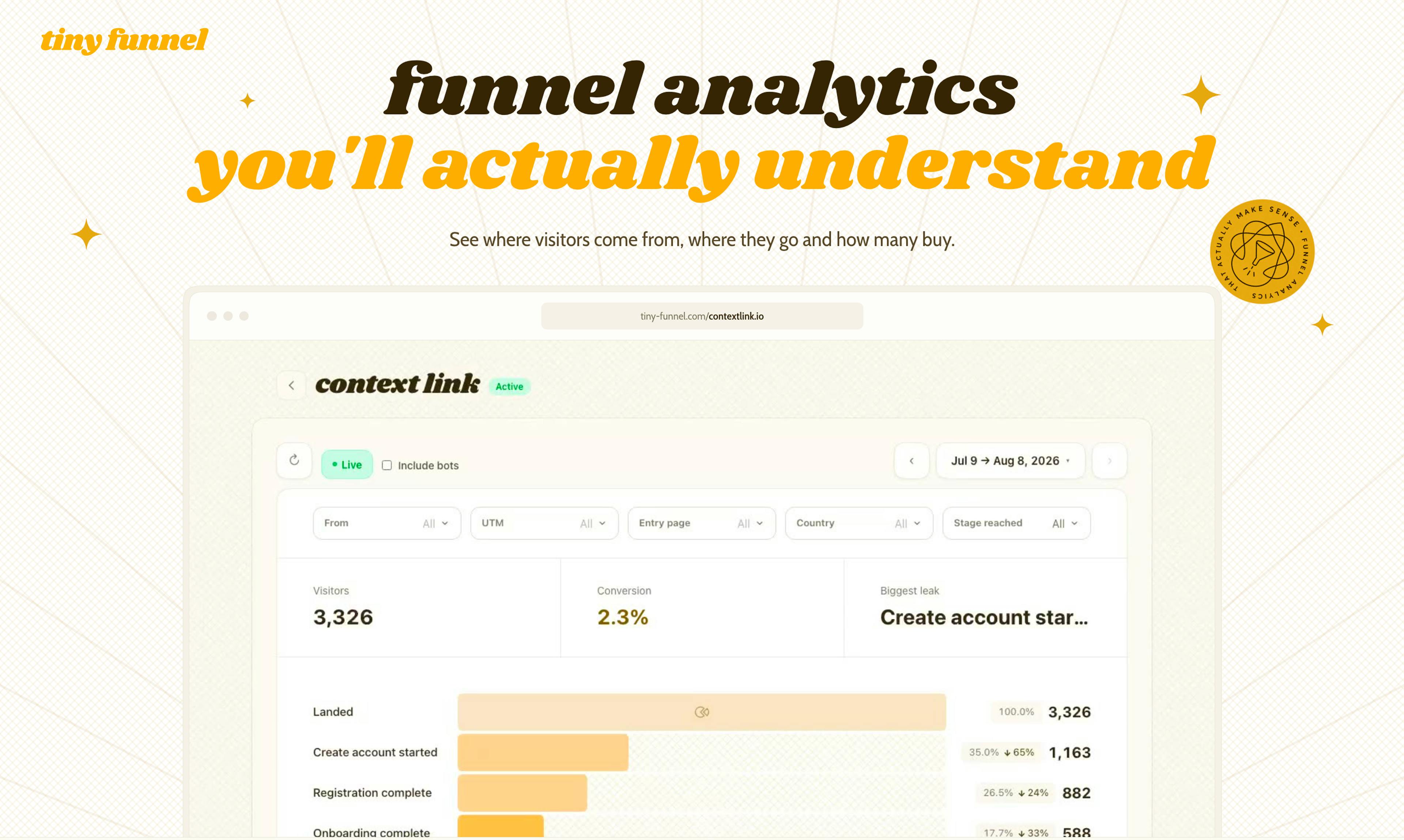
Tiny Funnel is a lightweight funnel analytics tool built by indie developer Oli Woods. It features dynamic filter previews that show data before selection, cookie-free tracking for complete visitor counting, time-series conversion views, and individual visitor journey tracking — all designed to help small teams and indie developers quickly understand their conversion funnels without complex setup.
When Funnel Analytics Gets Back to Basics
In the world of digital marketing and product growth, the Conversion Funnel is a core analytics tool that virtually every team relies on. It answers the most critical business questions: Where do visitors come from? How far do they get? And how many ultimately complete a purchase? Yet the analytics tools on the market often obscure what should be clear insights with overly complex configurations and dizzying dashboards.
Tiny Funnel, recently launched on Product Hunt, takes direct aim at this pain point. Its tagline is almost provocatively straightforward — "Funnel analytics you'll actually understand." After launch, it quickly earned 84 upvotes, landing at #9 on the daily leaderboard, categorized under Analytics, Marketing, and SaaS.
Tiny Funnel's Core Philosophy: Get Answers Faster
Tiny Funnel's design philosophy can be distilled into a single sentence — "Get answers and ideas as quickly as possible." This comes through vividly in its actual features.
Dynamic Filter Previews with Real-Time Data Linking
The most noteworthy design choice is its filtering interaction logic. In traditional funnel tools, you typically need to set up a bunch of conditions first, then wait for the chart to refresh before seeing results. Tiny Funnel flips this on its head: before you even select a filter, each option already displays its corresponding statistics.
For example, when you want to analyze visitors "from Google" who "reached at least step two," you don't have to select blindly — each filter option shows the associated data volume and conversion metrics right beside it. Once you make your selection, the entire funnel view updates accordingly. This "what you see is what you get" exploration approach dramatically lowers the cognitive barrier to data analysis, enabling even non-specialists to quickly find valuable insights.
Cookie-Free Tracking: Ensuring Every Visitor Gets Counted
Another technical highlight is its Cookie-less tracking mechanism. As global privacy regulations tighten and browsers increasingly block third-party cookies, traditional analytics tools that rely on cookies face massive data loss — many visitors who dismiss cookie consent banners simply never get counted.
Tiny Funnel's cookie-free approach ensures that "everyone gets counted." This not only means more complete and accurate data samples but also gives the product a compliance advantage, sidestepping the many complications brought by GDPR and other privacy regulations.
Time Dimension and Individual Visitor Journey Tracking
Beyond horizontal funnel analysis, Tiny Funnel offers two deeper perspectives that help teams understand conversion data from different dimensions.
How Funnel Conversion Rates Evolve Over Time
Scrolling down the page, users can see "your funnel through time." This time-series view is extremely useful for evaluating product iterations and marketing campaign effectiveness — you can visually observe whether conversion rate curves shift positively after a redesign or promotional campaign.
Tracking Any Visitor's Complete Conversion Path
Going even further, Tiny Funnel supports viewing "any visitor's full journey." This granular path tracking lets teams not only see macro-level group trends but also drill down to individual behavior, understanding how a single user navigates between pages and where exactly they drop off. The combination of macro and micro perspectives makes analytical conclusions more comprehensive and credible.
Who Is Tiny Funnel For: Small Tool, Big Thinking
Tiny Funnel was built by independent developer Oli Woods, and everything from its name to its positioning exudes a "small but beautiful" sensibility. In an analytics tool landscape dominated by heavyweights like Google Analytics, Mixpanel, and Amplitude, Tiny Funnel has chosen a differentiated path: rather than pursuing comprehensive feature sets, it focuses on making "funnel analysis" — this one thing — as simple and intuitive as possible.
For the many small and medium teams, indie developers, and early-stage startups out there, they often don't need the full capabilities of an enterprise analytics suite. What they actually need is a lightweight tool that's quick to set up, easy to understand, and privacy-friendly. Tiny Funnel fits precisely into this market gap.
Reflections on the "De-Complexification" Trend in Analytics Tools
From a product perspective, Tiny Funnel embodies a growing trend — the "de-complexification" of analytics tools. As data tools become increasingly powerful, usability has paradoxically become the new scarce resource. Making data truly serve decision-making rather than drowning people in charts — that's exactly where Tiny Funnel's value lies.
Of course, as a newly launched independent product, its data integration capabilities, large-scale data processing performance, and compatibility with existing workflows still need to be proven over time and through user feedback. But the design principles it proposes — "see the data before filtering" and "cookie-free full-count statistics" — undoubtedly offer valuable reference points for the entire analytics tool category.
For teams struggling with conversion rates and put off by complex analytics tools, Tiny Funnel might be worth a try.
Related articles

CSS Anchor Positioning: A New UI Positioning Approach Without JavaScript
A deep dive into CSS Anchor Positioning: from anchor-name and position-anchor to the anchor() function, position-area shorthand, position-try-fallbacks, anchor-size, and upcoming anchor queries.

New AI Chart Interaction: Continuous Follow-up Questions and Visualization in Conversation
Explore a new AI interaction method for continuously generating charts in conversation. Use the /visualize command to ask follow-up questions and visualize answers in the same chat window, improving data analysis efficiency.

Cursor Merges Into X Subscription: Paid Plans Share Unified Usage Pool, Grok Model Coding Usage Doubled
Cursor joins The X Subscription with a unified usage pool and doubled Grok coding quota. Third-party models shift to API pricing. Existing users can keep or migrate plans.