Tired of Tutorials? This Free Game Lets You Learn Claude Code by Playing

Developer replaces tutorials with level-based game Claude Code Quest to teach Claude Code hands-on.
A developer on Reddit built a free game called Claude Code Quest to solve the "read tons of tutorials but still can't do it" learning problem. It splits Claude Code learning into three difficulty levels, each requiring real hands-on completion rather than forgettable docs. Beyond basic commands, it covers advanced features like Skills, Hooks, Subagents, and MCP that often stump beginners. The game is free but depends on real Claude Code access, so it suits those who've already decided to start and need practice. The project is open source on GitHub, with the author still iterating and seeking feedback. Its core value: shifting learning from reading to executable practice, using tasks, levels, and hands-on feedback to solve motivation and feedback problems.
Learning Claude Code trips up a lot of people at the same spot: after watching piles of tutorials, they still don't know where to start when it's actually time to use it. A developer on Reddit took a different approach—building a free game called Claude Code Quest that gets you to actually use the tool by playing through levels.
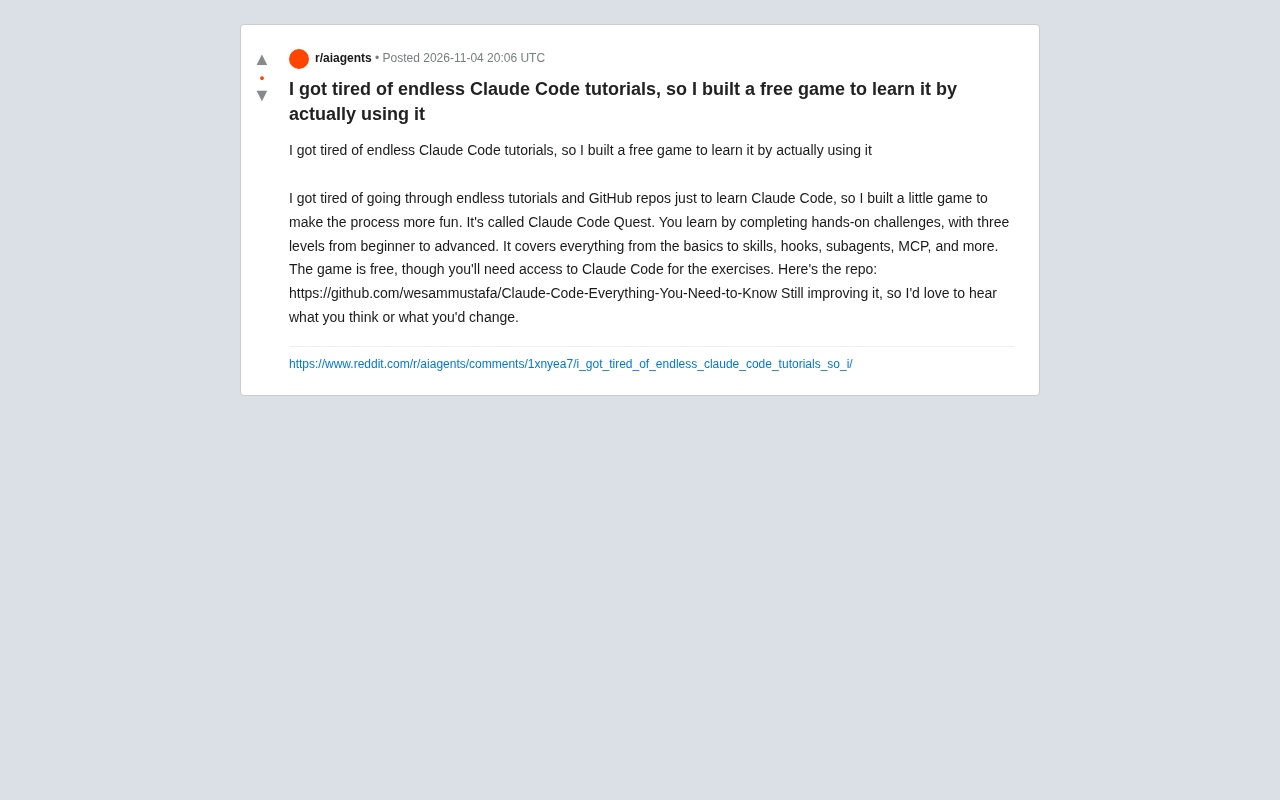
From "Passively Watching Tutorials" to "Actively Using the Tool"
According to the original Reddit post, the author's motivation was simple: endless tutorials and GitHub repos make the learning process tedious. Claude Code Quest splits the learning path into three difficulty levels, from beginner to advanced, and each stage is a hands-on challenge rather than documentation you read and forget.
What's notable about this design is the "learn by doing" loop: when players complete tasks in the game, they're essentially calling Claude Code in a real environment to perform specific operations. Learn a concept, use it immediately—memory and muscle memory build together.
What the Game Covers
According to the original post, Claude Code Quest isn't limited to basic command-line operations. It also covers more advanced features like Skills, Hooks, Subagents, and MCP—precisely the parts many beginners find abstract and get stuck on when reading docs.
Breaking these concepts down into levels is like slicing a steep learning curve into a series of achievable small goals. For people who already know the basics but want to systematically fill in their skills, this structured practice path saves more time than fragmented searching.
Skills, Hooks, Subagents, and MCP are four key mechanisms for extending Claude Code's capabilities, and understanding them helps clarify what this game is actually training.
- Skills: Reusable instruction packages that encapsulate the execution steps and conventions for a type of task, letting Claude Code work through preset flows in specific scenarios—essentially giving the model an "operations manual."
- Hooks: A hook mechanism that automatically triggers scripts at key points in tool calls (such as before or after executing commands), used for validation, interception, or logging—a means of achieving automation and safety constraints.
- Subagents: Child agents spawned outside the main conversation with their own independent context, used to handle subtasks in parallel or in isolation, preventing the main session from being flooded with intermediate information.
- MCP (Model Context Protocol): An open protocol that standardizes how models connect to external tools and data sources, enabling Claude Code to access databases, third-party services, and other external capabilities.
These four correspond respectively to process reuse, automation control, task decomposition, and external integration—the dividing line between "knowing how to use commands" and "knowing how to build workflows."
Free, But With a Prerequisite
The author explicitly states that the game itself is free, but there's one thing to note: completing the exercises requires access to Claude Code. In other words, this isn't a pure web-based simulator—the practice sessions depend on a real tool environment.
This prerequisite also defines its positioning—it's suited for people who have already decided to get started with Claude Code and need a practice path, not for those who just want to understand the concepts.
Claude Code access typically means the ability to run the Claude Code CLI in a local terminal or IDE through an Anthropic account (with API credits or a subscription plan). It's not a web service you can open directly in a browser—it's a development environment that requires installing a command-line tool on your machine and completing login authentication before you can use it. This also explains why the game can't be made as a pure simulator: every step in the exercises actually triggers Claude Code's reasoning and tool calls, consuming real tokens. For those who want to try it, this means preparing an account, setting up the environment, and confirming that credits are available—the game itself is just a practice layer built on top of that environment.
Open Source and Continuously Iterating
The project code is on GitHub (repo name: Claude-Code-Everything-You-Need-to-Know), and the author says in the post that improvements are ongoing and feedback is openly solicited: they want to hear users' opinions and what people think should be changed.
The combination of open source and public feedback means the content has a chance to keep pace with Claude Code's own updates. For this kind of tool, that's more valuable long-term than a one-off tutorial.
Who It's For, and Who It's Not For
If you're tired of the "watch video—type along—forget everything in a couple days" cycle and want a practice path with feedback and progress, this project is worth a try. The three difficulty levels also mean both beginners and those with some foundation can likely find a starting point.
But if you haven't set up your Claude Code environment yet, or just want a quick overview of what it can do, the requirement for real access makes the barrier a bit higher. Get your environment running first, then use this as an entry point for systematic practice—that's probably a more sensible order.
A Brief Observation
When it comes to AI coding tools, tutorial content is already saturated—what's genuinely scarce is "executable practice design." Gamifying the learning process essentially solves two problems: motivation and feedback. Tasks give you goals, levels give you progress, and hands-on work gives you feedback. This project isn't large, but the approach it represents—using hands-on practice rather than reading materials to carry learning—is more valuable as a reference for AI tool learners than yet another introductory guide.
One-line Summary
A developer replaces tutorials with the level-based game Claude Code Quest to help people learn Claude Code hands-on.
Paragraph Summary
A developer on Reddit created a free game called Claude Code Quest to address the learning dilemma of "reading piles of tutorials but still not knowing how to do it." It splits the Claude Code learning path into three difficulty levels, each a challenge requiring real hands-on completion rather than documentation you read and forget. The content goes beyond basic command-line operations to cover advanced features like Skills, Hooks, Subagents, and MCP that beginners often get stuck on. The game is free, but practice depends on real Claude Code access, making it better suited for people who have already decided to get started and need a practice path. The project is open source on GitHub, and the author is still iterating and openly soliciting feedback. Its core value lies in shifting learning from reading materials to executable practice, using tasks, levels, and hands-on feedback to solve the problems of motivation and feedback.
Related articles

FastAPI Learning Path: From Beginner to AI Project Practice
A Bilibili creator recommends *FastAPI Web Development: From Beginner to Advanced with Practical Projects*. This article outlines the FastAPI learning path: target audience, the 15-chapter six-part structure, project-driven learning, and practical directions from web backend to AI Agents, helping beginners avoid detours.

Reverse-Engineering Taobao's sign Signature Parameter with AI in 10 Minutes: A Practical Walkthrough
Based on a Bilibili hands-on demo, this article explains how to combine DeepSeek with vision models to automatically reverse-engineer Taobao's sign signature parameter, track dynamic titter and token values, and successfully scrape product data within ten minutes—while analyzing the capability boundaries and compliance risks of AI Agents in crawler reverse engineering.

LangChain+MCP from Beginner to Practice: A Deep Dive into the Bilibili Tutorial
A deep dive into a Bilibili LangChain+MCP tutorial: framework positioning, agent abstraction, and MCP protocol basics. Why not hand-build frameworks, and how beginners can follow the code-practice path.