"Tokens Exhausted": The AI Anxiety Behind a Robot Video
A near-indistinguishable AI robot satire reveals the anxieties of the synthetic media and LLM era.
The viral short "Tokens Exhausted" spread on Reddit partly because viewers couldn't tell whether it was genuine Boston Dynamics footage — a symptom of the synthetic media age. By fusing robot hardware with LLM-native concepts like token exhaustion and latency, and imagining a robot being quizzed on how many R's are in "strawberry," the video skewers the reality of driving physical machines with flawed language model logic. It went viral because it simultaneously delivers entertainment, satire, and tech anxiety — making audiences laugh, feel uneasy, and wonder where human-machine integration is really headed.
A Video That Blurs the Line Between Real and Fake
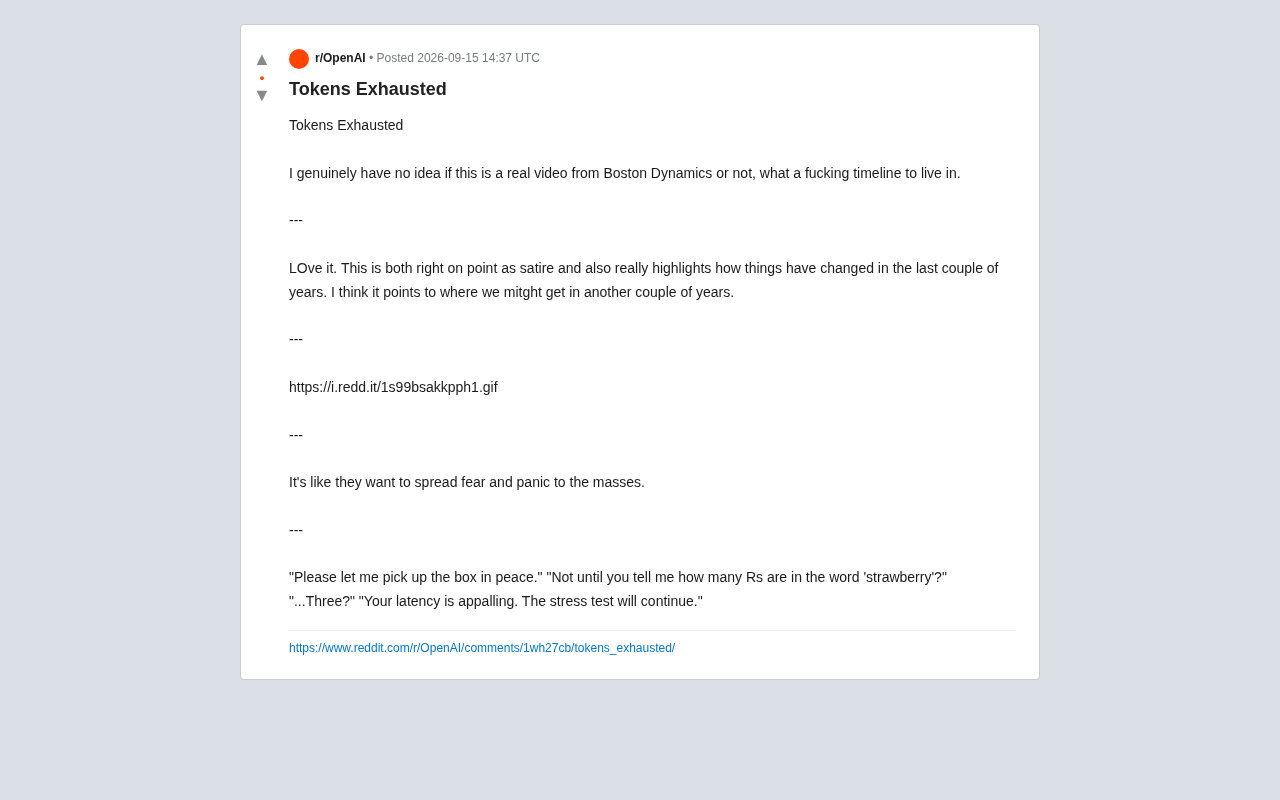
A short video titled "Tokens Exhausted" has sparked heated discussion on Reddit. The original poster's reaction says it all: "I genuinely cannot tell if this is a real Boston Dynamics video or not. What kind of era are we living in?"
That single sentence may reveal more about our current moment than the video itself. When synthetic media has become so convincing that it approaches — or even surpasses — the limits of human perception, the average viewer has no reliable way to tell whether footage of a humanoid robot moving boxes came from an actual lab or was generated entirely by AI.
Why This Satire Hits a Nerve
One commenter cut to the heart of it: "I love this. It works perfectly as satire, while also highlighting just how much things have changed in the past couple of years. I think it hints at where we might be headed in a few more."
The video's cleverness lies in splicing together two distinct technological threads: Boston Dynamics-style robot hardware on one side, and the distinctly LLM-flavored concepts of "token exhaustion," "latency," and "stress testing" on the other. The title "Tokens Exhausted" directly ties a robot's physical capabilities to the computational cost of LLM inference — as if every movement the robot makes draws down a compute budget.
A quick explainer: "Tokens Exhausted" as a concept comes from the context window limitations of large language models. Every time you call an LLM, the amount of text it can process is bounded by its "context window" — once exceeded, the model can no longer continue reasoning and must truncate or reset. A token is the basic unit LLMs use to measure text, roughly corresponding to half a word to one full English word, and computational costs are billed directly by token count. Grafting this concept onto a physical robot conjures an absurd vision of the future: a robot that burns through an expensive inference budget with every physical action, grinding to a halt once the chain of movements grows too long. This mapping resonates because the field of embodied AI genuinely does pursue technical approaches that use LLMs or large vision-language models as the robot's "brain" — and inference latency and compute costs are real engineering bottlenecks.
The "How Many R's in Strawberry" Gag
The most inspired comment in the thread took the absurdity to its logical extreme:
"Just let me move the box in peace." "Not until you tell me how many R's are in the word 'strawberry'." "…Three?" "Your latency is terrible. Stress test continues."
This fictional exchange lands squarely on two real AI talking points. The first is the now-famous "how many R's in strawberry" problem — early large language models repeatedly fumbled this simple letter-counting task, becoming a canonical example of how models can appear intelligent while failing at basic common sense. The second is "latency" and "stress testing," engineering metrics reframed as a form of harassment directed at the robot, producing a pitch-black sense of humor.
Slotting these references into a box-moving robot scenario, the satire's real target becomes clear: we are attempting to drive what should be reliable physical machines using a system of language model logic riddled with known flaws.
Why "strawberry" became a classic test case comes down to the underlying mechanics of how LLMs process text. LLMs don't read words character by character — they split text into "tokens" (sub-word units). "Strawberry" is often tokenized as something like "straw" + "berry," which means that when the model is asked to count letters, it isn't actually "seeing" a complete word. It's stitching together statistical impressions of sub-tokens. This leads it to confidently answer "2" when asked how many R's there are. The phenomenon was widely discussed around the time of GPT-4's release, becoming a vivid illustration of the fact that a model's linguistic fluency and its symbolic reasoning ability are not the same thing. The irony is that tasks trivially easy for humans expose the model's most fragile side — it can write a polished essay, yet struggle to count the letters in a single word.
Where the Fear Comes From
Some commenters read a darker subtext into the whole thing: "Feels like they just want to spread fear and panic to the general public."
That reaction isn't unfounded. The combination of humanoid robots and an AI brain naturally triggers people's imagination about technology spiraling out of control. And when content like this is impossible to authenticate, the anxiety only amplifies — you can't even reassure yourself by saying "it's just a fake video," because you're not sure it is.
What's worth reflecting on is that this content spread virally precisely because it satisfies three needs at once: entertainment, satire, and anxiety. It makes you laugh. It makes you uneasy. And it makes you think about where technology is headed.
A Mirror Held Up to the Present
Setting aside the question of authenticity, the Reddit discussion itself is a valuable snapshot of the moment. It reflects several trends already in motion: synthetic media has become good enough that even the genuine output of real companies gets second-guessed; public awareness of LLM limitations — letter counting, hallucinations — has spread widely enough to become meme fodder; and the fusion of robotics and AI is emerging as a new focal point for collective imagination and collective anxiety.
What looks like a silly, absurdist clip is really a meditation on a serious question: can we still trust what we see? As the original post lamented — we really are living in an era where telling the real from the fake is no longer a given.
Related articles

Claude Code vs. Codex in Enterprise Projects: How AI Engineering Handles Complex Systems
From Vibe Coding to AI engineering: a breakdown of Claude Code and Codex in real enterprise projects, covering three dev modes, domestic LLM rankings, SuperPower workflows, and Open Router's profit logic.
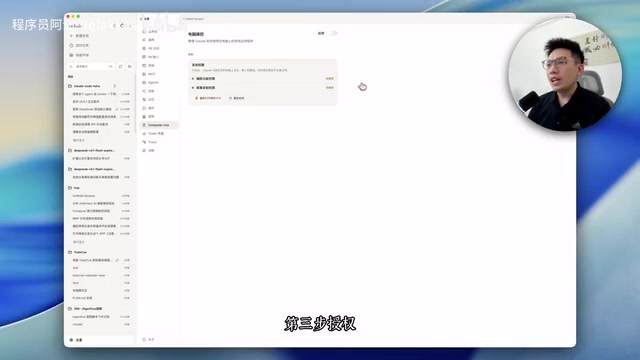
Hands-On with Open-Source Desktop Client CC-HAHA: Let AI Automatically Control Your Computer
CC-HAHA is an open-source desktop client with computer use support, letting AI control your GUI via virtual mouse. Learn the 3-step setup and model comparisons.
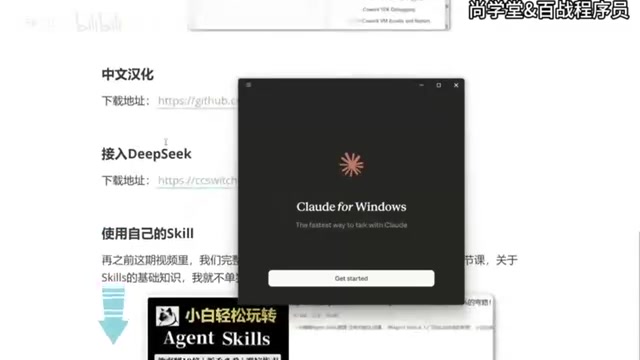
Claude Code Desktop: A Complete Guide to Chinese Localization, Account-Free Use, and DeepSeek Integration
Step-by-step guide to installing Claude Code Desktop, enabling account-free use, adding Chinese UI, connecting DeepSeek via CC Switch, and importing custom Skills.