Too Many Zotero Papers to Read? This AI Skill Auto-Summarizes and Batch-Deep-Reads Them

Using review plus deep reading, it strings Zotero literature from screening to deep understanding into a verifiable workflow.
The article introduces a self-built AI Skill by a Bilibili creator for the problem of having too much Zotero literature and not knowing where to start. The Skill has two independent features: the review reads PDFs under a specified collection, creates a paper card for each paper, then aggregates them into a comparison table and thematic review to help find gaps and key literature; deep reading explains a paper's technical route, experimental logic, and limitations rather than restating the abstract. The author stresses that key judgments must be traceable to the original text, and recommends screening with the review first, then deep-reading key papers. AI handles only mechanical organization; the saved energy should go into understanding methods and research questions.
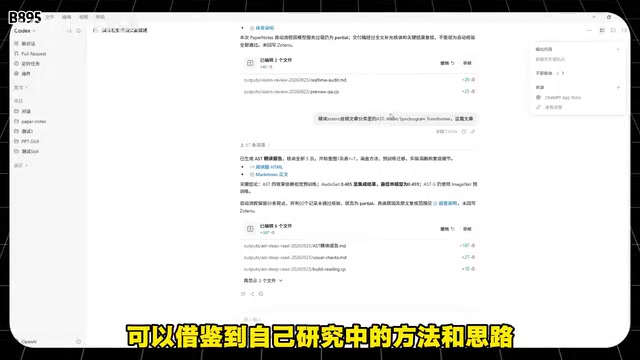
Saving papers into Zotero is just the first step. The real headache is this: the more papers pile up in your library, the less you know where to start, which ones deserve a deep read, and which methods are actually related. A Bilibili creator shared a self-built AI Skill that connects the whole pipeline—from screening to deep understanding—using two tracks: literature review and batch deep reading.
What Review and Deep Reading Actually Solve
This Skill includes two independent features, aimed at two different stages of the research workflow.
The review feature is positioned as "entering a new direction." When you already have a batch of papers and want to quickly know what each one does, how their methods relate, what common problem they're solving, and what gaps are worth attention—that's what the review is for. It reads the PDFs under a specified Zotero collection, produces a paper card for each article, then organizes those cards into a thematically structured review.
The deep reading feature is aimed at "thoroughly understanding a single paper." How the method was designed, how the experiments were done, what conclusions the results actually support, and whether there are ideas transferable to your own research—these are what deep reading unfolds.
The creator's recommended order is clear: first use the review to build an overall picture, then screen out the key papers from it, and finally invest your time in deep reading.
Zotero is an open-source reference management tool whose core capabilities include capturing web metadata, managing PDF attachments, organizing items by collection, and supporting the construction of a personal knowledge base via tags and notes attached to items. Its collection structure is the entry point for all automated workflows in this article—the reason the Skill can "read PDFs under a specified collection" depends on Zotero's unified indexing of each item and its attachments. In addition, Zotero provides a local API and a plugin ecosystem (such as Better BibTeX and ZotFile), enabling external programs to batch-read items and full texts by collection. Understanding this helps clarify that the quality of the review and deep reading largely depends on whether PDFs are properly named on import, whether metadata is complete, and whether collections are well organized—otherwise the AI just gets a pile of text whose sources are hard to locate.
Review Feature in Practice: Horizontal Comparison, Not Item-by-Item Listing
In actual use, instructions need to be clear enough: which collection to read, what question to summarize around, and how you want the results organized. In the demo, the creator directly specified the Zotero collection and the research question.
After the run finishes, the first thing to check is literature coverage—which articles were processed, which weren't, and whether there are obvious research gaps in this batch. Then comes the paper comparison table, which puts each article's research question, core method, experimental conditions, and results into the same table.
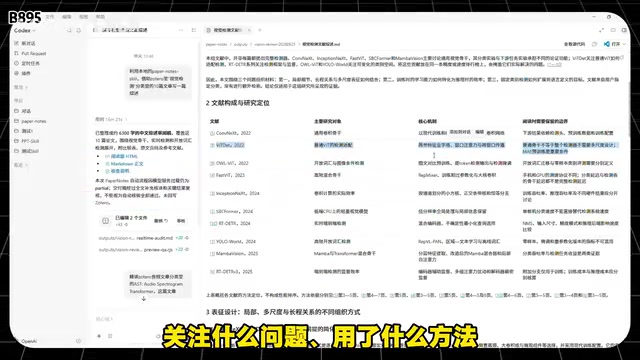
The value of this table is that it helps us quickly locate the objects worth comparing further. Next is the main body of the thematic review—the key thing to check is whether it truly connects several papers and places viewpoints from different articles under the same theme for comparison.
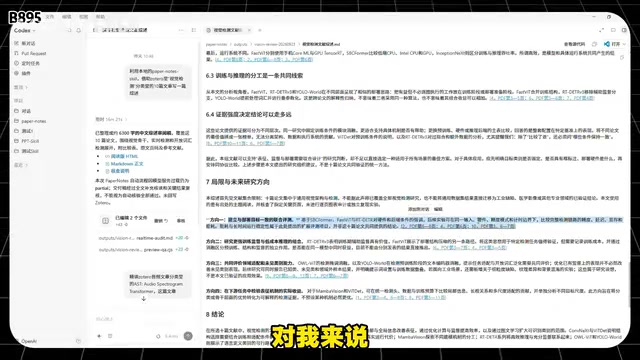
The creator particularly emphasized one verification habit: every key judgment in the text should be traceable to a source. When you see an important conclusion, go back to the original paper to confirm whether it is really supported. AI-generated reviews do not mean you can skip checking the original text.
Finally, three things need dedicated checking: experimental conclusions, experimental conditions, and future research directions. Conclusions cannot be viewed apart from conditions, and future directions should be distinguished as either explicitly proposed by the authors or analyzed by the AI based on existing literature.
Paper card is an intermediate artifact that structurally compresses a single paper, usually containing fixed fields such as research question, method, data/experimental conditions, main conclusions, and limitations. Its role is not to replace the original text, but to turn each paper into field-aligned small blocks without losing key information, so that multiple papers can be compared side by side. Compared with having the model directly read ten PDFs and then write a review, first generating cards and then aggregating them has two advantages: first, the card fields are uniform, so horizontal comparison won't suffer from structural misalignment like "this one discussed conditions, that one didn't"; second, cards can serve as traceable anchors—every judgment in the review body can point back to a specific card or even a specific original text. This is exactly the foundation that makes the article's emphasis on "key judgments must be traceable to sources" achievable.
Deep Reading Feature: Breaking a Paper Down to the Point of Reproducibility
The deep reading prompt needs to be more specific. If you want to focus on experimental methods, technical routes, and transferable design ideas, you can state that directly in the instruction.
When reading the deep reading report, the creator focuses on three parts.
The method section is not mainly about repeating the method names in the abstract, but about whether it clearly explains what the input is, which key steps it goes through, what problem each step solves, and what final result it produces. Only when the technical route can truly be connected end to end does deep reading have value.
The experiment section is not mainly about copying numbers, but about answering three questions: what experiments did the authors use to validate the method? Which judgments do the results support? Which conclusions actually cannot be directly derived from this experiment? If you want to reproduce it, conditions such as training data, evaluation protocol, and supervision method must also be clearly stated.
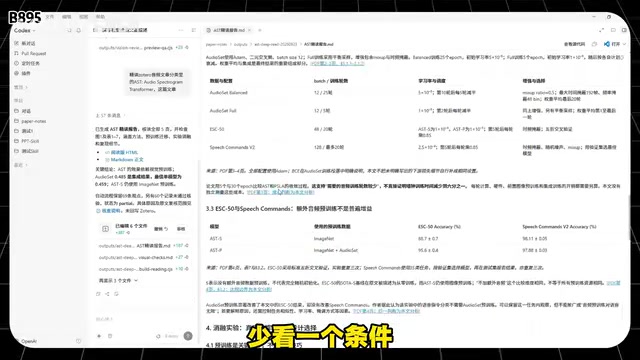
Limitations and follow-up questions require distinguishing between limitations the authors themselves acknowledge and problems the AI analyzes based on evidence—these two categories must not be mixed together.
Technical route refers to the complete processing chain from input to output, including how data enters the model, which modules or stages it passes through, what function each stage serves, how modules connect, and how the final output is used. Its difference from a "method name" is that a method name is just a label (for example, "used contrastive learning"), while a technical route must answer where that label sits in the whole pipeline and what it depends on before and after. A practical standard for judging whether a deep read is qualified is: after reading it, can someone else retell "given the same input, what should I do in what order." If you can only repeat terminology but cannot clearly explain the step connections, it means the deep read stayed at the abstract level and is of no help for reproduction or understanding the design motivation.
Batch Deep Reading: Suitable for Key Papers That Have Already Been Screened
If there are quite a few key papers, you can directly initiate batch deep reading by Zotero collection. Its logic differs from the review: it generates an independent analysis report for each paper, then lets you view them uniformly through an index. So it is more suitable for literature that has already been screened, and processing time will also be longer. The creator's approach is to first screen with the review, then concentrate resources on the articles truly worth reading.
Indexed aggregation is an organizational method for handling multiple independent reports: instead of merging analysis results into one long article, it generates an independent report for each paper and then additionally generates an index listing each report's themes, method keywords, and interrelations, for people to jump to as needed. Its difference from a review lies in granularity—a review performs horizontal merging across papers, while indexed batch deep reading preserves the independent completeness of each paper and only provides a navigation layer. The advantage of this design is that it won't lose single-paper details due to forced merging; the cost is that people must judge for themselves which few to read first. Therefore, it is more suitable for a small batch of key papers that have already been screened through a review and have clear goals, rather than as an entry point when first encountering a direction.
The Real Value of This Workflow
Combining the previous episode's literature search and import, the complete chain looks like this: after searching and downloading, organize by topic in Zotero, use the review to quickly understand a batch of articles and find the key ones, then deep-read the key papers and go back to the original texts for verification.
The role of AI is not to read all papers for you, but to connect the workflow among search, organization, comparison, screening, and deep reading. What it reduces is the mechanical labor of repeatedly organizing materials; the energy saved should be invested in understanding methods, judging evidence, and thinking about your own research questions.
One-line Summary
Using the two tracks of review and deep reading, it strings Zotero literature from screening to deep understanding into a verifiable workflow.
Paragraph Summary
The article introduces a self-built AI Skill by a Bilibili creator, designed to solve the problem of having more and more Zotero literature but not knowing where to start reading. The Skill includes two independent features: the review is aimed at "entering a new direction," reading PDFs under a specified collection, generating a paper card for each paper, and then aggregating them into a paper comparison table and thematic review to help discover research gaps and key literature; deep reading is aimed at "thoroughly understanding a single paper," focusing on explaining the method's technical route, experimental logic, and limitations rather than restating the abstract. The author emphasizes that key judgments must be traceable back to the original text, requiring dedicated checking of experimental conclusions, experimental conditions, and future research directions, and distinguishing between limitations acknowledged by the authors and limitations analyzed by AI. The recommended process is to first screen with the review, then deep-read or batch-deep-read the key literature. AI only handles mechanical organization, and the saved energy should be used to understand methods and think about research questions.
Related articles

Amphibious Transforming Drone: Beyond 100x Power Savings, What Are the Real Needs?
Is the amphibious transforming drone just a gimmick? Starting from the 100x power difference of the M4 Morphobot, explore real application scenarios and thesis topic ideas, analyzing boundary conditions where pure drones and pure ground robots both fail.

Warhound Raises $200 Million: Genetically Engineered "War Dogs" Paired with Anduril Gear
Warhound raises $200M, backed by Ben Lamm and Palmer Luckey, to genetically engineer dogs for military and law enforcement use and equip them with Anduril gear. This article analyzes its technology direction, funding logic, and ethical controversy.

Claude API Comes to Google Cloud: IAM Integration and SDK Access Guide
Anthropic hosts the full Claude API on Google Cloud with IAM-controlled permissions and unified billing. This guide covers the Vertex AI and Anthropic-hosted entry points, IAM role configuration, and SDK access.