Toolfence-scan: A Static Check Tool for AI Coding Assistant Skills

Toolfence-scan provides static checks for Cursor, Claude, and Copilot skill packages, identifying security risks before loading.
Toolfence-scan is a static check tool for the AI coding assistant skill ecosystem, covering Cursor, Claude, and Copilot. It notes that skill packages are forming a supply chain like software dependencies, where verification before introduction is critical. Static checks intervene early without executing code, can detect structural issues such as unsafe invocation patterns and suspicious external references, and are suitable for CI integration or skill introduction reviews. Cross-platform coverage reduces management complexity, but static checks are only the first filter and must be combined with source review, version pinning, and runtime monitoring.
Why AI Coding Assistants Need Static Checks
As AI coding assistants like Cursor, Claude, and Copilot begin to extend their capabilities through "skills," an overlooked risk is emerging: these skills often contain executable code, tool invocation rules, and external resource references. Once unverified content is introduced, it can bring security risks to projects. Toolfence-scan is a static check solution proposed to address this pain point.
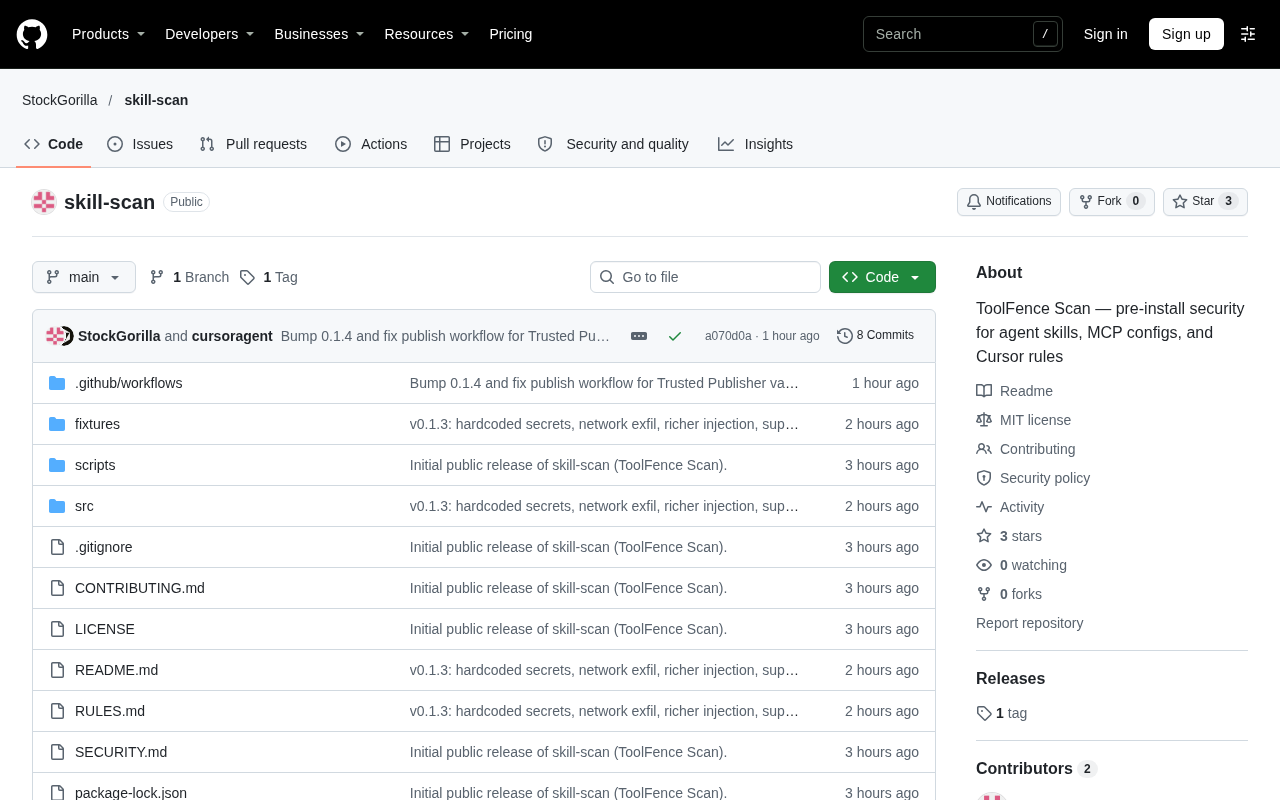
According to information published on Hacker News, Toolfence-scan is positioned to provide static checks for skill packages of mainstream AI coding assistants such as Cursor, Claude, and Copilot. It does not execute skill code; instead, it uses static analysis to identify potential issues before skills are loaded or used. This approach is in line with traditional dependency security scanning, but it targets the new scenario of the AI assistant ecosystem.
The Value of Static Checks in the AI Skill Ecosystem
Skill Packages Are Becoming a New Supply Chain
The skill mechanism of AI coding assistants allows developers to encapsulate common workflows, tool integrations, and domain knowledge. Once these skill packages are shared within a team or obtained from the community, they form a supply chain relationship similar to software dependencies. The core principle of supply chain security is: verify content before introducing it. The static checks provided by Toolfence-scan are precisely the first gate in this verification chain.
The concept of a "Software Bill of Materials" (SBOM) in supply chain security also applies here. An SBOM is a machine-readable inventory that records software components and their dependencies, helping organizations track which third-party code has been introduced. For AI skill packages, a similar inventory can record the capabilities declared by the skill, referenced external resources, invoked tools, and version information. When a static check tool scans a skill, it is essentially generating and verifying this inventory—checking whether the skill's actual behavior exceeds its declared scope or whether it references unlisted external endpoints. Bringing SBOM thinking into AI skill management means teams can audit skill packages just like traditional dependencies, quickly identify changes when skills are updated, and provide evidence for compliance reviews.
Advantages of Static Analysis Over Runtime Protection
The biggest advantage of static checks is that they are "pre-emptive." They can identify suspicious patterns, unsafe invocation methods, or declarations that do not match expectations without actually executing skill code. For the AI coding assistant scenario, this means developers can make judgments before a skill enters the project, rather than waiting until runtime to discover problems. Although the release information on Hacker News is brief, it points out the core feature of "static checks," indicating that the tool's design philosophy is early intervention and low intrusiveness.
Static analysis already has mature methodologies in traditional software security, mainly including pattern matching, data flow analysis, and control flow analysis. Pattern matching uses a predefined rule base to identify known dangerous code patterns, such as hardcoded secrets, unsafe deserialization calls, or suspicious network requests. Data flow analysis traces the propagation path of data through a program to determine whether tainted data reaches sensitive operations without sanitization. Control flow analysis builds a graph of the program's execution paths to identify unreachable code or abnormal control transfers. Toolfence-scan's static checks for AI skill packages likely combine these techniques: parsing the skill's description files and code, extracting call graphs and resource references, and then comparing them against the rule base. Understanding these underlying methods helps developers judge the coverage and limitations of static checks—for example, the detection rate of pattern matching for novel attacks depends on how quickly the rule base is updated.
Unified Checks for a Multi-Assistant Ecosystem
Toolfence-scan explicitly covers three platforms: Cursor, Claude, and Copilot. This is worth noting. The current AI coding assistant market is characterized by multiple strong players, and the skill formats and extension mechanisms of different assistants are not unified. A tool that can provide static checks across platforms is actually reducing management complexity for developers in multi-assistant environments.
From an engineering perspective, cross-platform checks mean the tool needs to understand how different skills are described and abstract common check rules. This is more challenging than building checks for a single platform, but it also has more long-term value—as the assistant ecosystem continues to diversify, a unified check layer will become part of the infrastructure.
The skill extension mechanisms of the three major AI coding assistants currently differ significantly. Cursor's skills usually exist in the form of rule files or custom commands, Claude's skills are extended through MCP (Model Context Protocol) servers or project-level instruction files, and Copilot relies on the VS Code extension ecosystem and instruction files. These mechanisms differ in configuration format, permission model, and resource loading methods. The engineering challenge for a cross-platform static check tool is that it needs to write parsers for each skill format, abstract heterogeneous descriptions into a unified intermediate representation, and then run check rules on that intermediate representation. This "parse-abstract-check" architecture is similar to the design approach of multilingual static analysis tools such as Semgrep, which supports multiple programming languages through a unified abstract syntax tree. If Toolfence-scan can continuously maintain this abstraction layer, its rule base can be reused across platforms, reducing the cost of developing separate check logic for each assistant.
What Static Checks Can and Cannot Find
Static checks are good at identifying structural problems: unsafe invocation patterns, suspicious external references, behavior that does not match declared capabilities, and so on. But they also have boundaries—static analysis cannot fully simulate runtime behavior, and for risks that can only be triggered through dynamic interaction, static checks may fall short.
Toolfence-scan's positioning should therefore be a "first filter," not the "only line of defense." A reasonable approach is to incorporate it into a more complete skill governance process: static checks first, combined with source review, version pinning, and runtime monitoring. Discussion of this project on Hacker News is limited, but the emergence of such tools itself reflects growing community attention to AI skill security.
Practical Significance for Developers
For teams already using Cursor, Claude, or Copilot skills, Toolfence-scan provides a low-cost means of risk investigation. Its static check feature means it can be integrated into CI processes or the review step before skills are introduced, without changing existing development habits.
More broadly, the skill ecosystem of AI coding assistants is still in its early stages, and toolchains and best practices are still taking shape. The value of static check tools like Toolfence-scan lies not only in what problems they can detect today, but also in the fact that they raise the right question: as we delegate more and more capabilities to AI assistants, how do we ensure that these capabilities themselves are trustworthy?
Detailed information about the project can be found in the relevant Hacker News discussion, and it is suitable for developers interested in AI assistant security and skill engineering to learn more.
One-line Summary
Toolfence-scan provides static checks for Cursor, Claude, and Copilot skill packages, identifying security risks before loading.
Paragraph Summary
Toolfence-scan is a static check tool proposed for the AI coding assistant skill ecosystem, covering the three major platforms Cursor, Claude, and Copilot. The article points out that skill packages are forming a supply chain similar to software dependencies, and verifying content before introduction is crucial. The advantage of static checks is early intervention without executing code, and they can identify structural problems such as unsafe invocation patterns and suspicious external references, making them suitable for integration into CI processes or skill introduction review steps. Cross-platform coverage reduces management complexity in multi-assistant environments, but static checks are only the first filter and need to be combined with source review, version pinning, and runtime monitoring to form a complete governance process. The tool reflects the early formation of AI skill security awareness.
Related articles

A 19-Year-Old's Rental Horror Story: Ceiling Collapse, Bug Infestation, and the Lessons It Taught Me
At 19, my first off-campus rental brought bug infestations, no heat, a collapsed ceiling, and a ruined laptop with no renter's insurance. Here are the hard-won lessons for first-time student renters.

Veda Nurse's Cranial Nerve Exam: Why ASMR Role-Play Is Going Viral
Bilibili creator Veda's cranial nerve exam ASMR video goes viral, blending humor and sensory triggers through nurse role-play. This article analyzes its unique appeal and the audience psychology behind ASMR role-play.

LG Cinebeam AI Review: 120-Inch Giant Screen + 3000 Lumens, a New Choice for the Living Room Theater
LG Cinebeam AI projector review: 3000 ANSI lumens, 4K, 100 inches from about 8 cm and 120 inches from about 18 cm. Built-in webOS, AI Concierge voice recommendations, AI Sound Pro 11.1.2 virtual surround, and Game Optimizer—positioned for fixed living room installation, complementing the portable Cinebeam S.