ToolJet: A Vibe-Coding Internal Tool Platform That Passes Security Review
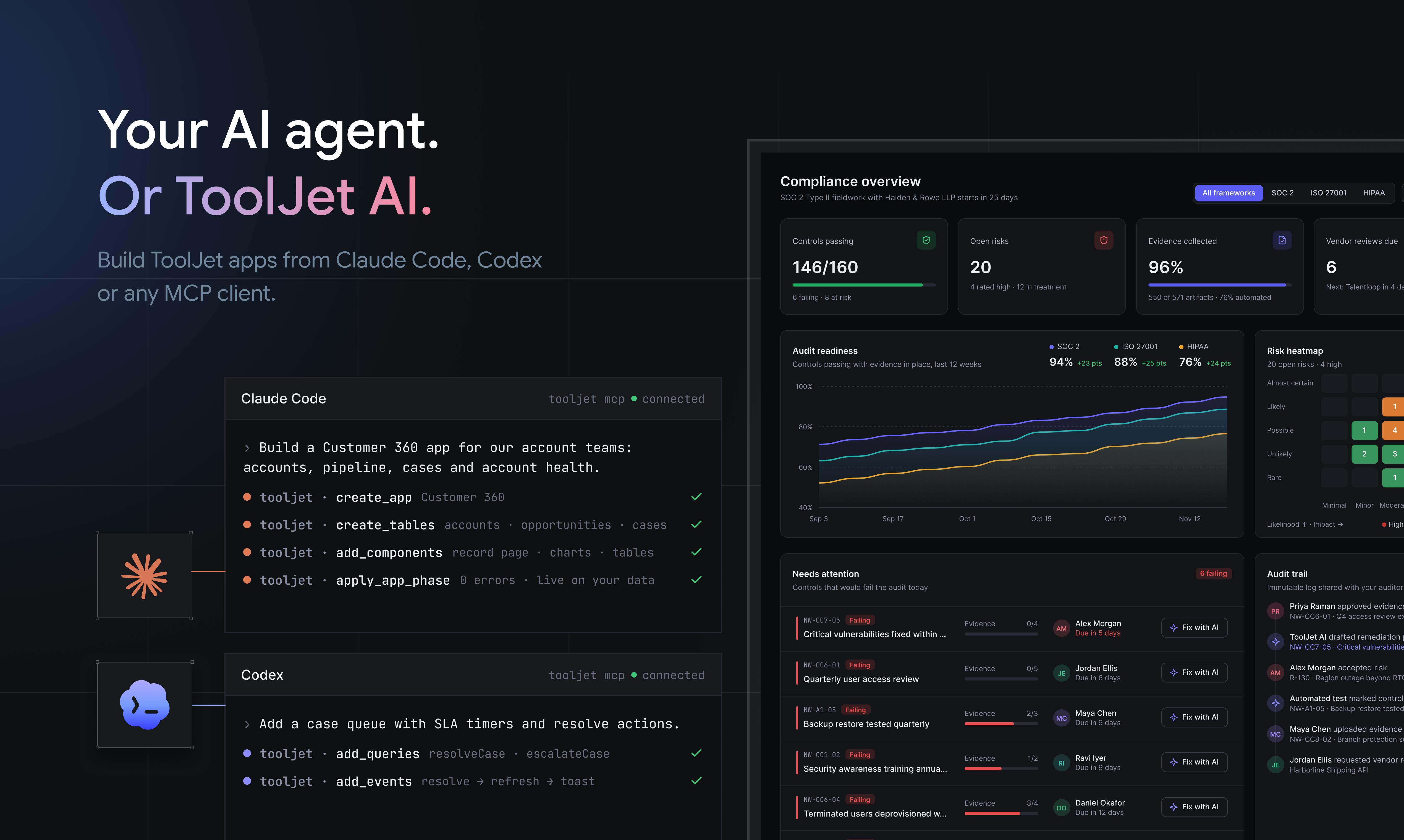
ToolJet offers a secure hosting and governance platform for AI-generated internal tools, bridging vibe coding and enterprise security review.
ToolJet positions itself on Product Hunt as "vibe-coded business apps that pass the security review." It's not another AI code generator but a landing platform for AI-generated React internal tools, offering 100+ data integrations, a built-in database, permission management, per-save security scanning, version review, and human-approval workflows. It targets enterprise teams already prototyping with Claude Code, Codex, or Cursor but stuck at security review. The product received 77 votes, ranking 18th; performance metrics and pricing are undisclosed, and scanning depth remains to be verified.
When Vibe Coding Meets Enterprise Security
AI coding assistants are changing how internal tools get built. Tools like Claude Code, Codex, and Cursor let developers rapidly generate React applications using natural language, but enterprise security teams tend to be cautious—AI-generated code may introduce unknown vulnerabilities, and manual review can't keep up with iteration speed.
ToolJet proposes a compromise on Product Hunt: let AI handle the frontend, while the platform handles hosting and security governance. Its tagline sums up the value proposition bluntly: "Vibe-coded business apps that pass the security review."
Vibe coding was coined by Andrej Karpathy in early 2025, referring to a programming style where developers describe intent entirely in natural language and let AI generate and iterate on code, emphasizing rapid "feel-your-way" building rather than line-by-line review. Typical tools include Cursor, Claude Code, and Codex. This approach dramatically lowers the barrier to prototyping, but it also introduces uncertainty around code quality and security—generated code may contain injection vulnerabilities, permission bypasses, or sensitive data exposure, and developers often lack the willingness or ability to audit line by line. In enterprise settings, this "fast and rough" model directly conflicts with compliance, audit, and change management requirements, giving rise to demand for a middle layer that adds automated security controls and human approval steps after AI generation.
What ToolJet Does
ToolJet isn't positioned as yet another AI coding tool, but as a landing platform for AI-generated applications. According to its Product Hunt page, core capabilities include:
- 100+ data integrations: Connect to existing enterprise data sources, preventing AI apps from becoming data silos
- Built-in database: An out-of-the-box storage layer for internal tools
- Permission management: Control who can access and operate which applications
- Security scan on every save: This is the key differentiator from pure code-generation tools—security is shifted left to the save step
- Version review: Traceable review of AI-generated changes
- Workflows with human approval: Retain human decision points within automated processes
This combination of features points to a clear scenario: enterprises want to use AI to accelerate internal tool development without sacrificing security governance.
Shift Left Security refers to moving security checks and testing earlier from late-stage development or post-launch to the coding, save, and even design phases, so issues can be found and fixed at lower cost. In traditional CI/CD, security scanning is often a late-stage pipeline gate with slow feedback that easily blocks releases. By embedding scanning into the "every save" step, ToolJet represents an extreme form of shift-left security: developers get instant feedback while editing AI-generated code, preventing problems from piling up until review. The effectiveness of this model depends on the coverage and false-positive rate of the scanning rules—too strict and it slows iteration; too loose and it's effectively useless. So real-world results still need verification.
The Enterprise Path for Vibe Coding
At its core, vibe coding's appeal is speed—describe requirements in natural language, and AI generates runnable code. But enterprise environments define "speed" differently: fast delivery is predicated on not introducing compliance risk.
ToolJet's approach can be understood as turning security review from "after-the-fact inspection" into "continuous accompaniment." Code is automatically scanned on every AI save, version changes are reviewable, and human approval is embedded in workflows—these mechanisms let security teams avoid becoming a development bottleneck while retaining necessary control points.
The product received 77 votes on Product Hunt, ranking 18th, with categories covering developer tools, artificial intelligence, and vibe coding. The vote count isn't particularly prominent, indicating it's still in an early-attention phase, but its positioning hits a real tension: the democratization of AI coding versus enterprise security governance.
Internal tools refer to applications enterprises build for their own business operations, not面向 external customers—such as approval backends, data dashboards, and operations panels. These tools are typically numerous, short-lived, and subject to rapidly changing requirements, making them ideal for AI coding, since even small defects have relatively contained impact. But they often need to connect to enterprise databases, follow permission models, and meet audit requirements—exactly what pure code-generation tools struggle to guarantee automatically. ToolJet's division of labor—"AI generates the frontend, the platform hosts the backend and governance"—targets the structural pain point of internal tools: "fast to develop but hard to govern."
Who It's For
Judging from the feature list, the target users are teams that need to rapidly build internal tools within the enterprise, especially organizations that have already adopted Claude Code, Codex, or Cursor for prototyping but are stuck at the security review stage. For personal projects or non-sensitive scenarios, pure code-generation tools may already suffice; but when applications need to connect to enterprise data, involve permission controls, or require approval workflows, platforms like ToolJet demonstrate their value.
In currently available public information, ToolJet's specific performance metrics, pricing, and customer case studies have not been disclosed, and the depth and coverage of its security scanning remain to be verified. The Product Hunt page has only 1 comment, indicating limited community discussion.
Preliminary Assessment
ToolJet has seized on a key pain point in bringing AI coding into the enterprise. Its differentiation isn't in code-generation capability—that's the battlefield of Claude Code and Cursor—but in security governance and runtime support after generation. Whether this "platform underneath" positioning holds depends on the actual effectiveness of security scanning and the ease of use of data integrations. In today's fierce competition among AI coding tools, choosing a neglected supporting layer may be wiser than competing head-on.
One-line Summary
ToolJet provides a secure hosting and governance platform for AI-generated internal tools, bridging the gap between vibe coding and enterprise security review.
Paragraph Summary
ToolJet positions itself on Product Hunt as "vibe-coded business apps that pass the security review." It's not another AI code generator, but a landing platform for AI-generated React internal tools. It offers 100+ data integrations, a built-in database, permission management, automatic security scanning on every save, version review, and workflows with human approval, turning security review from after-the-fact inspection into continuous accompaniment. Target users are enterprise teams that have already used Claude Code, Codex, or Cursor for prototyping but are stuck at the security review stage. The product received 77 votes and ranked 18th, with limited discussion; performance metrics and pricing are undisclosed, and the depth of security scanning remains to be verified. Its differentiation lies in security governance and runtime support after generation, not in code generation itself.
Related articles

Graphify: The 151K-Star Open-Source Sensation That Turns Your Entire Codebase into an AI Knowledge Graph
Graphify, a 151K-star open-source tool, turns your entire codebase into a knowledge graph for AI Agents to query directly. Supports 40+ languages, 20+ AI assistants, local 30-second interactive code maps, zero-token builds, and unified Markdown, PDF, image, and audio ingestion.
When Stochastic Parrots Claim to Have …
When Stochastic Parrots Claim to Have Proven the Riemann Hypothesis
Scott Aaronson's 'stochastic parrots prove the Riemann Hypothesis' quip highlights the trust crisis in AI-generated math proofs and the promise of formal verification.

Gemini 4 Neon vs Claude Opus 5.5: Who Wins Across Five Real-World Tasks?
Bilibili creator tests Gemini 4 Neon vs Claude Opus 5.5 across 3D video, games, design, writing, and advice. Neon matches Opus daily, but 3D and design still lag.