Top 10 AI Coding Tools Ranking: The Traffic Landscape from Cursor to OpenAI

Ten AI coding tools ranked by web popularity reveal a complete chain from model to interface.
The article reviews a ranking of AI coding tools by global web traffic, covering ten products from 10th to 1st place. The list includes model and infrastructure providers such as Cohere, Hugging Face, and OpenAI, as well as API aggregators like OpenRouter, local execution tools like Ollama, and application-layer products such as Cursor, Devin, Kiro, Lovable, and OpenCode. The author offers three observations: the boundaries of coding tools are blurring, forming a complete chain from model to interface; the open-source localization route and the closed-source product route are evenly matched; and traffic ranking does not equal practical ranking, as infrastructure products rank high mainly due to broad reach, so readers should judge the shopping-guide nature of the list themselves.
A ranking of AI coding tools by global web traffic puts the ten products developers are most focused on right now on the same table. What makes this list unusual is that it isn't sorted by funding amount or user reviews, but by web traffic—which to some extent reflects "how much they're discussed" rather than "how much they're used." For developers who want to understand the landscape of the AI coding space, this list offers a vantage point.

The Middle of the List: The Power of Open Source and Localization
Ranks 10 through 7 show a clear split: on one end, enterprise platforms; on the other, open-source and local-first solutions.
Cohere ranks 10th. This enterprise AI company offers the Command language model, Embed embedding models, and the North agent platform. Its presence shows the list isn't limited to "tools that write code" but also brings the underlying model services that support AI coding into view.
Devin ranks 9th—Cognition's autonomous AI software engineer, capable of planning, coding, testing, and submitting pull requests. This kind of "autonomous agent" product is the most aggressive form in AI coding over the past two years—no longer assisting people in writing code, but replacing them to complete the entire task loop.
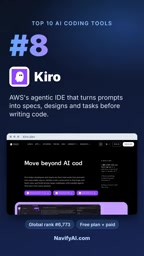
8th place, Kiro, comes from AWS and is an agentic IDE. Its approach differs from most tools: before writing code, it first turns prompts into specs, design, and tasks. This "plan first, code later" workflow attempts to solve the old problem of chaotic structure when AI generates code directly.
7th place, OpenCode, is an open-source AI coding agent for the terminal that supports any model provider.
Spec-driven Development
Kiro's "write the spec first, then generate code" route corresponds to the spec-driven development approach: breaking vague natural-language prompts into requirement items, technical design, and an executable task list, forming reviewable, traceable intermediate artifacts, which the model then implements task by task. It targets the typical problems of direct code generation—misunderstood requirements, arbitrary architecture, and uncontrolled scope of changes. Because spec files are plain text, they can be placed under version control and used as the basis for subsequent iterations and code reviews. This workflow is more controllable than one-shot prompting in team collaboration and medium-to-large projects.
Mid-Tier Rankings: Local Execution and Unified APIs
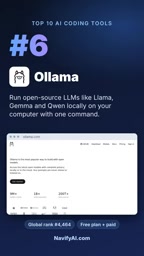
6th place, Ollama (transcribed in the original as "alarmer," actually Ollama), lets users run open-source large models such as Llama, Gemma, and Qwen locally with a single command. It isn't a coding tool itself, but it's the starting point for many developers building local AI coding environments—especially favored by privacy-sensitive or cost-sensitive teams.
5th place, OpenRouter, provides a unified API to access hundreds of AI models, covering vendors such as OpenAI, Anthropic, and Google, with unified billing. For developers who need to switch between and compare prices across multiple models, it saves the trouble of opening accounts one by one.
The Technical Prerequisites of Ollama and Local Inference
Ollama's ability to run models like Llama, Gemma, and Qwen with a single command relies on model quantization techniques and a lightweight inference runtime. Quantization compresses weights that would otherwise require tens of GB of VRAM down to 4-bit or even lower precision, enabling consumer-grade GPUs and even laptops with unified memory to host 7B–30B-class models; the runtime handles model downloads, weight loading, context management, and an OpenAI-style local API. The trade-off is that local models generally lag behind cloud flagship models in long context, complex reasoning, and code generation quality. Therefore, the local route is better suited to low-latency, privacy-critical scenarios such as autocomplete and private code Q&A, rather than fully autonomous agent-style development.
The Top Four: Application Layer and Infrastructure Layer
4th place, Lovable, represents "chat as app": describe it in a conversation and it generates a runnable full-stack web application. It's aimed more at non-professional developers or rapid prototyping scenarios.
3rd place, Cursor, is the highest-ranked pure coding tool on the list—an AI-first code editor with codebase-aware chat, autocomplete, and coding agent capabilities. In the developer community, Cursor is almost synonymous with the "AI editor" category.

2nd place, Hugging Face, is the open-source AI hub, gathering models, datasets, and demo apps, and providing hosting and inference services. Its presence on a coding tools list shows that the model ecosystem itself has become part of the development workflow.
1st place, OpenAI, the AI research company behind ChatGPT, Sora, and the GPT series of models, provides services to developers through its API. Topping the traffic chart is no surprise—even without writing code directly, a large number of developers use ChatGPT for everyday programming consultation.
The Difference Between Codebase Awareness and Agentic Coding
What Cursor calls "codebase awareness" means the tool indexes the project before answering—splitting files, symbols, and reference relationships into chunks and generating vectors or a structured index, then retrieving relevant context when a question is asked before handing it to the model, thereby avoiding the limitation of seeing only the currently open file. The "autonomous agent" represented by Devin is a different layer of capability: it has a terminal, browser, and editor in an isolated virtual machine or container environment, and can autonomously execute commands, read errors, iterate on changes, and ultimately submit a PR, with humans reviewing only at key checkpoints. The former is human-machine pairing; the latter is task delegation. The two have completely different requirements for context management, tool-calling permissions, and failure recovery mechanisms.
Three Observations Behind the Ranking
First, the boundaries of "coding tools" are blurring. The list mixes model providers (Cohere, OpenAI), model hubs (Hugging Face), API aggregators (OpenRouter), local runners (Ollama), and editors (Cursor). This shows that AI coding is no longer a matter of a single tool, but a complete chain from model to interface.
Second, open source and closed source each hold half the field. OpenCode, Ollama, and Hugging Face represent the open-source and localization route, while Cursor, Devin, and Lovable represent the closed-source product route. The two routes are evenly matched in popularity; developers' choices depend more on data privacy, cost, and use cases than on pure performance comparisons.
Third, traffic ranking is not the same as practical ranking. The high positions of OpenAI and Hugging Face largely come from their broad reach as infrastructure rather than their focus on coding scenarios. If you look only at "writing code," the rankings of Cursor, Devin, and Kiro may better reflect real usage intensity. The source of the list also notes that prices and alternatives for each tool can be queried on NavifyAI.com, indicating that such rankings themselves have a shopping-guide nature, and readers need to judge for themselves.
For developers, the practical value of this list isn't in memorizing the rankings, but in seeing clearly the position of each layer: model layer, access layer, agent layer, editor layer, application generation layer—each layer has representative products, and each has its own trade-offs.
One-line Summary
Ten AI coding tools ranked by web popularity reveal a complete chain from model to interface.
Paragraph Summary
The article reviews a ranking of AI coding tools by global web traffic, covering ten products from 10th to 1st place. The list includes model and infrastructure providers such as Cohere, Hugging Face, and OpenAI, as well as API aggregators like OpenRouter, local execution tools like Ollama, and application-layer products such as Cursor, Devin, Kiro, Lovable, and OpenCode. Based on this, the author offers three observations: the boundaries of coding tools are blurring, and AI coding has formed a complete chain from model to interface; the open-source localization route and the closed-source product route are evenly matched in popularity; traffic ranking does not equal practical ranking, and the high positions of infrastructure-type products come more from broad reach, so readers need to judge the shopping-guide nature of the list for themselves.
Related articles
 Tech Frontiers
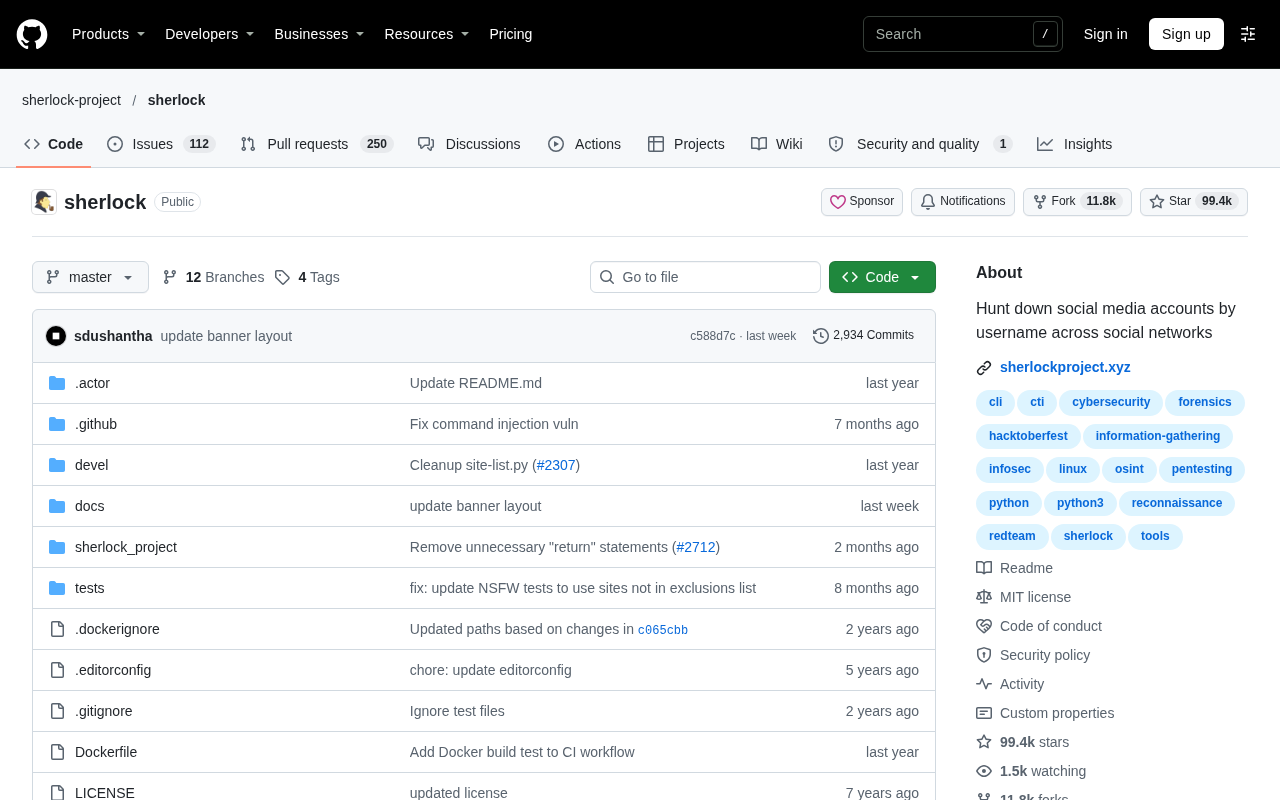
Sherlock: An Open-Source Tool for Tracking Usernames Across Social Networks
Sherlock is an open-source Python tool that tracks social accounts across networks by username. This article covers its core features, why developers love it, typical use cases, and privacy compliance considerations.
 Tech Frontiers
GitHub Daily·Nov 07: Agent-Ready and Context Compression
GitHub Trending Nov 07: meta's agent-ready design system astryx, billion-context's 5x context compression, sherlock nearing 100k stars, plus local-first localthings and bare-metal GPU orchestration nvke.
 Tech Frontiers
Buoyant Open-Sources Kinference: An Inference Control Plane for vLLM on K8s
Buoyant open-sources Kinference, an inference control plane for vLLM on Kubernetes, with declarative routing, KV-cache-aware load balancing, and per-tenant metrics—claiming 95% lower median TTFT in official benchmarks.