Top 3 Jev Alternatives: A Decision Model Selection Guide

Jev rose as a low-cost typed decision model, but open weights, multimodality, and self-hosting needs have spawned three alternatives—choose based on real-data evaluation, not price.
The article analyzes Jev, an AI model returning typed decisions with probabilities at $0.042 per million input tokens with free output—an already low unit price. Alternatives compete not on savings but on open weights, multimodal input, deployment flexibility, and workload performance. It breaks down Cloudflare Clef-flash (Apache 2.0, image/video, 24,576-token window), Perplexity pplx-decider (as low as $0.02/M, 27B open-weight multimodal), and Kev (multiple sizes, fine-tuning, Jev-compatible format, self-hostable). There's no universal winner; selection depends on goals. Evaluation: build a 200–500 real-sample set, measure accuracy, latency, calibration, and actual cost per accepted decision, and set human-review thresholds for high-impact decisions.
Title
Top 3 Jev Alternatives: A Decision Model Selection Guide
Meta Description
Compare Jev with three decision model alternatives—Cloudflare Clef-flash, Perplexity pplx-decider, and Kev—on pricing, open weights, multimodality, and self-hosting, plus a benchmarking methodology and migration advice.
Article Content
AI applications don't always need to generate long passages of text. More often, they need a judgment they can act on directly: Is this support ticket urgent? Should it go to sales or billing? Does this message violate policy? Should the AI agent call a tool or ask a human for help?
The traditional approach is to have a general-purpose LLM output structured JSON—high latency, opaque costs. Jev, launched by TypeSafe AI, instead returns typed decisions with probabilities that applications can act on directly. But Jev is no longer alone in the market: Cloudflare, Perplexity, and the open-source community are all releasing alternatives with their own trade-offs. This article breaks down Jev's pricing logic and compares three alternatives worth evaluating.
Is Jev's pricing really expensive?
Jev's public pricing is $0.042 per million input tokens, with output tokens free and no per-seat charges. At that rate, 1 billion tokens costs about $42 per month, and 10 billion tokens only reaches $420 (excluding infrastructure, retries, and other overhead).
On unit price alone, Jev is already very cheap. The motivation to look for alternatives usually isn't saving a few dollars—it's these points:
- No free tier: The MVP phase requires repeated prompt testing and dataset replays; a low unit price doesn't mean free experimentation.
- Input volume is the main cost driver: Passing 10,000 tokens per decision instead of 1,000 multiplies cost tenfold. Optimizing inputs, caching repeated decisions, and batching questions are often more effective than switching vendors.
- Closed source limits deployment flexibility: Jev is a hosted, closed-source model—it can't be self-hosted or fine-tuned on your own labeled data.
- Cheap inference isn't cheap decision-making: Insufficient accuracy leads to misrouted tickets and wrongly banned legitimate users, making total costs higher.
The conclusion is clear: Jev's alternatives compete on open weights, multimodal input, deployment flexibility, and performance on specific workloads—not on price alone.
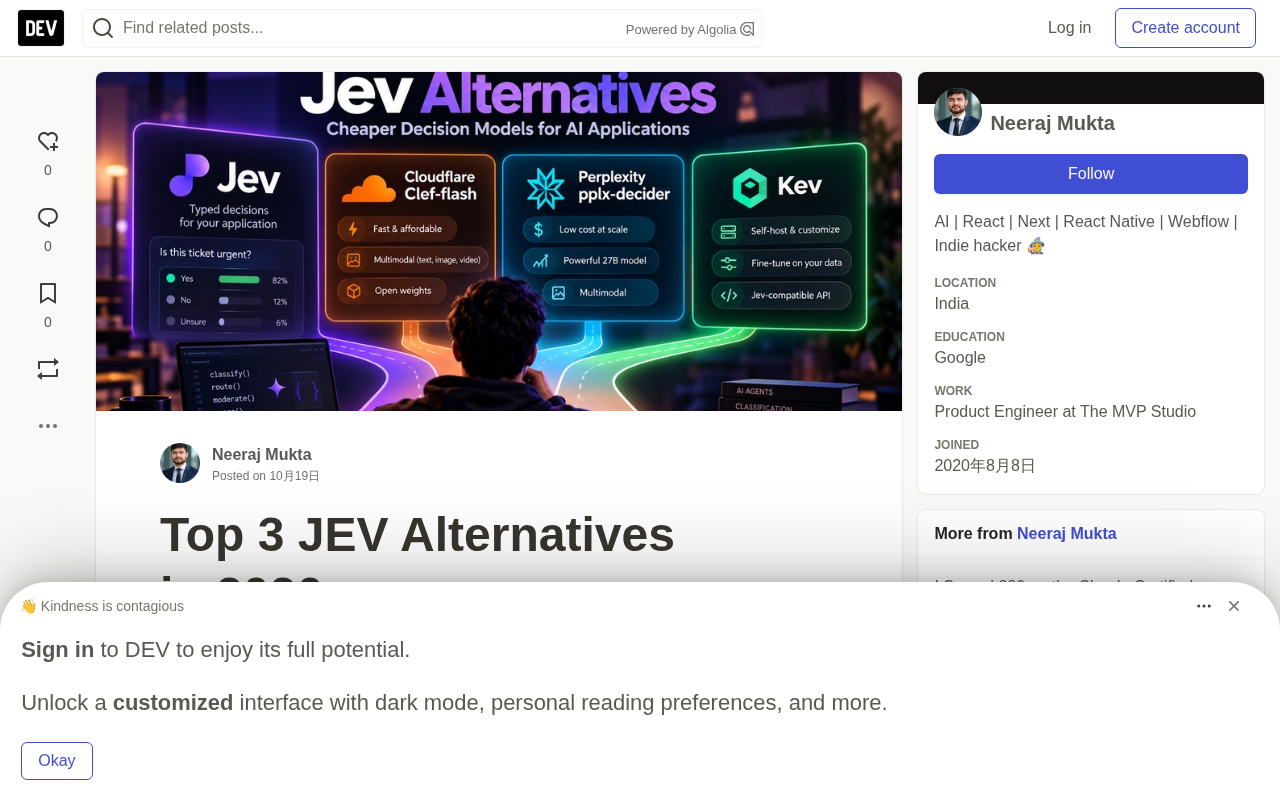
Breaking down the three Jev alternatives
1. Cloudflare Clef-flash: the top choice for Cloudflare developers
In October 2026, Cloudflare launched Clef and Clef-flash, two open-weight decision models that take an input state and a typed question and return probabilities for allowed answers. Clef-flash is the smaller, faster version, supporting text, JSON, images, and video.
Pricing is $0.038 per million input tokens, with a hosted context window of 24,576 tokens. Its advantages: slightly cheaper than Jev; an Apache 2.0 license allows self-hosting; supports image and video input, whereas Jev is text-only; and it integrates naturally with apps already using Workers AI.
The limitations are equally clear: the smaller hosted context window is unfriendly to long documents and long conversation histories; the larger Clef model costs $0.24 per million input tokens; open weights don't mean free production inference—self-hosting still requires compute and operations; and accuracy and confidence calibration still need validation on your own data.
If your backend already runs on Cloudflare, Clef-flash is the first thing worth benchmarking.
The Apache 2.0 license is a permissive open-source license released by the Apache Software Foundation. It allows users to freely use, modify, and distribute the software, including in commercial closed-source products, without requiring derivative works to disclose their source code. The main obligations are to retain copyright notices, the license text, and any NOTICE file, and to clearly state modifications. Unlike copyleft licenses such as GPL, Apache 2.0 does not force derivative works to be open-sourced, making it very friendly for enterprise self-hosting and secondary development. Clef-flash's use of Apache 2.0 means teams can integrate it into closed-source commercial systems, modify the model code themselves, and deploy it privately—greatly reducing legal risk. Note, however, that the license for open-weight models may differ from the code license; verify the specific terms of the weight files before use.
Context window refers to the maximum number of tokens a model can receive in a single inference, including input text, image tokens, and conversation history. It determines how much information the model can "remember." Clef-flash's hosted context window is 24,576 tokens, roughly equivalent to 18,000 English words or 30,000 Chinese characters. This is usually sufficient for short-text classification, ticket routing, and similar decision tasks, but it may truncate when processing long documents, multi-turn conversations, or inputs with extensive history. If input exceeds the window, you need to trim, summarize, or segment it in advance; otherwise the model can't see the full information. Compared with Jev's undisclosed window, this limit is a key point to evaluate during selection, especially if your workload involves long text or multimodal long video.
2. Perplexity pplx-decider: a candidate for high-concurrency, cost-sensitive scenarios
Perplexity's pplx-decider series targets the decision model space directly; its 27B version, pplx-decider-v1.1-27b, was released in October 2026 and is positioned as an open-weight, multimodal decision model.
According to recent comparison data, hosted input pricing is as low as $0.02 per million tokens, the lowest unit price among the three alternatives. The 27B scale offers a different quality-versus-compute trade-off, and open weights leave a self-hosting path open.
Be wary of the following: larger models require more resources to self-host; a low token price doesn't mean low total cost—if the model consumes more tokens or needs more retries, the bill may exceed the alternative; API compatibility, licensing, and deployment requirements should be confirmed against official documentation; and public benchmarks may not predict performance under your labeling scheme, language, and business rules.
When optimizing for unit economics at scale, pplx-decider is worth including in your evaluation—but compare actual billed tokens per decision, not the advertised per-million-token price.
3. Kev: the developer's choice for self-hosting and control
Kev is a family of open-weight decision models associated with developer Jared Palmer, with the same task positioning as Jev: answer predefined questions about an input and output structured results.
What makes it special is that it offers multiple model sizes, documentation supports fine-tuning on your own labeled samples, and its server can use a Jev-compatible request format, making migration relatively low-cost. Self-hosting means no per-token API fees, but compute, hosting, storage, and engineering time remain real costs.
The price is operational burden: deployment, monitoring, scaling, and maintenance are all on you; at low traffic, hardware and engineering costs may exceed API savings; fine-tuning requires high-quality labeled data and continuous evaluation; and open weights don't automatically mean Jev-level performance.
For a weekend MVP, a hosted API is simpler; self-hosting only becomes truly competitive for a mature product with substantial inference volume or strict data requirements.
Fine-tuning means continuing to train a pretrained model on labeled data for a specific domain or task so that its outputs better align with business rules. For decision models, fine-tuning can significantly improve accuracy on your own labeling scheme, industry terminology, and edge cases. Kev's documentation supports fine-tuning on your own labeled samples, meaning teams can adapt the model with a few hundred to a few thousand high-quality samples without relying on general benchmarks. But fine-tuning requires ongoing investment: preparing labeled data, splitting training/validation sets, preventing overfitting, and evaluating and updating the model regularly. In addition, a fine-tuned model may degrade on other tasks (catastrophic forgetting), so general-capability evaluations should be retained. For data-sensitive scenarios or complex rules, fine-tuning is one of the core advantages of a self-hosted approach.
Side-by-side comparison of the four options
| Dimension | Jev | Clef-flash | pplx-decider | Kev |
|---|---|---|---|---|
| Core strength | Simple hosted decisions | Cloudflare and multimodality | Cost-sensitive decisions | Self-hosting and customization |
| Listed input price | $0.042/M | $0.038/M (hosted) | As low as $0.02/M (hosted) | No mandatory per-token fee when self-hosted |
| Output billing | Free | Free | Per current API | Depends on deployment |
| Open weights | No | Yes | Yes, verify license | Yes |
| Multimodal | Primarily text | Yes | Supports some inputs | Depends on model |
| Operational effort | Low | Low when hosted | Low when hosted | Higher when self-hosted |
All prices above are in USD, based on public or recently reported rates as of October 2026. They are not like-for-like performance benchmarks; verify each vendor's latest documentation before deployment.
Calibration measures whether a model's output confidence probabilities match its actual accuracy. For example, if a model gives a 0.9 confidence on 100 decisions and about 90 of them are correct, it is well calibrated; if only 70 are correct, it is overconfident. In decision scenarios, calibration directly affects threshold setting: only a well-calibrated model lets you reliably route between "automatic execution" and "human review" based on confidence. For evaluation, bucket predictions by confidence, compute actual accuracy per bucket, and plot a reliability diagram. If a model is poorly calibrated, it may err even at high confidence despite high overall accuracy, leading to serious consequences. Therefore, when comparing Jev with alternatives, calibration should be a core metric—especially when the business needs to set automatic decision thresholds.
Selection decisions and evaluation methodology
There is no universal winner; it depends on what you're optimizing for: if you want a turnkey hosted API for typed decisions and performance is adequate, stay with Jev—migrating just to save money may not pay off; if you use Cloudflare, need multimodal decisions, or want open weights without giving up hosted inference, choose Clef-flash; if hosted inference cost is the priority and your own evaluation confirms effectiveness, consider pplx-decider; if you need self-hosting, customization, or control over the inference environment, choose Kev.
Don't just look at benchmark rankings before migrating—build a small evaluation set from real inputs:
- Collect 200–500 representative samples from actual workloads, label the correct answers, and flag decisions where errors are costly.
- Run the same batch of samples through Jev and each alternative using equivalent questions.
- Measure accuracy, per-category precision and recall, latency, and calibration.
- Record actual billed tokens including retries and the cost per accepted decision, and observe how models behave on ambiguous or unfamiliar inputs.
- Set clear confidence thresholds in production systems, routing uncertain or high-impact decisions to human review.
There's also an easily overlooked option: if the label set is fixed and labeled data is plentiful, a traditionally trained classifier may beat all of the above on cost and latency; if the task requires open-ended reasoning or explanations, a general-purpose LLM with structured output may be more suitable.
Jev's value lies in challenging a common assumption—not every intelligent step needs to generate text. Most applications need reliable, actionable decisions. The market is evolving rapidly, and open weights let teams decide for themselves where and how decisions happen. The pragmatic path is: start with the simplest hosted option, benchmark alternatives on your own data, and migrate only when they demonstrate a meaningful improvement in cost, quality, latency, or control. The best decision model isn't the one with the highest benchmark score—it's the one that makes your application run better.
One-line Summary
Jev rose as a low-cost typed decision model, but demand for open weights, multimodality, and self-hosting has spawned three alternatives—selection should be based on real-data evaluation, not price comparison.
Paragraph Summary
The article analyzes Jev, an AI model that returns typed decisions with probabilities, priced at $0.042 per million input tokens with free output—a low unit price. But the competition among alternatives isn't about saving money; it's about open weights, multimodal input, deployment flexibility, and performance on specific workloads. It breaks down three alternatives: Cloudflare Clef-flash (Apache 2.0, image and video support, 24,576-token context window), Perplexity pplx-decider (as low as $0.02/M, 27B open-weight multimodal), and Kev (multiple sizes, fine-tuning support, Jev-compatible request format, self-hostable). A side-by-side comparison shows there is no universal winner—selection depends on optimization goals. Finally, it offers an evaluation methodology: build an evaluation set from 200–500 real samples, measure accuracy, latency, calibration, and actual cost per accepted decision, and set human-review thresholds for high-impact decisions.
Related articles

Random Pruning of the DPO Computation Graph: 1.4x Training Speedup and Lower Peak Memory
DPO training too slow and memory-hungry? This paper proposes a random pruning framework for the DPO computation graph, sampling independently across position, sequence, and branch dimensions; branch pruning achieves a 1.426x step-time speedup and cuts training time by about 30%, with in-depth attribution of memory and time gains.

Why Does JEPA Underperform MLM in Longitudinal EHR Representation Learning?
New study compares JEPA and MLM for longitudinal EHR representation learning on MIMIC-IV: three JEPA variants train stably without collapse but underperform MLM; target size, not heterogeneity, drives prediction error.

Transfer Learning + Visible Light Communication: A New Approach to Energy-Efficient Indoor Positioning
A study proposes a transfer learning-based visible light communication indoor positioning method, achieving 47% accuracy improvement on the BOSCH factory dataset, 67.5% model efficiency under high noise, and introducing the ME composite metric for energy-efficient positioning in energy-constrained industrial IoT scenarios.