Top 5 Enterprise AI Gateways Compared: Bifrost, Portkey, Tyk, F5, and Cloudflare

Compare five enterprise AI gateways across security, platform, finance, and compliance to help teams choose based on their stack and governance needs.
When multiple teams within an enterprise each connect to different large models, API keys, retry logic, and cost attribution often spiral out of control. Enterprise AI gateways solve this by adding a layer before model calls to unify identity authentication, budget control, failover, and audit trails. This article compares Bifrost, Portkey, Tyk AI Gateway, F5 AI Gateway, and Cloudflare AI Gateway across five dimensions: security, platform, finance, compliance, and deployment flexibility. It points out that the primary basis for selection is often the team's existing stack—organizations already using Tyk, F5, or Cloudflare can bring AI traffic into existing systems at low cost; without that constraint, teams must weigh open-source governance depth against community maturity, with self-hosting and air-gapped deployment being the key criteria distinguishing enterprise-grade from pilot-grade products.
When enterprises begin adopting large language models at scale, AI infrastructure often grows chaotically—one team wires up the OpenAI API for a prototype, another adds Anthropic because it performs better on a specific task, and six months later the company has a dozen applications internally, each with its own API keys and retry logic, yet no one can clearly say who is spending how much.
Enterprise AI gateways exist to solve exactly this problem: adding a layer in front of all model calls so you know who is calling, what they are allowed to do, and how much it costs. This article compares five products—not by which feature list is longer, but by who can actually hold up when security, platform, and finance teams all come knocking at once.
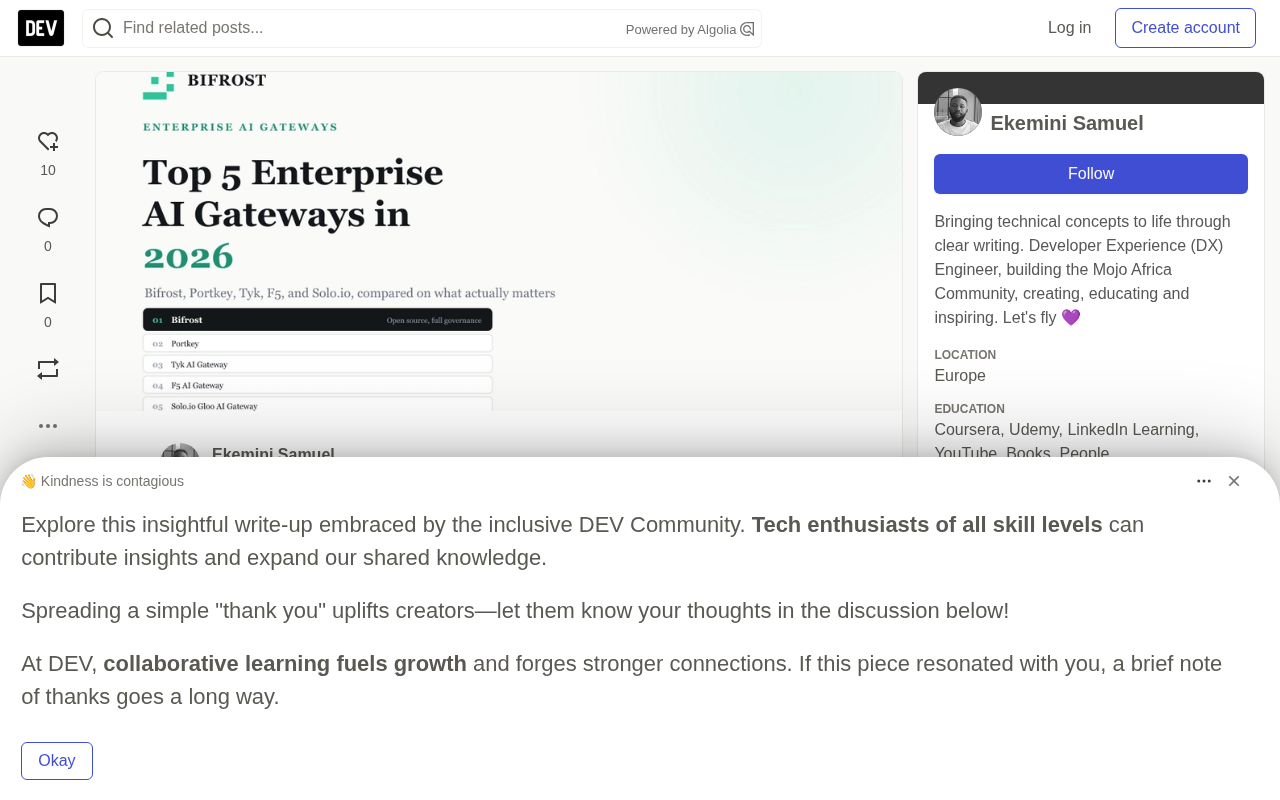
What enterprises actually need an AI gateway to do
The term "AI gateway" now covers a wide range of products, from simple request routers to full governance platforms. Before comparing the five specific products, let's clarify what different teams within an organization will ask in production.
- Security teams need to verify identity on every request. Not a shared API key for the whole team, but knowing which application, which service account, and which person initiated the request—and being able to revoke access without redeploying.
- Platform teams want the gateway itself not to be the component that goes down. This requires load balancing across providers and keys, automatic failover when a provider fails, and sufficiently low overhead.
- Finance teams need to know model costs before the bill arrives, broken down by team, project, or application. Budgets should be settable in advance, not just a log to trawl through at month-end.
- Compliance teams need an audit trail that stands up to scrutiny. Every request, every response, every policy decision, recorded somewhere that cannot be quietly modified.
- Everyone wants deployment flexibility. A gateway that only supports someone else's SaaS is hard to accept for companies with data residency requirements, regulated industries, or internal policies prohibiting production traffic from passing through third-party infrastructure. Whether it can be self-hosted, including fully air-gapped deployment, is the standard that separates a gateway you can put in front of all your traffic from one that's only good for side projects.
API Gateway is the technological predecessor of the AI gateway: it sits between clients and backend services, handling routing, authentication, rate limiting, logging, and protocol translation in a unified way. Typical examples include Nginx, Kong, Tyk, and managed gateways from cloud providers. The AI gateway is essentially an extension of this pattern to the large language model context, but adds several dimensions that traditional API gateways don't address: token-metered cost accounting, semantic routing across model providers, content safety detection for prompts and responses, and interception and authorization of agent tool calls such as MCP. Understanding this inheritance helps with selection: if a team already has a mature API gateway system, extending its capabilities is often more cost-effective than introducing an isolated system; conversely, if model calls account for a small share of traffic, there's no need to build a separate platform for AI scenarios.
Air-gapped Deployment refers to deploying a system in a network environment physically isolated from the public internet, typically used in regulated industries such as government, finance, and healthcare. In this environment, the gateway and its dependent model runtimes (such as vLLM, Ollama), key management services, and cache backends must all be self-sufficient on the internal network, unable to rely on external SaaS APIs or telemetry reporting. This is why this article repeatedly uses "air-gap support" as a distinguishing criterion: it's not just a difference in deployment options, but determines whether a gateway can enter organizations that prohibit production data from flowing through third-party infrastructure. When evaluating, confirm whether air-gap is fully supported or only for some components.
Core comparison of five enterprise AI gateways
| Gateway | Core language | License | Self-hosted/air-gapped | Best for |
|---|---|---|---|---|
| Bifrost | Go | Apache 2.0 (enterprise edition) | Yes, including air-gapped | Teams that want full governance without giving up open source |
| Portkey | Open source | MIT (enterprise edition) | Yes, including hybrid and air-gapped | Teams that want a mature, widely adopted, feature-rich gateway |
| Tyk AI Gateway | Go | Open source (enterprise edition) | Yes, multi-cloud and on-premises | Teams already standardized on Tyk or other API gateways |
| F5 AI Gateway | Part of the F5 platform | Commercial license | Currently SaaS and hybrid; air-gapped planned | Teams already using F5 for application delivery and security |
| Cloudflare AI Gateway | Cloudflare global network | Commercial license | SaaS only | Teams already running on Cloudflare |
1. Bifrost: An open-source governance solution for regulated industries
Bifrost is an open-source AI gateway built in Go, with the core under Apache 2.0 and a paid enterprise edition offering identity management, high availability, and support. Through a single OpenAI-compatible interface, it provides access to over 10,000 models from more than 25 providers, including OpenAI, Anthropic, AWS Bedrock, Google Vertex, Azure, Gemini, Groq, Mistral, Cohere, and xAI, as well as self-hosted options like vLLM, SGLang, and Ollama. Switching providers only requires changing the base URL, not rewriting code.
What makes Bifrost an enterprise gateway rather than just a fast router is that identity and governance are built in, not bolted on afterward. Each caller gets a Virtual Key, and budgets, rate limits, and model permissions are effectively attached to that key, scoped by team, customer, or individual model, with hierarchical enforcement—a sub-team's budget won't quietly exceed its parent's. When a key is exhausted, it returns an explicit 402 rather than failing silently or, worse, continuing to succeed on someone else's bill.
Bifrost treats agent tool calls as a first-class citizen of the gateway, not a separate system. Its MCP Gateway intercepts tool calls over STDIO, HTTP, and SSE, with filtering at the client, request, and virtual key levels, so agents can only see the tools they're allowed to use. Code Mode lets the model write a short script to orchestrate tools instead of loading all tool definitions into context—according to a case study published by Maxim, running 508 tools across 16 MCP servers dropped from $377 to $29, a reduction of about 92%, while maintaining 100% task pass rate.
On the operations side: adaptive load balancing with circuit breakers recalculates provider weights based on real-time latency and error rates; automatic failover is configured via a fallbacks array in the request payload, rather than separate infrastructure; semantic caching supports Redis, Qdrant, Weaviate, or Pinecone; complexity-based routing can automatically send simple queries to cheaper models and complex queries to stronger ones.
For multi-region deployment, Bifrost's cluster mode runs as peer-to-peer nodes without a single leader, sharing traffic patterns, rate limit state, and provider health via gossip protocol, so there's no coordination node that becomes a new single point of failure.
On compliance: fine-grained RBAC and custom roles, with SSO and SCIM 2.0 support for Okta, Microsoft Entra, Keycloak, Zitadel, Auth0, Google Workspace, and generic OIDC; signed and tamper-proof audit logs exportable to S3 or GCS; support for VPC or fully air-gapped deployment. Guardrails include built-in content safety, PII, and secrets detection, and can be extended to Presidio, Azure AI Language, AWS Bedrock Guardrails, Azure Content Safety, Google Model Armor, CrowdStrike AIDR, Check Point, Lakera Guard, and more. Secrets themselves can live in AWS Secrets Manager, GCP Secret Manager, or HashiCorp Vault. SOC 2 Type II, ISO 27001, HIPAA, and GDPR are already covered.
Bifrost Edge is a capability none of the other four on this list have: an agent running on employee laptops that routes AI traffic from desktop apps, browser AI, and coding agents through the same gateway, extending governance beyond the server boundary.
Best for: Enterprises running mission-critical AI workloads that need first-class performance, scalability, and reliability. Suited to regulated industries and strict enterprise requirements, with support for air-gapped deployment, VPC isolation, and on-premises infrastructure.
Model Context Protocol (MCP) is an open standard proposed by Anthropic at the end of 2024, designed to let large language models call external tools and data sources in a unified way, replacing the previous approach where each agent framework defined its own tool integration. An MCP server exposes several tools, and clients (such as coding assistants or agent runtimes) communicate with it via STDIO, HTTP, or SSE. The problem with MCP is this: once agents can discover and call tools on their own, the security boundary shifts from "what the model can say" to "what the model can do," bringing risks such as privilege escalation via tools and sensitive data exfiltration through tools. This is exactly why the MCP Gateway exists—performing identity verification, tool whitelist filtering, and audit logging along the tool call chain, bringing tool traffic into the same governance framework as other API calls.
Virtual Key is a credential layer abstracted by the gateway, used to replace directly distributing provider API keys. Each caller holds their own virtual key, while the actual upstream keys are centrally kept by the gateway. As a result, permission revocation, budget allocation, and rate limiting can all be bound to virtual keys without modifying underlying provider configurations. The hierarchical structure allows sub-team budgets to be constrained by the parent, preventing local overspending from affecting overall cost control; when quotas are exhausted, returning an explicit error code (such as 402) is easier for upstream applications to correctly catch and handle than silent degradation.
2. Portkey: The most widely adopted open-source choice
Portkey is an open-source gateway whose core project has nearly 12,000 stars on GitHub. It started as a lightweight unified API across model providers and has since developed a large enterprise feature set: SAML 2.0, SSO with Okta and Azure AD, role-based access control, PII anonymization, and SOC 2, ISO 27001, GDPR, and HIPAA certifications.
Deployment is flexible, with SaaS, hybrid, and fully air-gapped tiers, and the product line now includes its own MCP Gateway and Agent Gateway aimed at agent tool-calling issues. Portkey's recent "Gateway 2.0" release pushed more enterprise-grade features back into the open-source core rather than keeping them in paid tiers, a meaningful shift for teams that want to start free and grow.
Best for: Teams that want a mature, widely adopted gateway with rich enterprise features and an active community. Note that the original text mentions Portkey has a "pending acquisition," which is worth confirming directly with the vendor.
Semantic Cache differs from traditional caching based on exact key-value matching: it converts request prompts into vectors and retrieves semantically similar historical requests from a vector database. If similarity exceeds a threshold, the cached result is returned directly instead of calling the model. This can significantly reduce cost and latency, especially for scenarios like customer service Q&A and document retrieval where phrasing varies but intent repeats. Implementation typically relies on vector stores such as Redis, Qdrant, Weaviate, or Pinecone, at the cost of introducing an embedding model to compute vectors and bearing the risk of answer偏差 from false hits. Therefore, threshold setting and cache scope definition are key parameters at deployment time, not something to just enable by default.
SSO and SCIM are two complementary standards for enterprise identity governance. SSO (single sign-on, usually based on SAML 2.0 or OIDC) solves the authentication problem: employees log in once with their enterprise account to access the gateway console. SCIM 2.0 solves the lifecycle synchronization problem: when employees join, transfer, or leave, the identity provider (such as Okta or Microsoft Entra) automatically syncs account creation, permission changes, and deactivation to the gateway, eliminating manual repetition across multiple systems. For organizations requiring audit trails, SCIM is no less important than SSO—it ensures the fact of "who has access" always stays consistent with the authoritative identity source, avoiding the risk of departed employees still holding valid credentials.
3. Tyk AI Gateway: A natural extension for API gateway teams
Tyk is an API and AI gateway, paired with Tyk AI Studio. It works with the same policy engine, access control, and cloud-free deployment patterns that Tyk customers already use for REST, GraphQL, and gRPC APIs, and extends them to model providers.
Platform teams already using Tyk to manage the API layer won't want to build an unrelated system for LLM calls, with its own policy language and its own way of defining permissions. Tyk's AI Gateway brings model traffic into the same Kubernetes-native deployment and policy engine, a genuine simplification for teams in this situation. Enterprise users mentioned in Tyk's own case studies include Zeiss, Domino's, and Deloitte.
Because it grew out of a general-purpose API gateway, it handles a broader range of protocols than most AI-specific gateways—important if your LLM traffic is just part of a wider API surface.
Best for: Teams already running Tyk or evaluating general-purpose API gateways, who want LLM traffic governed together with existing systems.
4. F5 AI Gateway: Security capabilities are the differentiator
F5 is best known for application delivery and security—the layer in front of a company's general web and API traffic. Its AI Gateway extends the same platform to LLM traffic, consolidating Model Gateway, MCP Gateway, and AI-specific Guardrails into a single console.
Guardrails are where F5's existing security background shows directly: prompt injection and sensitive data leakage detection based on the same detection capabilities F5 already uses for web application traffic. On cost, F5 claims a combination of routing, model tiering, and semantic caching can reduce token spending by up to 60%—though, as with any vendor-reported figure, it's worth asking exactly what workload that number was measured against.
Currently supports SaaS, hybrid SaaS, and hybrid multi-cloud deployment, with air-gapped deployment planned but not yet available.
Best for: Organizations already using F5 for application delivery and security that want to govern AI traffic in the same console.
5. Cloudflare AI Gateway: Infrastructure proximity
Cloudflare AI Gateway takes Cloudflare's usual approach to everything: put it on its global network and let teams configure it through a dashboard or API, rather than infrastructure they run themselves. It acts as a control plane in front of model providers, offering request caching to reduce duplicate calls, failover routing, and unified billing.
The appeal is proximity to infrastructure teams already have. Routing rules—including deciding which provider handles a request based on latency, cost, or availability—can be changed from the dashboard without redeploying, and logs come with token counts, cost, duration, and request status built in, without wiring up a separate observability stack. Built-in guardrails are designed to catch sensitive information before it reaches the provider.
What it doesn't offer is a self-hosted or air-gapped deployment option. Cloudflare AI Gateway runs on Cloudflare's infrastructure, not yours, which is a real constraint for teams with strict data residency requirements.
Best for: Teams already running on Cloudflare that want the AI gateway and other infrastructure in the same dashboard.
How to choose
If you choose based on the stack your team already has, the decision is almost automatic: already on Tyk, choose Tyk; already on F5, choose F5; traffic already behind Cloudflare, choose Cloudflare. The value of these three gateways is that they don't require you to operate a second, unrelated system.
Without that constraint, the real question is what you're optimizing for. Portkey offers the most mature, widely adopted option, with a long feature list and a large community, but its pending acquisition is worth a direct conversation with the vendor. Bifrost offers the same depth of governance capabilities (identity, budgets, guardrails, auditing), is fully self-hostable including air-gapped deployment, and isn't tied to the broader platform lock-in of a single company. For teams that want to own their enterprise AI gateway the way they own the rest of their stack, that's a harder thing to find—and Bifrost is built around exactly that.
Vendor Lock-in is a common consideration when evaluating infrastructure, referring to the migration cost of switching vendors. In the AI gateway context, there are two layers of lock-in risk: first, the gateway itself comes from a cloud vendor whose deployment and configuration are deeply tied to that platform, making migration difficult; second, even if the gateway is open source, its advanced governance capabilities are only available in paid versions. The former affects deployment freedom, while the latter affects the long-term cost structure. The way to judge is to see whether core governance functions (identity, budgets, auditing, guardrails) are fully available under an open-source license, and whether key configurations can be exported in standard formats. The difference between Bifrost and Portkey in this article lies exactly here: both are open source, but they choose different paths on "whether governance depth flows back into the open-source core," which directly determines the team's cost curve at different stages of scale.
FAQ
What's the difference between an AI gateway and a model API? A model API is how you send requests to one provider. An AI gateway sits in front of all your model providers, handling identity, routing, budgets, and governance for every request, no matter which model you're actually using. You call the gateway once, and it decides where the request actually goes.
If you only use one model provider, do you still need an AI gateway? Even with only one provider, a gateway gives you identity verification per request, per-team or per-application rate limits and budgets, and audit trails—things the provider's own API doesn't offer by default. It also means that when you decide to add a second provider or failover, you don't need to rewrite application code.
How much latency does an AI gateway add? It varies by implementation, but a well-built gateway should add a negligible amount. Bifrost benchmarks at about 11 microseconds of overhead at 5,000 requests/second. At that level, the gateway isn't what's slowing down your application; the model call itself is. Whichever gateway you evaluate, ask about the benchmark methodology, not just the headline number.
Can an AI gateway reduce model costs? Yes, through several mechanisms: semantic caching avoids paying repeatedly for nearly identical requests, complexity-based routing automatically sends simple queries to cheaper models, and simply seeing spend by team or application often exposes previously invisible waste.
Does an AI gateway only support chat completions, or also agents and MCP tools? The better products support both. Agent tool calls account for a growing share of LLM traffic, and treating them as ungoverned is the same mistake as treating chat completions as ungoverned earlier on. Bifrost's MCP Gateway, Portkey's Agent Gateway, and F5's MCP Gateway are all explicit responses to this, filtering which tools agents can access and keeping tool traffic within the same identity and audit model as everything else.
One-line Summary
Compare five enterprise AI gateways from security, platform, finance, and compliance perspectives to help teams choose based on their stack and governance needs.
Paragraph Summary
When multiple teams within an enterprise each connect to different large models, API keys, retry logic, and cost attribution often spiral out of control. Enterprise AI gateways solve this by adding a layer before model calls to unify identity authentication, budget control, failover, and audit trails. This article compares Bifrost, Portkey, Tyk AI Gateway, F5 AI Gateway, and Cloudflare AI Gateway across five dimensions: security, platform, finance, compliance, and deployment flexibility. It points out that the primary basis for selection is often the team's existing stack—organizations already using Tyk, F5, or Cloudflare can bring AI traffic into existing systems at low cost; without that constraint, teams must weigh open-source governance depth against community maturity, with self-hosting and air-gapped deployment being the key criteria distinguishing enterprise-grade from pilot-grade products.
Related articles

Amphibious Transforming Drone: Beyond 100x Power Savings, What Are the Real Needs?
Is the amphibious transforming drone just a gimmick? Starting from the 100x power difference of the M4 Morphobot, explore real application scenarios and thesis topic ideas, analyzing boundary conditions where pure drones and pure ground robots both fail.

Warhound Raises $200 Million: Genetically Engineered "War Dogs" Paired with Anduril Gear
Warhound raises $200M, backed by Ben Lamm and Palmer Luckey, to genetically engineer dogs for military and law enforcement use and equip them with Anduril gear. This article analyzes its technology direction, funding logic, and ethical controversy.

Claude API Comes to Google Cloud: IAM Integration and SDK Access Guide
Anthropic hosts the full Claude API on Google Cloud with IAM-controlled permissions and unified billing. This guide covers the Vertex AI and Anthropic-hosted entry points, IAM role configuration, and SDK access.