TP-Link Making Routers in the US? The Truth and the Challenges

TP-Link's Wi-Fi 8 routers are blocked by the US ban, forcing it to weigh US manufacturing—unlikely in the short term.
TP-Link released its first Wi-Fi 8 routers but can't sell them in the US due to the Trump administration's foreign router ban, while Netgear and Asus, also manufacturing in Asia, received exemptions. TP-Link says it's evaluating US production and has contacted contract manufacturers, but gave no timeline and admitted supply chain, cost, and skilled labor hurdles make full localization unrealistic short-term—initial efforts may be final assembly only. Analysts see geopolitics and market share behind the ban. If TP-Link proceeds, consumers may face higher prices, but the industry could see a chain reaction forcing other brands to follow.
TP-Link, the global giant in consumer Wi-Fi routers, is facing an existential crisis in the US market. Its latest Wi-Fi 8 routers cannot enter the United States due to the Trump administration's ban on foreign routers, while competitors Netgear and Asus—which also manufacture in Asia—have unexpectedly received exemptions. Will TP-Link actually move its production lines to the US? We take a deep dive into its response and the industry context.
Under the Ban: TP-Link's Predicament
According to RSS sources, TP-Link has just released its first batch of Wi-Fi 8 routers, but they cannot be sold in the US due to the American ban on foreign routers. The ban was enacted by the Trump administration to restrict foreign-made connected devices. Puzzlingly, Netgear and Asus also manufacture routers in Asia yet appear to have received some form of exemption. This asymmetric treatment makes TP-Link's situation all the more delicate.
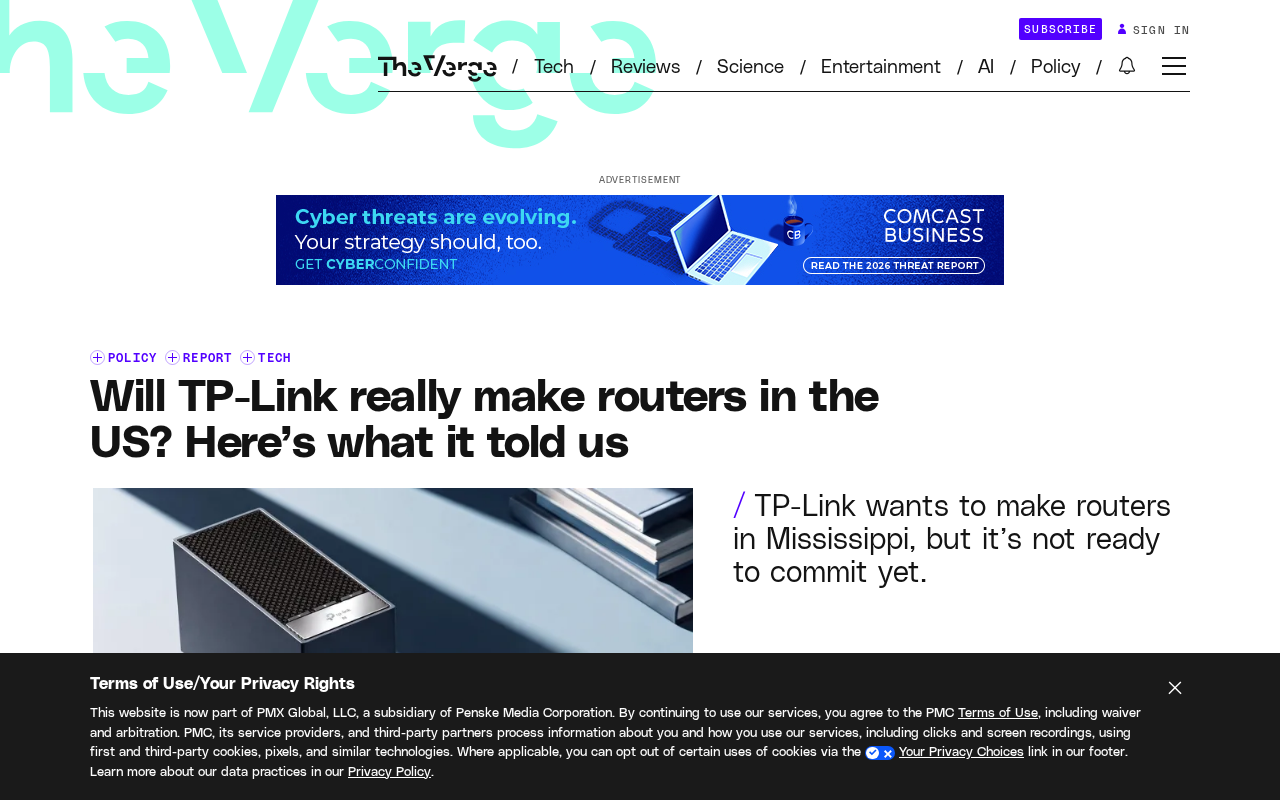
TP-Link has a large user base in the US market. The ban not only affects its new product launches but could also undermine its existing market share. The company must find a way to respond, and "Made in America" has emerged as the most direct solution.
Wi-Fi 8 (based on the IEEE 802.11bn standard) is the next generation of wireless LAN technology. Its core goal is not simply to boost peak speeds but to emphasize "Ultra High Reliability"—significantly reducing latency and packet loss in congested environments through multi-access point coordination, enhanced OFDMA and MIMO, and other mechanisms. Compared with Wi-Fi 7, Wi-Fi 8 focuses more on the stability of the actual user experience rather than doubling theoretical bandwidth. The first Wi-Fi 8 routers are expected to hit the market in 2025–2026, which explains why TP-Link is launching new products now and rushing to enter the US market—getting ahead on the new standard is crucial for capturing the high-end segment.
TP-Link's Official Response: The US Manufacturing Plan
Facing the ban, TP-Link told the media about its US manufacturing plan. The company said it is actively evaluating the feasibility of producing routers on American soil and has already approached multiple contract manufacturers. However, TP-Link did not provide a specific timeline or investment scale, raising questions about the sincerity of its commitment.
TP-Link emphasized that US manufacturing is no easy task. Router production involves a complex supply chain, including chips, antennas, housings, and other components, which currently rely mainly on Asian suppliers. Migrating the entire supply chain to the US would require enormous costs and years of effort. The company acknowledged that fully achieving US manufacturing in the short term is unrealistic but said it would proceed in phases.
The OEM/ODM model is standard practice in the networking equipment industry. Brand owners handle product definition, software, and brand operations, while hardware design, component procurement, and assembly are often carried out by Asian contract manufacturers. Complete router manufacturing involves PCB soldering, antenna tuning, RF calibration, and burn-in testing—processes that rely heavily on a mature electronics manufacturing ecosystem. The US lacks a large-scale contract manufacturing cluster for consumer networking equipment. If TP-Link wants to produce in the US, it would need to rebuild or import an entire manufacturing capability rather than simply relocating production lines. This is the practical reason behind its emphasis on "phased progress."
Industry Context: Why Are Competitors Exempt?
The exemptions for Netgear and Asus have sparked speculation. Some analysts believe these two companies may have obtained exemptions by emphasizing that their products meet specific security standards or by having deeper cooperation with the US government. TP-Link, on the other hand, faces stricter scrutiny because its headquarters is in China (even though its US subsidiary operates independently). Geopolitical factors have played a key role here.
In addition, TP-Link's leading market share may also be a factor. The US government is applying pressure on the market leader to promote competition. But TP-Link counters that its product security is no different from other brands and that the ban is unfair.
The US security review mechanism for connected devices typically involves multiple agencies, including the Department of Commerce, the Federal Communications Commission (FCC), and the Department of Homeland Security. FCC equipment certification (such as the Covered List) and the Commerce Department's supply chain reviews of technologies related to "foreign adversaries" are key thresholds for whether router products can enter the US market. Companies that can sign security cooperation agreements with the US government, accept source code audits, or join relevant trusted supply chain programs may obtain exemptions or grace periods. The specific exemption paths for Netgear and Asus have not been made public, but such reviews are often opaque, with geopolitics and corporate lobbying power playing a significant role.
The Challenges and Possibilities of US Manufacturing
Producing routers in the US faces multiple challenges. First is cost: US labor costs are far higher than in Asia, which could drive up product prices. Second is the supply chain: key electronic components still depend on Asia, and the US lacks a complete domestic ecosystem. Finally, there is the skilled workforce: router manufacturing requires skilled workers, and the US has a shortage in this area.
However, TP-Link is not without opportunities. The US government may offer subsidies or tax incentives to attract manufacturing back home. TP-Link could also choose to partner with US-based contract manufacturers and gradually increase its localization rate. The company has indicated that initially it may only perform final assembly in the US rather than the full manufacturing process.
Impact on Consumers and the Market
If TP-Link does move production to the US, consumers may face higher prices. But in the long run, domestic manufacturing could bring faster product iterations and better after-sales service. For the market, TP-Link's move could trigger a chain reaction, forcing other brands to also consider US manufacturing.
Currently, TP-Link's US manufacturing plan is still in its early stages. The company needs to find a balance between the pressure of the ban and commercial viability. We will continue to monitor its progress.
(Note: This article is based on limited information from RSS sources; some details are reasonable speculation.)
Related articles

5 Practical Ways Real Estate Agents Can Use AI to Boost Efficiency (2026 Edition)
How can real estate agents use AI to boost efficiency? Based on a YouTube walkthrough, this breaks down five methods — ChatGPT for listing descriptions, Canva for marketing materials, forms for open house leads, Zapier for automated follow-up, and seller meeting prep — and flags risk boundaries like fair housing laws, photo authenticity, and price verification.

Grok Bot vs ChatGPT Agent: Which AI Agent Is More Powerful?
How does Grok Bot differ from ChatGPT Agent? This comparison examines how they work: Grok Bot has a cloud computer and runs persistently inside tools to execute multi-step tasks automatically; ChatGPT Agent operates web pages in a browser and is more mature at general tasks. Includes selection advice.

Walmart Agent Gateway: AI Shops for You Automatically—Why Is Amazon Going the Opposite Way?
Walmart's Agent Gateway lets ChatGPT, Gemini and other AI assistants access its product catalog to search, compare and add to cart, with spending limits and per-purchase approval. Amazon blocks external AI agents—two retail giants, opposite paths. Currently US-only, India may follow.