Tracing AI Agent Failures: How Do You Pinpoint the Root Cause of Bad Decisions?

Reddit discussion reveals the AI Agent failure tracing challenge: observability tools only answer "what happened," while causal analysis still requires a combined approach.
Based on a Reddit discussion, this article explores the core challenges and current practices in tracing AI Agent failures. Traditional debugging tools struggle to reconstruct an Agent's internal reasoning path, while observability platforms like LangSmith and LangFuse mainly record trajectories and offer limited support for causal analysis. The mainstream approach is observability tools plus manual review; custom analysis pipelines are an advanced choice for a minority of teams. No single tool fully solves the problem — a combined approach is the realistic path.
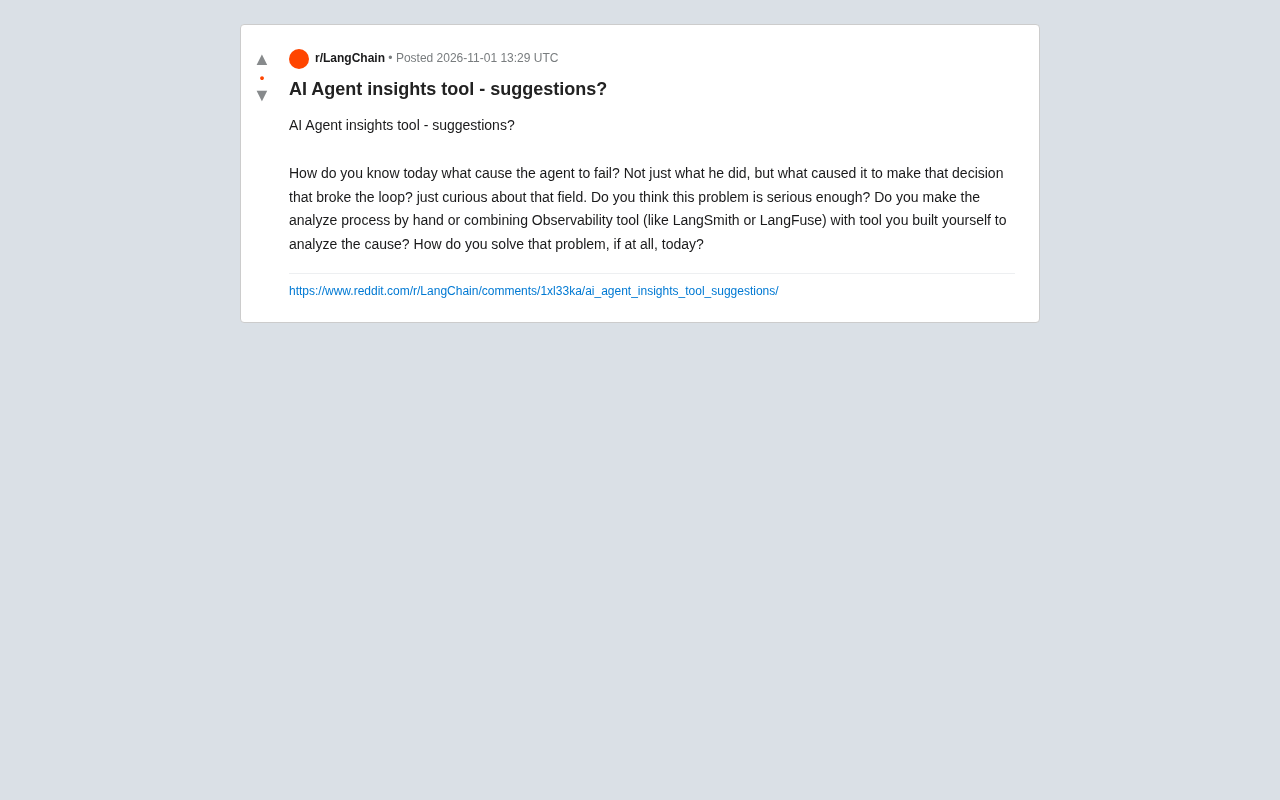
When an AI Agent fails at a task, developers often face more than just "what did it do wrong" — they face "why did it make the decision that led to a crash loop." A recent Reddit discussion goes straight to this pain point: How do we really understand why an Agent failed? Manual analysis, observability tools like LangSmith and LangFuse, or building your own analysis system?
Why tracing Agent failures is so hard
Traditional software debugging has clear stack traces and logs, but AI Agent decision-making involves probabilistic LLM outputs, multi-step reasoning chains, and interactions with external tools. When an Agent falls into an infinite loop or produces the wrong result, the surface behavior is easy to record — but the internal reasoning path that triggered it is hard to reconstruct.
The original Reddit poster raised a key question: "not just what it did, but what caused it to make the decision that broke the loop." This points to the core gap in Agent observability: existing tools mostly focus on trajectory recording and metric monitoring, and support for causal inference remains weak.
Observability originates from control theory; in software engineering it usually refers to the ability to infer internal state from external system outputs (logs, metrics, traces). For AI Agents, observability means being able to record and replay their multi-step reasoning, tool calls, and decision paths. Unlike traditional monitoring, which focuses on threshold alerts for known metrics, observability emphasizes exploring and explaining unknown problems. Current Agent observability tools (such as LangSmith and LangFuse) mainly provide trajectory tracking and metric visualization, but remain insufficient at the causal inference level — one of the root causes of why Agent failure tracing is so difficult.
How much can existing tools solve
Platforms like LangSmith and LangFuse provide tracing of Agent execution trajectories, recording each step's inputs and outputs, tool calls, and latency. This data is valuable for post-mortem reviews, but it usually answers "what happened" rather than "why it happened."
Some developers say they combine observability tools with custom analysis scripts. For example, they export full trajectories from LangSmith and then run prompt replay or counterfactual analysis on failed steps. But this approach still relies heavily on human judgment and is hard to scale.
Counterfactual analysis is a causal inference method that evaluates the impact of a specific decision on the final outcome by asking "what would have happened if a different decision had been made at that point?" In Agent debugging, counterfactual analysis can help developers identify key failure points: for example, replaying a trajectory and modifying a step's prompt or tool call to see whether the result improves. This method reveals causal relationships better than simply recording trajectories, but it is costly to implement and requires tools that support flexible editing and replay of trajectories — support that mainstream observability platforms currently offer only to a limited degree.
Common approaches to building custom analysis systems
Some teams choose to build a customized analysis layer on top of observability tools. Common practices include: automatically clustering failed trajectories to identify high-frequency error patterns; injecting diagnostic prompts at key decision points to have the model explain its own choices; and building regression test sets that turn typical failure cases into evaluation cases.
However, each of these methods has limitations. The reliability of model self-explanation is questionable, clustering analysis requires enough failure samples, and maintaining regression test sets is costly. The original discussion did not offer a unified answer — it mostly exposed how fragmented current practices are.
Self-explanation refers to having an LLM explain its own reasoning process or decision basis in natural language. Common forms include Chain-of-Thought prompting and asking the model to output decision rationale. However, the reliability of self-explanation is debated: research suggests models may generate plausible explanations that do not match their actual computation process (the "rationalization" phenomenon). When tracing Agent failures, relying on model self-explanation should be done with caution — ideally cross-validated with other evidence (such as trajectories and tool outputs) to avoid being misled.
Is this problem worth investing in?
The original poster asked: "Do you think this problem is severe enough?" Judging from the tone of the discussion, most participants recognize its importance, especially for Agent applications in production environments. Pinpointing failure root causes directly affects iteration efficiency — if every failure requires manual case-by-case investigation, teams will struggle to optimize Agent behavior quickly.
But the level of investment depends on the use case. For low-risk, highly fault-tolerant tasks, basic trajectory recording may be sufficient; for Agents involved in critical business processes, in-depth causal analysis tools become a necessity.
Current mainstream practices and gaps
Taken together, current practices fall roughly into three categories: purely manual analysis (suitable for early exploration), observability tools plus manual review (the mainstream approach), and custom analysis pipelines (an advanced choice for a minority of teams). The consensus is that no single tool can fully solve the Agent failure tracing problem — a combined approach is the realistic path.
The disagreement is over expectations for automation. Some argue that as Agents grow more complex, automated root cause analysis will become essential; others warn that over-reliance on model self-explanation may introduce new instability.
For developers building Agent applications, the value of this discussion lies in confirming a direction: observability is only the starting point. Building systematic analysis capabilities for failure patterns is the key step toward improving Agent reliability.
Root Cause Analysis (RCA) is a systematic methodology for locating the fundamental causes of problems, commonly used in operations and quality management. In AI Agent scenarios, RCA aims to start from the surface of a failure and trace back to the decisions or environmental factors that caused it. Traditional RCA methods (such as 5 Whys and fishbone diagrams) can be borrowed, but need to be adapted to the probabilistic, multi-step interactive nature of Agents. Automated RCA typically combines trajectory clustering, anomaly detection, and causal inference techniques; it is still at an exploratory stage and is a key direction for improving Agent reliability.
One-line Summary
Reddit discussion reveals the AI Agent failure tracing challenge: observability tools only answer "what happened," while causal analysis still requires a combined approach.
Paragraph Summary
Based on a Reddit discussion, this article explores the core challenges and current practices in tracing AI Agent failures. Traditional debugging tools struggle to reconstruct an Agent's internal reasoning path, while observability platforms like LangSmith and LangFuse mainly record trajectories and offer limited support for causal analysis of "why it happened." The mainstream approach is observability tools plus manual review; custom analysis pipelines (such as failure clustering, diagnostic prompt injection, and regression test sets) are an advanced choice for a minority of teams. The consensus is that no single tool can fully solve the problem — a combined approach is the realistic path — while opinions differ on expectations for automated root cause analysis. Pinpointing failure root causes is critical to iteration efficiency for production Agents, but investment should be weighed against scenario risk.
Related articles

AI Can Read Neural Network Weights Directly: Do Models Already Exceed Expectations?
A Reddit developer experiment shows language models can directly read neural network weights and infer their function. Astra, Opus 5.5, and Muse Spark 1.3 all passed the test, sparking discussion on model generalization and training sources.

India's Microdrama Market Explodes: EloElo Secures $80M Investment from NBCUniversal
EloElo secures $80M from NBCUniversal to boost StoryTV, its microdrama platform with over 33M monthly active users, as India's microdrama market draws global capital.

Acoustic Detection of Multi-Rotor UAVs: Fusing Handcrafted Features with Pre-Trained Embeddings
Study reveals data leakage from random splits in UAV acoustic detection, proposes source-disjoint protocol with stacked ensemble of handcrafted features and YAMNet embeddings, achieving 95.29% accuracy for low-cost drone detection.