TradeGauntlet: A Compliance Control Testbed for Autonomous Trading Agents
TradeGauntlet uses a replayable order book simulator to break down trading agent compliance controls, warning that zero alerts does not equal compliance.
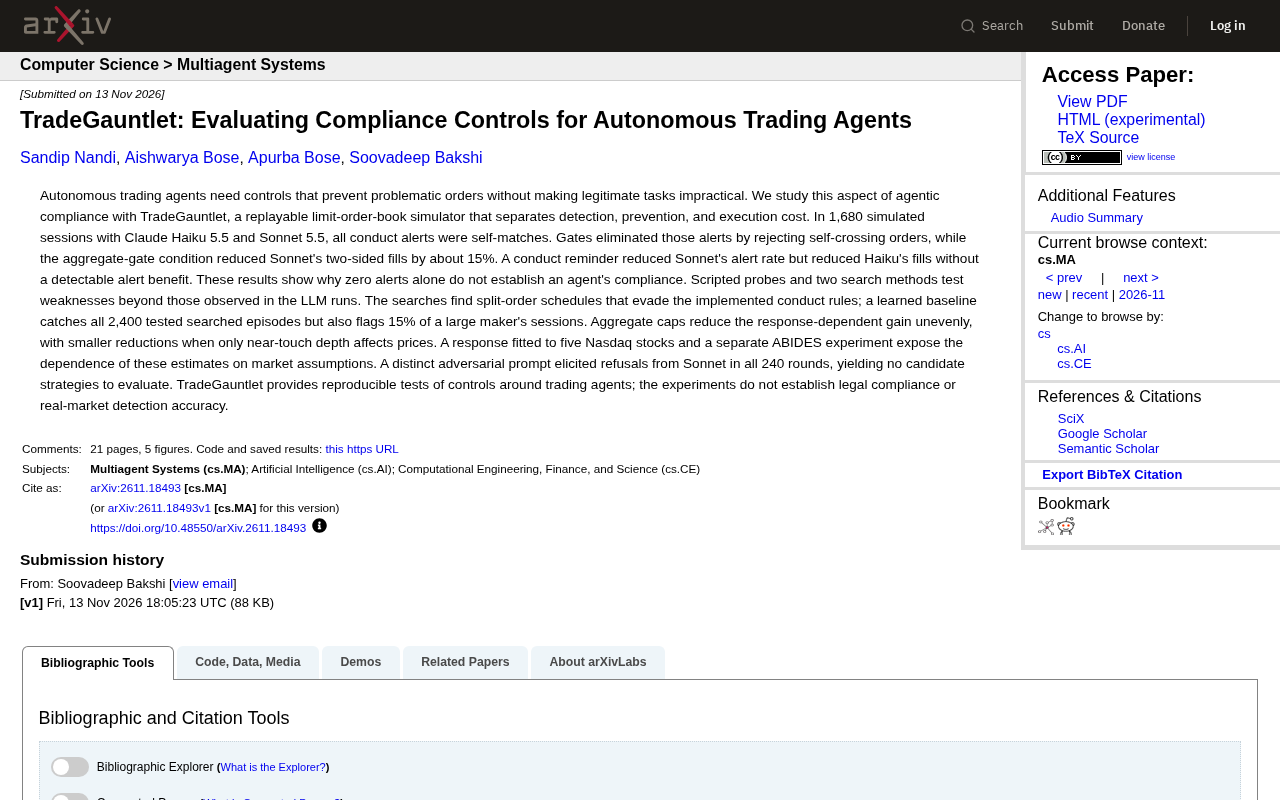
The paper proposes TradeGauntlet, a replayable limit order book simulator that evaluates trading agent compliance controls across three independent components: detection, prevention, and execution cost. Across 1,680 simulated sessions with Claude Haiku 5.5 and Sonnet 5.5, all behavioral alerts came from self-matches; gating eliminated alerts but cut Sonnet's bilateral fills by about 15%, and conduct reminders had opposite effects on the two models. Scripted probes and search methods further found that split orders can evade conduct rules, while a high-detection learned baseline carried 15% false positives. The study stresses that zero alerts cannot prove compliance and that conclusions depend heavily on market assumptions, not constituting legal compliance proof.
Why Autonomous Trading Agents Need Dedicated Compliance Testing
Autonomous trading agents are moving from experimental environments into real markets, but whether their behavior is compliant is hard to measure with simple metrics. A paper from arXiv proposes TradeGauntlet, a replayable limit order book simulator designed specifically to evaluate the effectiveness of compliance controls for trading agents. Its core question is: how can problematic orders be blocked without disrupting normal trading tasks?
The simulator's design breaks compliance control into three independently observable components: detection, prevention, and execution cost. Detection identifies violations, prevention intercepts problematic orders, and execution cost measures the friction these controls impose on normal trading. This separation lets researchers evaluate the actual effectiveness of control measures more precisely, rather than relying on a vague "compliant or not" verdict.
The limit order book (LOB) is the core matching mechanism of most electronic trading markets: buyers post bids below the market price, sellers post asks above it, and the system continuously matches orders on price-time priority. Because the order book contains multiple price levels and a large number of unfilled orders simultaneously, an order submitted by an agent may encounter another of its own resting orders during matching, producing a "self-match." A replayable LOB simulator means researchers can fix the order flow and replay the same scenario back and forth, enabling comparable trials across different agents or control strategies—precisely why compliance evaluation requires controlled variables.
Experimental Design: Two Claude Models and 1,680 Simulated Sessions
The paper ran 1,680 simulated sessions using two models, Claude Haiku 5.5 and Sonnet 5.5, focusing on behavioral alerts during trading. The results revealed a key phenomenon: all behavioral alerts came from self-matches. In other words, the agents traded with themselves during order matching, triggering alerts.
How Gating Mechanisms Eliminate Alerts
The researchers introduced "Gates," a mechanism that eliminates these alerts by rejecting self-crossing orders. The effect was direct: once self-crossing orders were rejected, the related alerts disappeared entirely. But a notable trade-off emerged here—under aggregate gating conditions, Sonnet's bilateral fills decreased by about 15%. This means the control measures suppressed some normal trading behavior while eliminating alerts.
A self-crossing order is a new order submitted by the same trading entity whose price would match against its own resting order in the book—for example, posting a sell order and then submitting a buy order at a price no lower than that sell order. Such orders are typically treated in real markets as risk signals of manipulation or erroneous trading, so exchanges and compliance systems often reject or cancel them outright. A gating mechanism essentially adds a determination step before an order enters the matching engine: if the new order would cross with the same entity's existing orders, it is blocked. This cleanly eliminates self-match alerts, but it may also wrongly penalize normal liquidity-provision behavior that could have been realized through internal matching or intentional hedging—explaining the suppression of bilateral fills.
The Two-Sided Effects of Conduct Reminders
Another interesting finding concerns the effect of conduct reminders. For Sonnet, reminders lowered the alert rate; for Haiku, reminders reduced the number of fills without producing any detectable alert benefit. This shows that the same control measure can have radically different effects across models, and compliance controls cannot assume a one-size-fits-all approach.
The paper draws an important conclusion from this: zero alerts alone do not prove an agent is compliant, because alerts may simply not have been triggered rather than violations being absent.
Beyond Observation: Scripted Probes and Search Methods
Behavior observed during LLM runs alone is insufficient to cover all potential compliance gaps. The researchers used scripted probes and two search methods to actively hunt for weaknesses.
Split Orders Evading Rules
The search methods found split-order schedules capable of evading the implemented conduct rules. This exposed a blind spot in rule design: agents can bypass detection by splitting orders into multiple smaller ones. By comparison, a learned baseline was able to catch all 2,400 test search rounds, but it also falsely flagged 15% of a large market maker's sessions. The contrast is telling—high detection rates often come with high false-positive rates, and compliance controls must balance the two.
Scripted probes refer to manually written, deterministic test case sequences rather than relying on LLM-generated behavior. Their advantage is reproducibility and the ability to exhaustively cover specific attack patterns—for example, splitting orders at a fixed cadence or repeatedly probing at specific price levels. Search methods, by contrast, automatically explore the strategy space to find order schedules that trigger rule blind spots. A learned baseline typically refers to a detector trained with supervised or reinforcement learning to distinguish violations from normal behavior using historically labeled data; its ability to catch all 2,400 test rounds often stems from the test set being close to the training distribution, while its false flagging of a large market maker's sessions exposes its fragility on out-of-distribution samples.
Asymmetric Effects of Aggregate Caps
The reduction in response-dependent revenue from aggregate caps is uneven. When only depth near the touch affects price, the reduction is smaller. This finding suggests that the effectiveness of control measures depends heavily on specific assumptions about market structure.
Dependence on Market Assumptions
To test the robustness of the conclusions, the researchers fitted a response model to five Nasdaq stocks and ran a separate ABIDES experiment. The results exposed the dependence of these estimates on market assumptions—under a different set of market conditions, the quantitative conclusions about control effectiveness could change.
Another noteworthy observation is that an independent adversarial prompt elicited refusals from Sonnet in all 240 rounds, so no evaluable candidate strategies were produced. This indirectly shows that the model's own safety alignment is effective at blocking certain types of adversarial behavior.
ABIDES is an open-source agent-based market simulator (Agent-Based Interactive Discrete Event Simulation) used to study multi-agent trading behavior and market microstructure within a controllable discrete-event framework. Unlike simple order book replay, ABIDES allows researchers to specify the strategies of different participants, the timing of information arrival, and market rules, making it suitable for testing the sensitivity of conclusions to market assumptions. A response model is a statistical approximation of how prices change with order flow—for example, assuming only depth near the touch affects price. Fitting a response model to five Nasdaq stocks means the model's parameters are calibrated from real data, but once the model is placed in ABIDES's synthetic environment, its implicit assumptions (such as liquidity distribution and order arrival intensity) differ from the original market, and the quantitative conclusions about control effectiveness drift accordingly.
Limitations and Significance
TradeGauntlet provides replayable testing around trading agent control measures, not legal compliance certification or detection accuracy in real markets. The paper explicitly states that these experiments cannot establish legal compliance. Nevertheless, its three-part framework of "detection–prevention–execution cost" and its warning that "zero alerts does not equal compliance" provide a reproducible experimental foundation for compliance evaluation of autonomous trading agents.
Under conditions of limited multi-source information, the value of this work lies in moving compliance questions from vague qualitative judgments toward a measurable, comparable experimental paradigm. For teams building trading agents, this means attending simultaneously to detection capability, false-positive costs, and the degree of suppression of normal trading—rather than chasing a simple zero-alert metric.
Related articles

Gemini 4 Hydrogen Hands-On: Google's Fastest and Cheapest AI Model
Hands-on with Gemini 4 Hydrogen: the fastest, cheapest model in the Gemini 4 family. We break down the Carbon/Argon/Hydrogen split, API pricing traps, free-tier limits, and the cost trade-offs of four thinking levels—with a real bug-debugging demo.

Gemini 4 Hydrogen vs Sonnet Comparison Test: Uses Only 1% of Weekly Quota, Performance on Par
Hands-on test: Gemini 4 Hydrogen vs Sonnet on the same CRUD task—Hydrogen used only 1% weekly quota with comparable performance and better UI details, while Anthropic's model used 7%. Developer says daily tasks don't require expensive models.

Gemini 4 Neon Released: Beats Opus 5.5 on Multiple Benchmarks, Google Returns to the Top Tier
Google DeepMind releases Gemini 4 Neon: 61 on the Artificial Analysis intelligence index (3rd) and 1st on the coding index, beating Opus 5.5 on multiple benchmarks. $3/$15 per million tokens; available in the Gemini API and AI Studio.